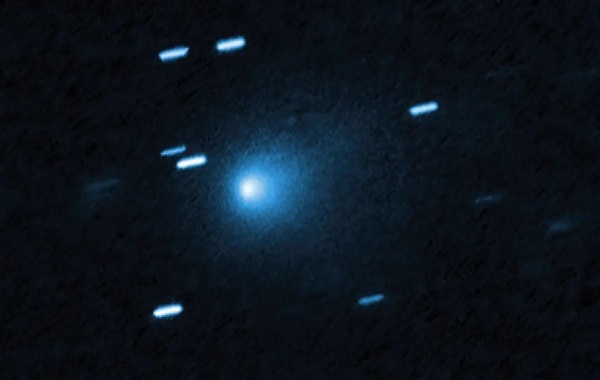
Water fingerprint found on comet older than our solar system, study reveals
In Rio Hurtado, Chile, 3I/ATLAS was first observed in the night sky by the Asteroid Terrestrial-impact Last Alert System (ATLAS) survey telescope.
On July 1, it was captured hurtling through space at a staggering speed of 130,000 mph (210,000 km/h). Within 24 hours, 3I/ATLAS was confirmed to be an interstellar object.
Astronomers determined the space object was on a hyperbolic orbital path, meaning it is not gravitationally bound to the sun.
A team of scientists from Auburn University recently pointed NASA’s Neil Gehrels Swift Observatory towards the interstellar object and made a remarkable discovery. The team is the first to detect hydroxyl (OH) gas, a chemical fingerprint of water, emanating from 3I/ATLAS.
Scientists find water signature on enormous interstellar comet
3I/ATLAS is the third interstellar object ever detected flying through our solar system – after ‘Oumuamua in 2017 and 2I/Borisov in 2019. The seven-billion-year-old space rock is believed to be the oldest comet ever observed.
It is also by far the largest of our three interstellar visitors, and is thought to be roughly the size of Manhattan.
The Auburn University team’s NASA Neil Gehrels Swift Observatory observations picked up the faint ultraviolet glow of OH gas from 3I/ATLAS. While ground observatories couldn’t detect the gas, the Neil Gehrels Swift Observatory is a space-based telescope capable of detecting these faint footprints.
By effectively finding water on 3I/ATLAS for the first time, astronomers can begin to place it on the same scale used to study comets within our solar system. This will help scientists to compare 3I/ATLAS to native space rocks, helping them better understand the implications of its chemical makeup.
The Auburn University astronomers note that 3I/ATLAS’s water activity is surprisingly far from the sun. The Swift observations detected OH when the comet was almost three times farther from the sun than we are.
That is far beyond the distance where water ice can easily sublimate. The team also measured a water-loss rate of roughly 40 kilograms (88 pounds) per second.
“When we detect water – or even its faint ultraviolet echo, OH – from an interstellar comet, we’re reading a note from another planetary system,” Dennis Bodewits, professor of physics at Auburn, explained in a press statement.
“It tells us that the ingredients for life’s chemistry are not unique to our own.”
Interstellar objects ‘rewrite’ our understanding of the cosmos
The team has proposed a hypothesis to account for the sublimation so far from the sun. Sunlight could heat small grains of ice released from the comet’s nucleus. This would cause them to vaporize and emit their ultraviolet signature.
“Every interstellar comet so far has been a surprise,” said Zexi Xing, postdoctoral researcher and lead author of the study.
“Oumuamua was dry, Borisov was rich in carbon monoxide, and now ATLAS is giving up water at a distance where we didn’t expect it. Each one is rewriting what we thought we knew about how planets and comets form around stars.”
3I/ATLAS is now out of view until around mid-November. The ongoing US government shutdown is impacting NASA’sresearch on the object. However, observatories in space and on the ground will collect a great deal of data before it flies back into the inky blackness of space.
Source: Interesting Engineering
What If the Red Planet’s Past Ice Ages Tell Our Planet’s Future?
Water fingerprint found on comet older than our solar system, study reveals