Was Assur Built on Ritual, Not Stone? The Mystery Beneath Ishtar’s Temple
What if the very sand beneath an ancient temple could rewrite the history of a civilization?
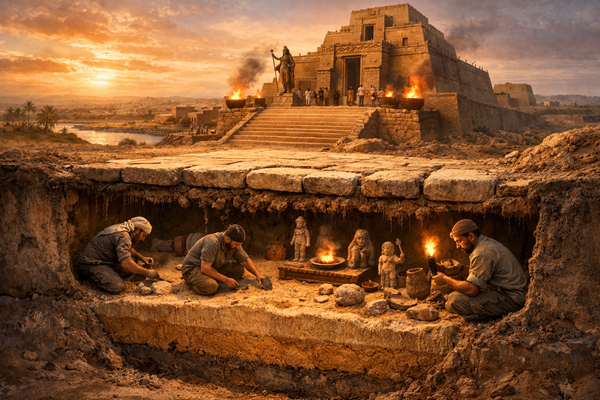
In Assur, Iraq, archaeologists uncovered a deliberately placed sand layer beneath the Ishtar Temple that now reveals when the city truly began and how its earliest rituals were performed.
Researchers date this foundation layer to between two thousand eight hundred ninety-six and two thousand seven hundred two BCE, establishing Assur as an active urban center more than four thousand seven hundred years ago. More importantly, the discovery sheds new light on the rise of the goddess Ishtar’s cult and the spread of Mesopotamian ritual traditions into northern Iraq.
So why would ancient builders place sand beneath sacred stone? And what does it tell us about Assur’s founders?
Ancient Assur and the Origins of the Assyrian Urban Center
Assur stood on the western bank of the Tigris River and later became the political and religious heart of the Assyrian state. Historians understand its importance during the first millennium BCE. However, its earlier third-millennium beginnings remained uncertain for decades.
Earlier excavations led by Walter Andrae between nineteen zero three and nineteen fourteen exposed the Ishtar Temple. Yet the deepest layers stayed unreachable. As a result, scholars could not firmly date the city’s foundation.
In two thousand twenty-four, the Assur Excavation Project at Ludwig Maximilian University of Munich changed that. Using modern coring technology, researchers finally reached beneath the temple cella and accessed untouched strata.
Because of this method, Assur’s earliest story could finally surface.
Ishtar Temple Excavation Methods and Radiocarbon Dating Evidence
The team extracted sediment cores from Temple H, the oldest architectural phase of the complex. Beneath the stone foundations, they encountered a one-meter-thick sand layer.
Above that sand, charcoal fragments appeared. Scientists radiocarbon-dated them and placed the construction between two thousand eight hundred ninety-six and two thousand seven hundred two BCE, corresponding to the Early Dynastic One period.
This result now makes Temple H the earliest confirmed occupation level at Assur. Consequently, researchers gained a fixed reference point for the city’s birth.
Instead of speculation, Assur’s origins now rest on measurable scientific evidence.
Geological Analysis of Ritual Sand from the Zagros Mountains
At first glance, the sand looked ordinary. However, mineralogical testing revealed something far more complex.
Researchers identified epidote-group minerals, glaucophane, zoisite, and lawsonite. These minerals form under blueschist-facies metamorphic conditions. Such rocks do not originate from the nearby Tigris River.
Instead, they trace back to the Zagros Mountains. The sand likely came from aeolian deposits recycled from the Upper Miocene Injana Formation and transported through the Lesser Zab River.
Therefore, the builders did not use random material. They selected it deliberately. The choice reflects knowledge of geology, symbolism, and landscape.
Why transport special sand when easier sources existed nearby?
Mesopotamian Ritual Practices and Sacred Temple Foundations
In southern Mesopotamia, priests purified sacred ground by placing sand beneath temples. This practice prepared the earth before construction began.
Until now, scholars had not seen this ritual in northern Mesopotamia. The Ishtar Temple changes that picture.
By installing this sand layer, Assur’s early inhabitants adopted ceremonial traditions from the south. At the same time, they sourced materials from the north. As a result, the temple became a bridge between two cultural worlds.
The sand may also connect Ishtar with the Hurrian goddess Shawushka. Both figures shared religious landscapes across regions. Consequently, Temple H reflects a fusion of beliefs, politics, and sacred architecture.
Could the sand itself have symbolized a link between heaven, earth, and distant mountains?
Selective Use of Ritual Sand in Assur’s Temple Architecture
Interestingly, other major Assur temples tell a different story.
The Sin-Shamash and Anu-Adad complexes do not contain similar sand layers. Builders applied the ritual only to Temple H.
That selective choice signals importance. Temple H likely carried political symbolism, not just religious meaning. Through its foundation, Assur’s founders announced identity, authority, and cultural alignment.
Thus, architecture became communication. Stone spoke power, and sand spoke belief.
Why honor Ishtar alone with such ceremonial preparation?
Archaeology, Mineralogy, and Cultural Landscape Reconstruction
This project marks the first systematic mineralogical study of archaeological sand in Iraq. By combining archaeology, geology, and history, researchers reconstructed more than a building. They reconstructed behavior.
Construction materials now reveal urban planning, ritual logic, and long-distance cultural exchange. Instead of viewing temples as static ruins, scholars can interpret them as living expressions of ideology.
Ultimately, the sand beneath the Ishtar Temple proves that Assur’s founders possessed specialized ritual knowledge and blended influences from distant regions.
Sometimes, the smallest grains carry the largest stories.
What the Ishtar Temple Discovery Really Tells Us About Early Civilization
So what does this discovery truly change?
It fixes Assur’s founding date.
It confirms northern adoption of southern ritual systems.
It reveals symbolic geology in sacred construction.
And it connects political authority with religious space.
More importantly, it reminds us that ancient cities were not built only with stone, but with meaning.
If sand could shape the destiny of Assur, what other secrets still lie hidden beneath the world’s oldest temples?
Perhaps the next layer we uncover will change history again.
Source: Was Assur Built on Ritual, Not Stone? The Mystery Beneath Ishtar’s Temple
Was Assur Built on Ritual, Not Stone? The Mystery Beneath Ishtar’s Temple