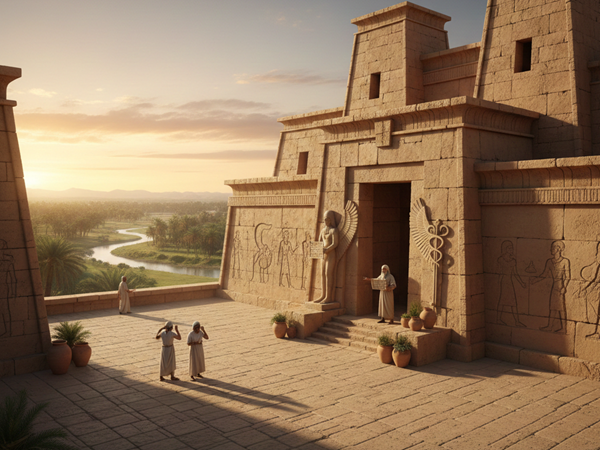
Was a Temple a Hospital? What Does Mesopotamia’s Secret Medical System Tell Us?
Ancient Mesopotamian medical texts are reshaping how historians understand early healing systems. In a study published in the journal Iraq, Assyriologist Dr. Troels Arbøll examined cuneiform prescriptions to reassess the role of divine sanctuaries in Mesopotamian medicine. His findings suggest that certain illnesses — especially those affecting the ear and the spleen/pancreas (ṭulīmu) — required not only physical treatment but also divine intervention.
Rather than relying solely on herbal remedies or rituals performed by healers, some patients were instructed to seek out sanctuaries of specific gods to obtain good fortune before treatment could succeed. These discoveries show that Ancient Mesopotamian medical texts integrated religion, diagnosis, and prognosis into a unified healing framework.
But why were only certain ailments connected to temples? And what exactly happened when patients crossed into sacred spaces?
Ancient Mesopotamian Medical Texts and the Hidden Role of Divine Sanctuaries
Surprisingly, Ancient Mesopotamian medical texts rarely mention temples directly. Most tablets from the second and first millennia BC focus on prescriptions and symptoms rather than religious locations. Likewise, the connection between professional healers — the asû (physician) and the āšipu/mašmaššu (exorcist-priest) — and sanctuaries remains unclear.
Out of hundreds of known medical tablets, only 12 prescriptions from six manuscripts instruct patients to visit a sanctuary of a deity. These references stand out precisely because they are so rare.
The sanctuaries mentioned belong to major gods such as Sîn, Ninurta, Šamaš, Ištar, and Marduk. Many of them were likely personal shrines inside homes, not only large public temples. This suggests that divine medicine was woven into everyday domestic life.
According to Dr. Arbøll, once patients reached the sanctuary, they probably recited prayers, performed ritual actions, and presented offerings meant to attract divine favor before continuing medical treatment.
Healing Rituals in Ancient Mesopotamian Medical Texts: From Prayer to Votive Offerings
Archaeology supports what the Ancient Mesopotamian medical texts imply. At the temple of the healing goddess Gula in the city of Isin, researchers have discovered votive figurines shaped to represent afflicted body parts.
Patients may have brought these figurines to symbolize their suffering and left them behind as acts of supplication. In effect, illness became something negotiable with the gods.
Rather than separating medicine from religion, Mesopotamian society blended the two. Healing required not only substances and incantations but also restored harmony between the patient and divine forces.
This raises a deeper question: was medicine in Mesopotamia less about curing the body and more about correcting fate?
Why Ancient Mesopotamian Medical Texts Required Good Fortune Before Treatment
One striking feature of these prescriptions is the insistence on acquiring “good fortune” before therapy could proceed. In several Ancient Mesopotamian medical texts, patients were told to seek divine favor for either the sixth day or for six days.
Dr. Arbøll explains that the phrasing allows both interpretations. However, he leans toward the idea that fortune lasted several days, matching the repeated nature of the medical rituals themselves.
If healing took time, fortune had to remain active while the cure worked.
Yet uncertainty remains:
Was the counting done from the first symptoms?
From diagnosis by a healer?
Or from the moment the sanctuary was visited?
Ancient diagnostic tablets show illnesses lasting days or weeks, but they never clarify exactly when divine timing began. This ambiguity highlights how Mesopotamian medicine balanced practical observation with metaphysical timing.
Ear and Spleen Disorders in Ancient Mesopotamian Medical Texts
Another puzzle emerges from the data. Of the six manuscripts mentioning sanctuaries, five concern ear diseases, while one addresses the spleen/pancreas (ṭulīmu).
Why only these organs?
Dr. Arbøll calls this the most perplexing aspect of the study. Other ailments might seem equally deserving of divine assistance, yet only ear and spleen disorders triggered sanctuary visits.
The ear, however, carried special symbolic meaning. In Mesopotamian thought, the ear was the gateway to wisdom, obedience, and divine messages. To damage the ear was not merely physical — it disrupted communication with cosmic order.
Moreover, ear infections were dangerous. They could escalate into vertigo, immobility, or even meningitis. What began as discomfort could transform into life-threatening illness.
In that sense, sanctuary visits functioned as preventive as well as therapeutic actions.
Was the temple meant to heal the body — or to protect the mind from chaos?
How Ancient Mesopotamian Medical Texts Blend Science, Religion, and Fate
The emerging picture from Ancient Mesopotamian medical texts is neither purely scientific nor purely magical. Instead, it reflects a hybrid system where diagnosis, ritual, and belief operated together.
Healers did not reject physical remedies. They enhanced them with divine alignment. Medicine worked best when the patient’s fortune was synchronized with the gods.
Rather than asking only, “What substance cures?”, Mesopotamian medicine also asked, “Is the patient aligned with destiny?”
This worldview transforms sanctuaries from optional religious spaces into functional components of healthcare.
Future Research on Epidemics in Ancient Mesopotamian Medical Texts
Dr. Arbøll’s research does not end with individual patients. He is now leading a broader project titled “From Catastrophe to Culture: Understanding Epidemics in Ancient Mesopotamia.”
One major focus will be whether communal prayer and collective ritual were used to remove epidemics from entire cities, not just individuals.
If temples could cure ears, could they also cure societies?
Could belief itself become medicine on a civic scale?
And how much of modern healthcare still echoes these ancient assumptions?
Final Thought
Ancient Mesopotamian medical texts reveal more than treatments — they expose a civilization negotiating between biology and belief. By sending patients into sanctuaries, Mesopotamian medicine acknowledged that healing required more than herbs and hands.
It required meaning.
And perhaps the most enduring question remains:
Where does medicine truly begin — in the body, in the mind, or in the stories we tell about fate itself?
Source: Was a Temple a Hospital? What Does Mesopotamia’s Secret Medical System Tell Us?
Did Homo Erectus Speak Two Million Years Ago Before Modern Humans Even Existed?
Did Homo Erectus Speak Two Million Years Ago Before Modern Humans Even Existed?
Was a Temple a Hospital? What Does Mesopotamia’s Secret Medical System Tell Us?