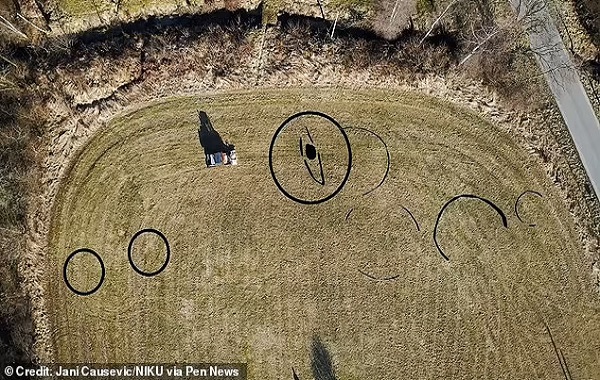
Viking ship discovered 30ft underground in Norway using radars may mark the grave of a high-status individual, archaeologists claim
Researchers used ground-penetrating radar to discover the Viking burial boat
It was 30ft long and up to 5ft wide, capable of holding six men at any one time
This is significantly larger than most boat burial sites found within Norway
The team suggest an unknown, but very high profile individual was buried
It is unclear whether it will be excavated or left undisturbed for future discovery
A long-lost Viking burial ship discovered 30ft underground may be the grave of a high-status individual, archaeologists believe.
The discovery was made as part of archeological work on a site that could form part of the route for the proposed E39 highway, near Øyesletta, western Norway.
The team used ground-penetrating radar to make the discovery, with the work led by the Norwegian Institute for Cultural Heritage Research (NIKU) based in Oslo.
Nothing is known about the person buried in the boat, but as that type of burial was reserved for the most important people in the community, they were likely very of high status, according to the team, led by archaeologist Jani Causevic.
‘Boats were an expensive thing back in the day,’ he said, adding ‘whoever is buried there was probably someone important, and they wanted to signify that by giving them a rich burial. Usually people of high status would be given a boat burial.’
The boat, 30ft long with seating for six men, was discovered alongside several smaller burial mounds in an active Viking community 1,500 and 2,000 years ago.

While boat graves are a known phenomenon in Viking history, most contain smaller vessels than the one found by Mr Causevic, according to NIKU.
The newly-discovered boat is nearly 30ft (9m) long with seating for six men – big enough to bury more than one person.
‘This is incredibly exciting,’ said Mr Causevic.
‘Not just to find such a discovery, but also to see how the use of georadar gives us the opportunity to explore and document cultural history through new and exciting methods.’
Øyesletta, and the surrounding municipality of Kvinesdal, were already known to be burial grounds, but this is the first time a boat grave has been found there.
The grave has not yet been excavated and what treasures remain inside is still unknown.
‘It is yet unclear what will happen to the boat,’ said Causevic.
‘If the road construction passes through, it will be excavated, but if they choose a different route, then the burials will most likely just be left alone.’
Boat graves are associated with the late iron age – which ended in 800 AD in Scandinavia – as well as the subsequent Viking age, from 793–1066 AD.
NIKU said these large boats represented some of the most richly-equipped Viking tombs and were the preserve of the most elite in a community.
The boat graves represent a special burial custom in many coastal settlements, both in and outside Norway’s borders.
Nils Ole Sandet, project manager with the local government, said: ‘That the project has managed to produce knowledge that we thought was lost is very exciting.
‘This means that we can understand and convey better stories about society and the use of Øyesletta in the Iron Age.’
Project manager Manuel Gabler has researched method development in georadar surveys, and is very pleased that this project is yielding results.
‘We have many years of experience with large-scale archeological geophysics in different parts of Norway,’ he said, adding this is the ‘first time that we systematically use the method in connection with the “Archeology in new ways” project.’
‘That is why I think it is great fun to not only test and demonstrate how the method can be used practically in the registration process, but also contribute with such an exciting discovery,’ he added.
Source: daily mail
Malta’s Secret Elongated Skulls Are Not Humans: Ancient Alien Heads?
Malta’s Secret Elongated Skulls Are Not Humans: Ancient Alien Heads?
Viking ship discovered 30ft underground in Norway using radars may mark the grave of a high-status individual, archaeologists claim