US scientists finally solve mystery of moon’s magnetism using simulations
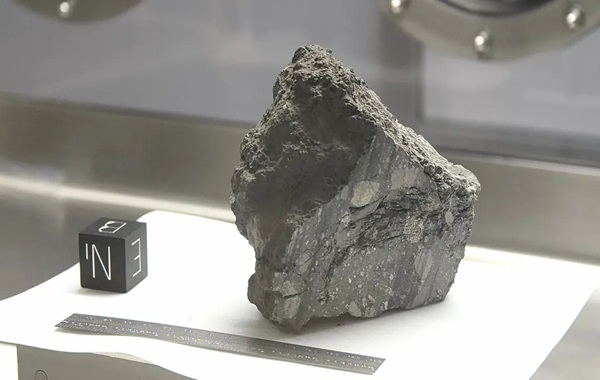
It’s a well-known fact that the moon has no magnetic field. However, some of the lunar rocks brought back by Apollo astronauts, as well as those observed by orbiting spacecraft on the moon’s far side, are surprisingly magnetized.
If the moon itself isn’t magnetic, how could its rocks be? This question has also baffled scientists for decades, but finally, a new study from researchers at the Massachusetts Institute of Technology (MIT) provides a logical explanation.
Using computer simulations, the researchers uncovered a scenario in which an ancient asteroid impact, combined with the moon’s weak magnetic field at the time, briefly amplified that field, just long enough for nearby rocks to capture and record its magnetic signature.
“There are large parts of lunar magnetism that are still unexplained, but the majority of the strong magnetic fields that are measured by orbiting spacecraft can be explained by this process, especially on the far side of the moon,” Isaac Narrett, first author of the study and a graduate student at MIT, said.
The moon had a magnetic field of its own
The mystery began with lunar samples and satellite data showing traces of strong magnetism, especially on the moon’s far side. Generally, magnetism in planets (including Earth) or moons is explained by a dynamo mechanism.
It is a process in which the movement of molten, electrically conductive material inside a planet’s core generates a global magnetic field. However, our moon, with its much smaller and cooler core, shouldn’t be able to produce anything strong enough to explain the magnetism seen in some of its rocks.
Earlier theories tried to explain this anomaly by suggesting that an external magnetic field, like the Sun’s, could have been amplified during a large asteroid impact. However, when researchers tested this idea in 2020, the simulations showed that the solar field was simply too weak to account for the magnetized rocks.
The study authors adopted a different approach. They assumed that the moon once had a weak magnetic field of its own, powered by an internal dynamo, perhaps just one microtesla in strength, i.e., about 50 times weaker than Earth’s.
Then they asked, what if a massive asteroid impact, like the one that created the moon’s giant crater, Imbrium basin, generated a hot, plasma cloud powerful enough to briefly expand this weak magnetic field?
Unraveling the lunar magnetism mystery
Using advanced simulations on MIT’s SuperCloud computing platform, the researchers modeled the scenario discussed in the previous paragraph.
They found that such an impact would have vaporized surface material, creating a plasma cloud that streamed around the moon and concentrated on the opposite side (far side), right where the highly magnetized rocks were found. There, the plasma would have compressed the Moon’s weak magnetic field, boosting its strength for a short period.
However, simulations show that this magnetic surge would have lasted for only around 40 minutes. So then, how did rocks manage to record such a long-lasting magnetic signature? Well, the researchers suggest that the impact would also have sent powerful seismic waves through the moon.
When those shockwaves hit the rocks just as the magnetic field was peaking, they pushed the rocks’ electrons and helped them align with the temporary field. As the field faded, the electrons stayed frozen in place, locking in a magnetic memory that still exists today.
“For several decades, there’s been sort of a conundrum over the moon’s magnetism — is it from impacts or is it from a dynamo? And here we’re saying, it’s a little bit of both, and it’s a testable hypothesis, which is nice,” Rona Oran, one of the study authors, and a plasma physicist at MIT, said.
Why should we care about the moon’s lost magnetism?
This study doesn’t just solve a lunar mystery, it opens a new window into how magnetism might work on other celestial bodies. For instance, it suggests that even in the absence of a strong, long-lasting magnetic field, a planet or moon can still acquire highly magnetized regions if a weak dynamo teams up with a massive impact.
This mechanism could apply to other planets, like Mars or Mercury, which show patchy magnetic fields but no active dynamos today. Plus, using this approach, scientists might be able to learn more about the interiors and violent past of celestial bodies.
However, so far, the study is based entirely on simulations. To confirm their theory, the study authors will need actual rock samples from the lunar far side, something upcoming missions like NASA’s Artemis program might finally provide.
Source: Interesting Engineering
Detecting the primordial black holes that could be today’s dark matter
US scientists finally solve mystery of moon’s magnetism using simulations