
Transparent Solar Panels Can Be Mounted Directly on Windows
One of the obstacles to large-scale solar energy adoption, especially in cities, is where to mount the large panels. On roofs? On skyscraper walls? In the vast open spaces that are almost nonexistent in dense urban centers?
Researchers from Singapore’s Nanyang Technological University (NTU) say they may have solved part of this problem with solar cells that are so invisible they can be mounted directly on windows.
The team claims to have developed ultra-thin, translucent perovskite solar cells that are approximately 10,000 times thinner than a human hair and about 50 times thinner than traditional perovskite solar cells, while maintaining some of the highest efficiencies reported to date for devices in this ultra-thin category.
Their recent work, published in ACS Energy Letters, could ultimately pave the way for electricity-generating windows, glass facades, smart glass, vehicle sunroofs, and other surfaces currently passively exposed to sunlight.
The idea of transparent solar cells isn’t entirely new. Researchers around the world have been working for years to create photovoltaic systems that can blend seamlessly with glass and urban infrastructure. The problem is, solar panels are fundamentally designed to absorb sunlight. The more light a solar cell captures, the less transparent it becomes.
Current commercial solar panels are also quite large systems physically, consisting not only of photovoltaic materials but also thick protective glass, encapsulation layers, metallic contacts, mounting hardware, and a structural frame. Typical residential solar panels weigh approximately 18 to 23 kg (40 to 50 lb) each and produce approximately 350 to 450 W of power under ideal conditions.
A modern office building can easily consume several gigawatt-hours of electricity per year. Now, imagine the enormous quantity and weight of solar panels that would independently power such a building. Where could these be mounted? In this context, roofs seem extremely limited. Alternatively, large open plots of land could be considered, but many cities lack such areas.
But what about the walls, you might ask? They’re everywhere and in abundance. Installing heavy, opaque panels on the glass facades of skyscrapers radically changes the building’s appearance, weight, and thermal insulation properties. But what if the walls don’t need to be heavy, bulky, or even visible?
These questions form the basis of the technology developed by NTU researchers, which aims to transform the glass surfaces currently prevalent in modern cities into active energy-generating systems.
A team led by Associate Professor Annalisa Bruno from the NTU Faculty of Physics and Mathematical Sciences and the Faculty of Materials Science and Engineering developed new devices using perovskites . Perovskites are a class of crystalline materials that have become one of the most favored areas in solar energy research in the last decade due to their potentially low production costs, high efficiencies, and ability to operate in low light conditions.
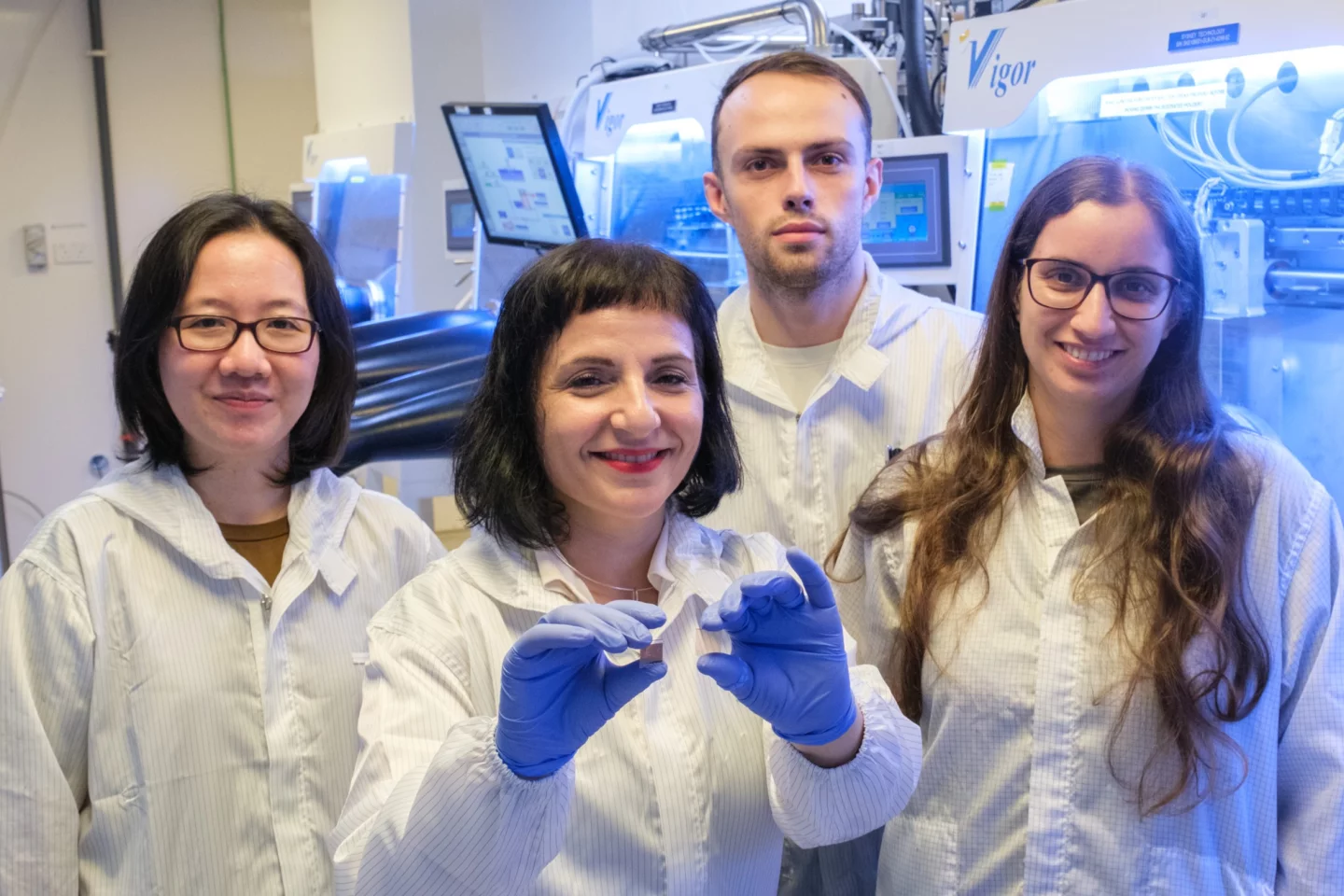
Researchers have produced ultra-thin perovskite absorber layers just 10 nanometers thick while maintaining usable photovoltaic performance. For comparison, a human hair is typically 80,000 to 100,000 nanometers thick.
Unlike traditional silicon solar cells, which perform best in direct sunlight, perovskite-based devices can continue to generate electricity even under indirect or diffused lighting conditions. This is particularly important in cities with tall buildings where skyscrapers create densely shaded urban canyons and cloud cover often reduces exposure to direct sunlight. Instead of relying solely on sun-facing roofs, theoretically, vertical glass surfaces across entire city blocks could generate energy throughout the day.
Researchers tested multiple thicknesses. Opaque devices with perovskite layers 10, 30, and 60 nanometers thick achieved power conversion efficiencies of approximately 7%, 11%, and 12%, respectively. On the other hand, a translucent version using a 60-nanometer-thick layer allowed approximately 41% of visible light to pass through the device while achieving an efficiency of 7.6%. Modern solar panels achieve efficiencies above 20%. However, considering the relatively zero weight, low-light performance, and other beneficial properties of the new perovskite, this technology stands out.
This balance between transparency and efficiency is one of the fundamental engineering challenges in transparent photovoltaics. The more transparent a device is, the less sunlight it absorbs and therefore the less electricity it generates. The NTU team says their results are among the best performances reported for translucent perovskite solar cells produced using similar materials.
More importantly, the devices were described as color-neutral; meaning they wouldn’t noticeably stain glass or drastically alter the appearance of glass-clad buildings. According to the researchers, the transparency of the cells can be adjusted by precisely controlling the thickness of the perovskite layers deposited during manufacturing.
The real breakthrough in the technology may lie not just in the thinness of the solar cells themselves, but also in how the NTU team produced them. The researchers used thermal evaporation, an industrially compatible, vacuum-based technique where materials are heated and evaporated in a vacuum chamber, depositing onto a surface as an ultra-thin film. According to the team, this could be the first ultra-thin perovskite solar cells produced entirely using a vacuum processing method, an approach already widely used in semiconductor and display manufacturing.
Unlike commonly used liquid chemical processing methods for experimental perovskite cells, the vacuum-based technique enables the production of highly homogeneous, large-area films with precise thickness control, avoiding toxic solvents and reducing structural defects that could negatively impact efficiency and scalability.
Researchers estimate that, if the technology is successfully scaled up, it could theoretically transform the glass facade of a tower like One World Trade Center in New York into a solar-powered surface, generating several hundred megawatt-hours of electricity per year—enough to meet the annual electricity needs of roughly 40 average US homes.
Bruno stated, “The built environment accounts for approximately 40 percent of global energy consumption; therefore, technologies that seamlessly transform building surfaces into energy-producing assets are becoming an increasingly urgent need.”
Reality, however, is more complex.
Perovskite solar cells have generated great excitement for years, but commercialization consistently faces a major hurdle: durability. Perovskites are highly sensitive to moisture, oxygen, heat, and prolonged ultraviolet radiation. Laboratory prototypes can produce impressive efficiencies, but maintaining performance for years under real-world conditions remains one of the field’s biggest unsolved challenges.
Professor Sam Stranks from Cambridge University, who was not involved in the research, described the study as promising but noted that “the next critical tests will be long-term stability, durability and performance across broader areas.”
This last point is particularly important. Producing tiny, high-performance samples in a lab is very different from manufacturing thousands of square meters of flawless solar glass for skyscrapers.
However, if the robustness and scaling issues can ultimately be resolved, the implications could be significant.
Modern cities are already covered in enormous amounts of glass that does little more than let light through while increasing the cooling load inside buildings. Converting even a small fraction of this surface into electricity generators could create entirely new forms of distributed urban energy production without requiring additional land.
Potential applications extend far beyond architecture. NTU researchers specifically point to car windows, sunroofs, wearable electronics, and smart glasses as possible future use cases. Lightweight, translucent photovoltaic panels could one day allow devices to continuously charge from ambient light without the need for visible solar cells. Imagine how amazing it would be to be able to charge smart glasses all day long simply by wearing them.
The research team, through NTUitive, the university’s commercialization arm, has filed a patent application for an ultra-thin perovskite film structure and states that they are currently working with industry partners to validate and standardize the thermal evaporation production process. For now, the technology remains in the research phase.
Compiled by: Feyza ÇETİNKOL
Source : Transparent Solar Panels Can Be Mounted Directly on Windows
Unique Human Artifacts Dating Back 430,000 Years Have Been Discovered in Greece
Unique Human Artifacts Dating Back 430,000 Years Have Been Discovered in Greece
Transparent Solar Panels Can Be Mounted Directly on Windows/Transparent Solar Panels Can Be Mounted Directly on Windows