The Screaming Planet: JWST Reveals a Cosmic Nightmare Tearing Itself Apart
In a violent dance of death 880 light-years away, a “hot mess” of a world is defying physics and rewriting the rulebook on planetary destruction.
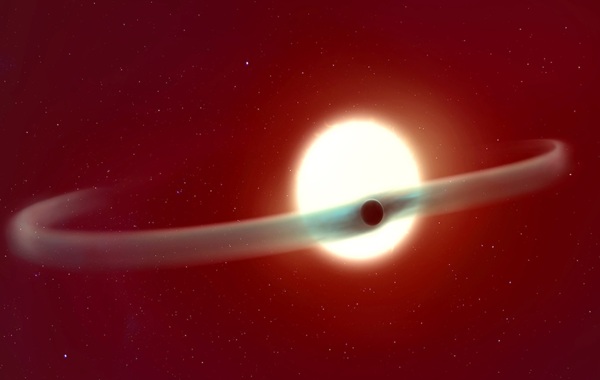
Deep in the cosmos, orbiting a searing star, lies WASP-121b—better known as Tylos. It is a hellscape of unimaginable extremes, a world where vaporized metal forms clouds and the skies rain liquid rubies and sapphires. But the James Webb Space Telescope (JWST) has just stared into this inferno and seen something completely unprecedented: the planet is being flayed alive, sprouting not one, but two colossal tails that strangle its own star.
A Spectacle Never Seen Before
Astronomers are used to seeing “leaky” planets. We know that ultra-hot Jupiters—gas giants orbiting dangerously close to their suns—often bleed their atmospheres into the void. But until now, we’ve only caught fleeting glimpses of this carnage, mere snapshots lasting a few hours.
This time, science took the long view.
For the first time in history, researchers used JWST’s Near-Infrared Imager and Slitless Spectrograph to lock onto an exoplanet for a grueling 37 hours straight. They watched Tylos complete an entire orbit—a “year” on this doomed world takes just 30 hours—and witnessed a continuous, violent hemorrhage of gas that stunned the scientific community.
The Double-Headed Dragon
What they found was a monster. Tylos isn’t just leaking; it is erupting.
The planet is dragging a massive plume of helium that spans nearly 60 percent of its entire orbit. But here is the twist that has shattered existing computer models: Tylos isn’t just leaving a trail of crumbs behind it.
The data revealed two distinct, enormous tails.
The Trailing Tail: As expected, the relentless stellar wind and radiation are blowing the planet’s atmosphere back behind it like a comet.
The Leading Tail: In a baffling gravitational tug-of-war, a second stream of gas is being pulled ahead of the planet, rushing forward into the orbital path.
Together, these twin tails of helium cover an area 100 times larger than the planet itself, creating a chokehold of gas around the star.
“A Turning Point” in Astronomy
“We were incredibly surprised to see how long the helium outflow lasted,” admits lead author Romain Allart of the Trottier Institute for Research on Exoplanets. The discovery is a major blow to our current understanding. Standard simulations can explain a simple tail, but they fail to account for the complex 3D geometry of this double-stream phenomenon.
It appears that a chaotic mix of intense stellar radiation, fierce solar winds, and crushing gravity is sculpting this planet’s death in real-time.
From Gas Giant to Bare Rock?
This isn’t just a freak show; it’s a window into the life cycle of worlds. This violent stripping of the atmosphere offers a crucial clue to a cosmic mystery: How do massive gas giants shrink?
By watching Tylos bleed out, astronomers may be witnessing the brutal process that transforms majestic Jupiters into smaller, Neptune-like worlds—or eventually strips them down to nothing but scorched, rocky cores.
Tylos is more than just a planet; it is a laboratory of extreme physics, a world screaming into the void, and thanks to JWST, we finally heard it.
Source: Science Alert
The Screaming Planet: JWST Reveals a Cosmic Nightmare Tearing Itself Apart