The Hidden Connection Between Black Holes and Habitability
Are We Looking at Black Holes All Wrong? The Shocking Truth
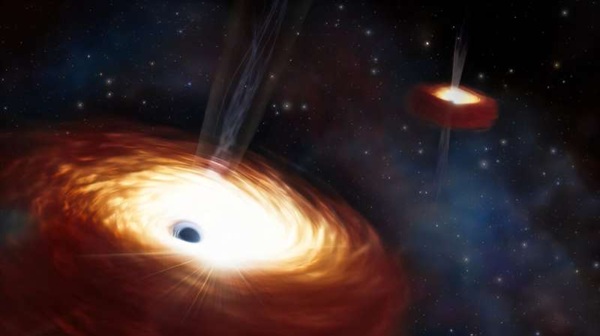
At the heart of most large galaxies, including our Milky Way, lurks a supermassive black hole. When interstellar gas spirals into its gravitational grip, it switches into active galactic nucleus (AGN) mode, unleashing torrents of high-energy radiation. Traditionally seen as harbingers of destruction, black holes might have a surprising nurturing side. A groundbreaking study in The Astrophysical Journal suggests AGN radiation could actually play a role in fostering life on distant planets.
A Paradox Unfolds: How AGN Radiation Can Support Life
It seems counterintuitive—how could the immense radiation from a black hole help life flourish? Researchers from Dartmouth and the University of Exeter used computer simulations to investigate. They discovered that an AGN’s ultraviolet radiation can significantly alter a planet’s atmosphere, either aiding or hindering life depending on its distance from the radiation source and the planet’s atmospheric composition.
Lead author Kendall Sippy explains, “Once life exists and has oxygenated the atmosphere, the radiation becomes less devastating and possibly even beneficial.” In other words, the presence of oxygen makes a planet more resilient, shielding it from extinction-level events.
The Protective Power of Ozone
Simulations of Earth and Earth-like planets revealed a striking pattern: if a planet already contains oxygen, AGN radiation triggers chemical reactions that expand its ozone layer. The more oxygen present, the stronger the effect. Since high-energy light breaks apart oxygen molecules, allowing them to recombine as ozone (O3), the buildup of this gas acts as a protective shield against harmful radiation.
This feedback loop mirrors Earth’s history. About two billion years ago, the first oxygen-producing microbes jumpstarted a similar process, leading to the planet’s life-sustaining atmosphere. The Gaia hypothesis suggests such self-regulating mechanisms are crucial for the emergence of complex life.
Co-author Jake Eager-Nash highlights the significance: “If life can quickly oxygenate a planet’s atmosphere, ozone can help regulate conditions to support its growth. Without a feedback mechanism, life may not persist.”
A Cosmic Experiment: What If Earth Were Closer to a Black Hole?
Earth’s black hole, Sagittarius A*, is too distant to affect our planet. But what if we were much closer to an AGN? To explore this, researchers simulated early Earth’s oxygen-free atmosphere in proximity to a powerful AGN. The results were stark—without oxygen, life would struggle to take hold. However, if oxygen levels neared modern concentrations, ozone would rapidly form, shielding the planet from dangerous radiation.
Eager-Nash was surprised by the speed of this transformation: “With modern oxygen levels, this could take just a few days—enough time for life to survive.”
The Deadly Reality of Red Nugget Galaxies
Would this phenomenon apply everywhere? Not quite. In compact, densely packed galaxies like NGC 1277—so-called red nugget relics—the intensity of AGN radiation would likely be lethal. By contrast, in sprawling spiral galaxies like the Milky Way, or massive elliptical galaxies like Messier-87, stars are spread further from the AGN, reducing the radiation’s impact on planetary atmospheres.
A Chance Meeting at Sea Sparks Breakthroughs
The origins of this study were as unexpected as its conclusions. While traveling to England for a sabbatical in 2023, Dartmouth astrophysicist Ryan Hickox boarded the Queen Mary 2—choosing the ship so he could bring his dog. There, he met Nathan Mayne, an astrophysicist from the University of Exeter, who was giving a guest lecture on climate modeling. Their discussion led to a revelation: Mayne’s PALEO software, designed to model solar radiation on exoplanets, could be repurposed to study the more intense radiation of AGNs.
This serendipitous encounter paved the way for Sippy to collaborate with Eager-Nash, then a Ph.D. student in Mayne’s lab. Using the Julia programming language, they modeled how radiation interacts with different atmospheric compositions. Sippy describes the software’s precision: “It calculates every possible chemical reaction, showing how radiation levels and atmospheric gases evolve over time.”
Unlocking the Secrets of Cosmic Radiation
The study’s findings challenge conventional wisdom about black holes. While AGN radiation is undoubtedly powerful, its role in shaping planetary atmospheres could be more nuanced than previously thought. In the right conditions, it might not just destroy—but also protect and sustain.
Could this mean that black holes are not just cosmic destroyers, but also silent architects of habitable worlds? The answer, it seems, depends on where you look in the vast and dynamic universe.
Source: The Hidden Connection Between Black Holes and Habitability