“The Glow of Ancient Life: Scientists Use 2,400-Year-Old Honey Fungus to Illuminate Wood”
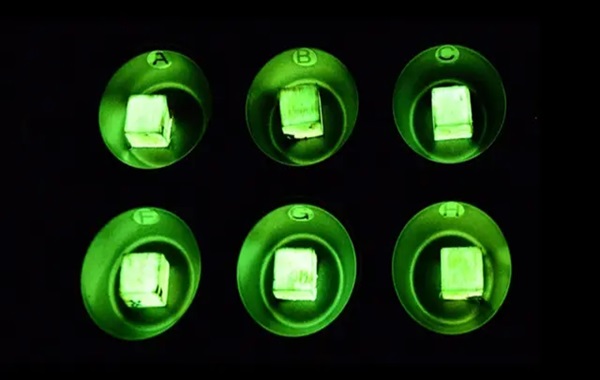
For the first time, scientists found a way to produce a novel material out of wood and a bioluminescent fungus. They made wood that glows bright green.
Fungal researchers from Empa’s Cellulose & Wood Materials lab in St. Gallen fused living and nonliving substances white rot fungus D. tabescens and balsa wood to make a bioluminescent material “with the aim to accomplish multifunctionality” and “help address societal changes.”
Looking ahead, the team emphasized that future advanced materials must possess “smart” capabilities, such as the ability to self-heal, respond to their environment, and change state. This “innovative hybrid material” could potentially serve as a sustainable light producer, according to its developers.

Making wood glow bright green with fungal threads
After testing different bioluminescent mushrooms, project head Francis Schwarze came to discover that the honey fungus turned out to be a particularly powerful producer of luciferin, which gives the ‘shroom its magic glow known as “foxfire.”
Out of all the types of wood they experimented with, balsa wood ended up being the winning match due to its low density count.
But there’s nothing new about the almost supernatural-looking effect that most people associate with marine life. Philosophers Aristotle and Pliny described bioluminescent fungi 2,400 thousands of years ago. Glowing wood could be considered a natural and awesome biohybrid where fungal threads interweave into the wood.
Results in the laboratory, however, have turned out to be difficult to achieve until now.
“The main reason for this is that the balance between the choice of fungal species, wood species, its moisture content and the environmental conditions required to produce bioluminescent wood is very challenging,” says the Empa researcher.
Soaking the wood blocks in water for three months with a specific moisture content of 700-1,200 percent before co-cultivating them with the fungus produced the desired effect, “highlighting the fundamental role of moisture” for bioluminescence production.
“Our studies show that the moisture content of wood, presence of oxygen, amount of lignin and malt as energy source, all strongly influence the intensity of bioluminescence,” study authors explain in the study.
Over the incubation period, “the balsa wood sample absorbed eight times their weight” according to the press release. When it came into contact with air, it triggered a chemical reaction involving caffeic acid that made the wood reach its maximum bright green luminosity in about 10 hours in a process that lasted an impressive 10 days.
Forget lamps, just use fungus wood
Unlocking these bioluminescent mechanisms could bring an electricity-free light source into the world for human consumption with a low-energy requirement, according to study authors.
Learning how to capitalize on this natural process would benefit the environment overall. Imagine no more night lights at home or simply having an alternative light source made out of fungus to reduce nighttime light pollution which remains a concern in large cities.
But first, researchers have to keep developing the material to enhance its intensity and prolong the effect.
The researchers are currently focused on overcoming the limitations of bioluminescence production and developing new methods to prolong its output. They believe that further studies are needed, particularly in controlling environmental conditions and selecting specific wood species. These factors, they argue, are crucial for achieving longer-lasting and more stable bioluminescence in wood, with potential applications in research, industry, and design.
Source: Interesting Engineering
“NASA Uncovers Secret Cold War Military Base Hidden Beneath Greenland’s Ice”
“The Glow of Ancient Life: Scientists Use 2,400-Year-Old Honey Fungus to Illuminate Wood”