
The future of facial reconstruction: Scientists create 3D-printed ears and noses from human cells
Scientists in Wales are 3D-printing cartilage for people born without body parts or who have missing facial features due to facial scarring.
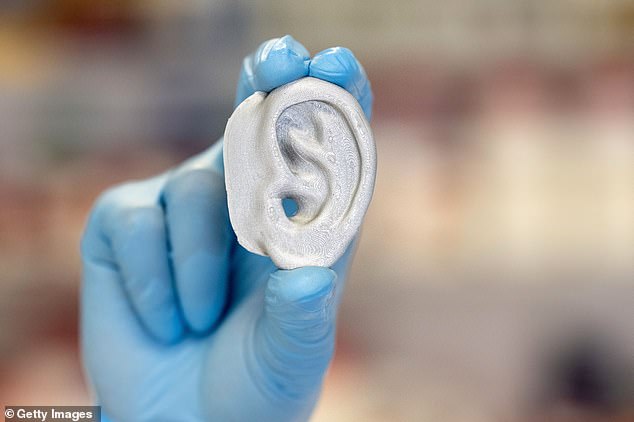
Using human cells and plant based materials, the experts say they are able to print ears, noses and other parts to help with facial reconstruction.
The technology would benefit those who have had facial scarring as a result of burns, cancer and other types of trauma.
The Scar Free Foundation has launched a three-year £2.5 million programme of ‘regenerative research’ into the technology based at Swansea University with the aim to progress to clinical trials involving humans.
According to the Scar Free Foundation, patients living with the loss of facial features have told researchers that existing plastic prostheses didn’t feel ‘part of them’ and would prefer their own tissue to be used for reconstruction.
So the programme will address this by creating a custom ‘cartilage’ scaffold which the patient’s own stem cells grow onto.
This will avoid the need to take cartilage from elsewhere in the body, which can lead to painful surgery and further scarring.
The first part of the process involves taking human cartilage specific stem cells from patients and nanocellulose (derived from plants) to create a printable ‘bioink’.
‘The impact of this work could be really exciting,’ said the project’s leader Professor Iain Whitaker at Swansea University, who is the only professor of plastic surgery in Wales.
‘It would give us as surgeons the ability to take cells from the human body, to expand them and put them into an ink, which could literally be printed into a three dimensional structure [and] implanted back into the human body.
‘This, from our point of view as surgeons, would mean we wouldn’t have to take tissue from elsewhere in the body, so it would be limiting scarring, limiting pain and you would be increasing options to help people reconstruct defects.’
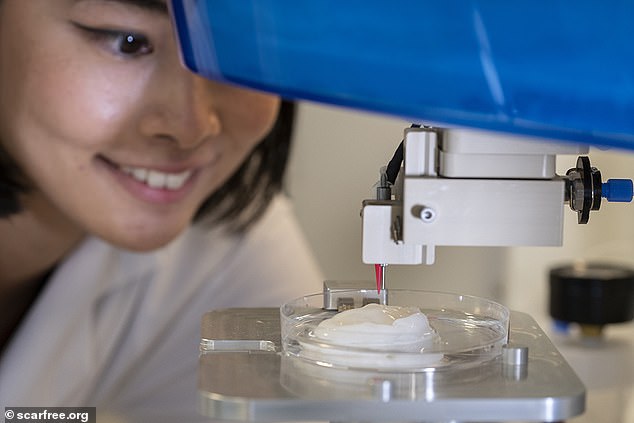
3D-printing uses software to create a three dimensional design before being printed by robotic equipment.
Automated robotic arms have a nozzle at the end that emit the printing substance – in this case cells and plant based materials – layer by layer.
The Scar Free Foundation’s programme will determine the ideal combination of cells to grow new cartilage and ‘optimise nanocellulose bioinks for 3D bioprinting’.
It hopes to show these bioinks are safe, non-toxic and well tolerated by the immune system prior to human clinical trials for facial reconstruction.
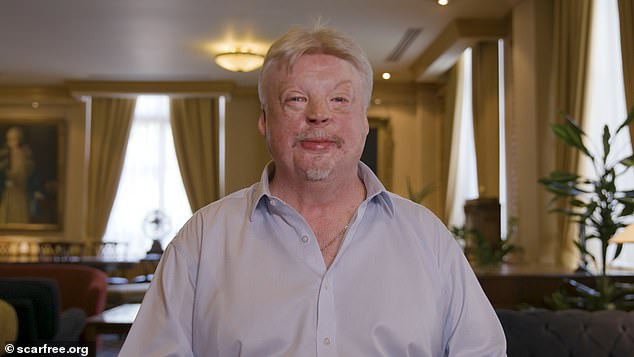
Simon Weston, a Welsh veteran of the British Army, who recovered from severe burn injuries suffered during the Falklands War, is the foundation’s lead ambassador.
‘It’s fantastic that this research is taking place and what we are going to do is amazing,’ he said.
‘This new research – bioprinting ear and nose cartilage made from the patient’s own cells – would have made a big difference to me.
‘There simply wasn’t the research or capability at the time to rebuild my ears – I literally had to watch them fall off.
‘This research also avoids the need for skin grafts taken from other parts of the body – a process which itself can be very painful and leaves behind new scars.’
According to the Scar Free Foundation, the programme will also examine the impact of facial scarring on mental health.
One in 100 people in the UK have a significant facial differences, which can take their toll on their personal mental health.
VFX Artist ‘Unwraps’ Classic Apollo Pic to Show Us What Buzz Aldrin Saw on The Moon
VFX Artist ‘Unwraps’ Classic Apollo Pic to Show Us What Buzz Aldrin Saw on The Moon.
/The future of facial reconstruction: Scientists create 3D-printed ears and noses from human cells/