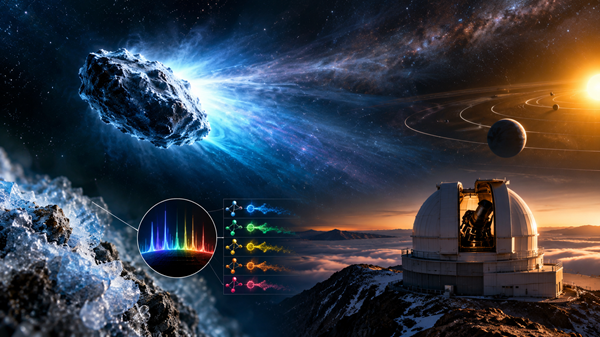
The Comet That Blew Its Cover: Why Did 3I/ATLAS Reveal a Secret Even Its Own Sun Never Knew?
Ever since 3I/ATLAS sped through our Solar System, scientists have puzzled over its birthplace. This comet swung close to Earth, looped around the Sun, and then fled back into deep space. As only the third interstellar object (ISO) ever detected, 3I/ATLAS offered a rare window into another star system’s leftovers. But what truly shocked astronomers were the outbursts of material that followed its closest solar approach. Those eruptions revealed the comet’s inner composition—and told a story of unimaginable cold.
Could this visitor have formed in a place completely alien to our own cosmic neighborhood? The answer, it turns out, is yes.
How Did Scientists Uncover Its Icy Origins?
A new paper in the Monthly Notices of the Royal Astronomical Society lays out the evidence. Researchers used the WHT Enhanced Area Velocity Explorer (WEAVE), a cutting‑edge spectrograph on the four‑point‑two‑meter William Herschel Telescope. By combining WEAVE’s Large Integral Field Unit (LIFU) with the telescope’s upgraded guiding system, they examined the ionized gases that streamed from 3I/ATLAS as it emerged from behind the Sun.
For the first time, astronomers captured five different ions produced simultaneously in the comet’s tail. These included ions of dinitrogen (N₂), carbon monoxide (CO⁺), carbon dioxide (CO₂⁺), water (H₂O⁺), and hydrocarbons (CH⁺). The simultaneous detection of so many ion species was unprecedented for an interstellar object.
Why does that matter? Because the ratio of dinitrogen to carbon monoxide acts like a cosmic thermometer. That ratio told the team that 3I/ATLAS must have formed at temperatures below minus two hundred forty degrees Celsius (minus four hundred degrees Fahrenheit). Such extreme cold only occurs far from a star, in the distant, icy edges of a planetary system. Think of our own Kuiper Belt or Oort Cloud—but around another sun.
Why Does the Nitrogen‑to‑Carbon Monoxide Ratio Matter?
Dr. Léa Ferellec, a Research Fellow at Northumbria University and the study’s lead author, explained in a Royal Astronomical Society press release: “This object gives us a rare chance to study material that formed somewhere completely different to our own Solar System. Finding that it’s so rich in nitrogen tells us it likely formed in extremely cold conditions, far from its home star.”
In other words, nitrogen gas is highly volatile. It only freezes out of a protoplanetary disk when temperatures drop well below those required for carbon monoxide. Therefore, a high N₂/CO ratio directly signals a frigid formation environment.
Moreover, the team examined how these ions varied along the comet’s tail. Solar wind sweeps charged particles backward, creating a long, glowing trail. Surprisingly, the researchers detected only a marginal decrease in hydrocarbon ions as they moved farther from the nucleus. This detailed mapping of ion distribution along an ISO tail had never been done before.
Co‑author Rubén Sánchez‑Janssen noted: “Powerful, large‑format IFUs with high sensitivity in the blue optical spectrum – like WEAVE‑LIFU on the WHT – are opening new frontiers for the study of comets and other solar system objects.”
What Do These Findings Mean for Future ISO Research?
Asteroids and comets are essentially pristine leftovers from planetary formation. Consequently, every interstellar visitor that passes through our system gives us a free sample of another star’s building blocks. Since 2017, when ‘Oumuamua flashed past Earth, each new ISO has taught us more. Yet 3I/ATLAS is the first whose interior composition we have probed in such detail.
But important questions remain. Did this comet originate in a system like our own, or one vastly different? Could its high nitrogen content hint at a different chemical history—perhaps a more efficient delivery of volatiles to forming planets? And when the fourth ISO is detected, will we see similar signatures, or will each visitor surprise us anew?
Improvements in instruments and methodology continue to push boundaries. The WEAVE‑LIFU instrument, for instance, was used thanks to Director’s Discretionary Time—a fast‑track allocation for urgent, high‑impact observations. That flexibility allowed scientists to catch 3I/ATLAS while it was still active.
Could This Comet Have Come from a System Unlike Ours?
The extreme cold required to trap so much nitrogen suggests that 3I/ATLAS formed in the outer reaches of its home system—perhaps in a region analogous to our Oort Cloud. Yet we still do not know the type of star that once hosted this icy wanderer. Was it a low‑mass red dwarf, a massive blue giant, or something in between? Each scenario would imprint a different chemical fingerprint.
Furthermore, the comet’s outbursts after perihelion hint at a stratified interior: layers of different ices that sublimated at different times. Such layering could reveal how the protoplanetary disk evolved around its parent star.
What Secrets Does Its Ion Tail Still Hold?
The study’s analysis of ion ratios along the tail represents a first for interstellar objects. Hydrocarbon ions showed only a slight decline with distance, suggesting that the parent molecules (likely methane or similar) were continuously released or that photochemistry replenished them. Understanding these processes will help future missions interpret data from comets in our own system as well.
Transitioning to the bigger picture, every ISO we study refines our models of planet formation. As Dr. Ferellec put it: “Every one of these objects we study helps us understand a little more about how planets form around other stars.”
Conclusion: A Window Opened, Many Questions Remain
The revelations about 3I/ATLAS go far beyond a single comet. They demonstrate that we can now dissect the chemistry of interstellar visitors with remarkable precision. The next such object could teach us even more—if we are ready.
Will the fourth ISO be a carbon‑rich body like Borisov? A rocky mystery like ‘Oumuamua? Or something entirely new? With instruments like WEAVE‑LIFU standing by, astronomers will not miss the chance to find out.
Source: The Comet That Blew Its Cover: Why Did 3I/ATLAS Reveal a Secret Even Its Own Sun Never Knew?
Consciousness in Alien Life: Could It Exist in Forms Beyond Our Imagination?
Consciousness in Alien Life: Could It Exist in Forms Beyond Our Imagination?
The Comet That Blew Its Cover: Why Did 3I/ATLAS Reveal a Secret Even Its Own Sun Never Knew?
Sources
- Ferellec, L. et al. (2025). “Composition and origin of interstellar object 3I/ATLAS from WEAVE‑LIFU spectroscopy.” Monthly Notices of the Royal Astronomical Society.
- Royal Astronomical Society press release, “New study reveals the extremely cold origin of interstellar comet 3I/ATLAS,” 2025.
- Isaac Newton Group of Telescopes, “WEAVE – WHT Enhanced Area Velocity Explorer.”