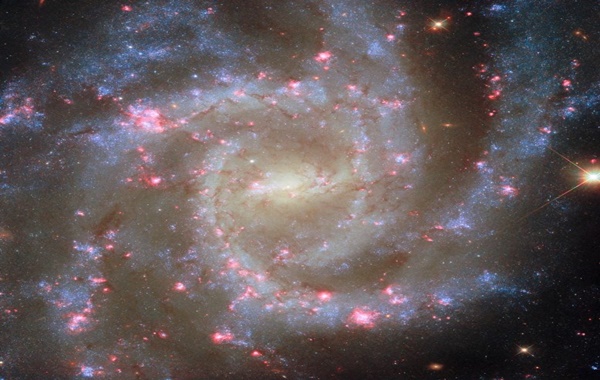
Stunning Pink Nebulae Glow in a Spiral Galaxy 35 Million Light-Years Away
NASA and ESA’s Hubble Space Telescope has released its latest Picture of the Week, showing a striking view of a nearby spiral galaxy. This cosmic subject, known as NGC 2835, is located about 35 million light-years away in the constellation Hydra (The Water Snake).
Hubble has imaged this galaxy before, including a release in 2020, and more recently, the James Webb Space Telescope also observed it. At first glance, the new photo does not look dramatically different from earlier ones. The galaxy’s graceful spiral arms still curve around a bright oval-shaped center filled with older stars, while younger, blue stars sparkle along the sweeping arms.
New details revealed with H-alpha light
What sets this latest image apart is the addition of data capturing a particular wavelength of red light called H-alpha. This allows astronomers to highlight regions glowing with H-alpha emission along the galaxy’s spiral arms. There, brilliant pink nebulae shine like blossoms scattered across the galaxy. H-alpha light is especially valuable to researchers because it reveals different types of nebulae linked to various stages in a star’s life. Massive newborn stars ignite glowing H II regions, while the final acts of dying stars leave behind supernova remnants or planetary nebulae, all of which can be traced through their H-alpha signature.
Using this capability, Hubble is surveying 19 nearby galaxies with the goal of cataloging more than 50,000 nebulae. This large-scale effort will help scientists better understand how stars interact with and shape their surrounding environments through their powerful radiation and stellar winds.
Source: https://scitechdaily.com
James Webb Space Telescope spots a potential new exoplanet just 4 light-years away from Earth