Six-Thousand-Five-Hundred-Year-Old Neolithic Cemetery in France Reveals a Ten-Ton Human-Shaped Stone
A Six-Thousand-Five-Hundred-Year-Old Neolithic Cemetery in France Reveals a Ten-Ton Stone Figure and Ancient Building Secrets
What kind of society could move a stone weighing almost ten tonnes, carve it with human-like features, and construct an elaborate burial ground thousands of years before the pyramids of Egypt? And why would its members bury one person sitting upright while building a monument that contained no human remains at all?
Archaeologists investigating a remarkable prehistoric cemetery near Paris have uncovered discoveries that raise precisely these questions. The site, located in Champigny-sur-Marne in France’s Val-de-Marne department, contains eleven graves, thirty megalithic stone blocks, traces of wooden structures, and a monumental stone figure weighing an estimated nine point seven tonnes. Researchers have also identified evidence of a deliberately prepared, cement-like building material.
Together, these discoveries reveal a level of planning and construction expertise that challenges simplistic assumptions about life during the European Neolithic period.
The cemetery dates to approximately 4750–4300 BCE, placing it in the Middle Neolithic. During this period, communities across much of Europe practised agriculture, raised domesticated animals, crafted stone tools, and developed increasingly complex relationships with their landscapes and the dead.
Yet Champigny-sur-Marne stands out for another reason. In the Île-de-France region surrounding Paris, archaeologists more commonly encounter isolated prehistoric burials than such a concentrated funerary complex.
The discoveries therefore offer an unusual opportunity to investigate how a prehistoric community organised its burial spaces, commemorated individuals, and used monumental architecture to give meaning to the landscape. Most importantly, they raise a question that the surviving evidence cannot yet answer: what did these people believe about the dead, and what role did their enormous stone monument play in those beliefs?
Arkeonews+1
The Ten-Ton Human-Shaped Standing Stone: What Did the Neolithic Monument Represent?
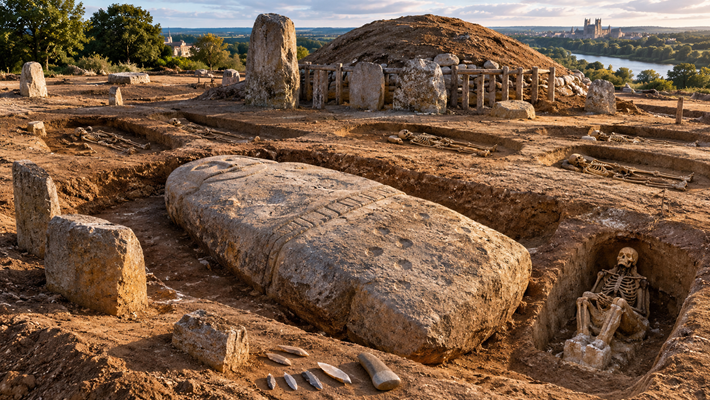
The cemetery’s most extraordinary discovery is a massive stone monument known as a statue-menhir. This term describes a standing stone that has been carved or decorated to represent a human figure. Unlike an ordinary unworked menhir, its surface carries features that suggest an intentional representation of a person.
The monument measures three point zero four metres in length, one point six eight metres in width, and zero point seven four metres in thickness. Researchers estimate that it weighs approximately nine point seven tonnes. Its scale alone makes it an impressive example of prehistoric stoneworking.
However, its decoration may prove even more revealing than its size.
Archaeologists identified an engraved belt and numerous small, circular depressions known as cupules. These hollows were deliberately made in the stone, although their precise significance remains uncertain. Researchers also observed possible traces of black and white pigments, raising the possibility that the monument once displayed painted details.
If the pigment evidence is confirmed, the stone may originally have looked very different from the weathered monument visible today. Could contrasting colours have highlighted the belt, emphasised particular features, or made the figure recognisable from a distance? Those possibilities remain open, and the available evidence does not yet establish what the original design looked like.
The engraved belt also invites questions about the identity represented by the monument. Did it portray a particular individual, a respected ancestor, a community leader, or a figure associated with religious beliefs? Perhaps it represented an idea rather than a specific person.
Archaeologists cannot currently distinguish between these possibilities.
A Monument That Required More Than Physical Strength
Moving a stone weighing almost ten tonnes would have demanded considerable coordination. The prehistoric builders had no modern cranes, powered lifting equipment, or industrial transport systems. Nevertheless, they selected, moved, positioned, and worked with monumental blocks as part of a carefully organised construction project.
The surviving evidence does not reveal exactly how they transported the stone. Researchers would need to establish its geological origin and examine the surrounding landscape before reconstructing the most plausible route and techniques.
Depending on the stone’s source and the terrain, prehistoric communities might have relied on wooden rollers, sledges, ropes, prepared tracks, or combinations of these methods. These are possible approaches, not confirmed details of this particular monument’s construction.
Even so, the stone’s dimensions highlight a larger question: how much collective effort was required to create this cemetery?
Its construction would have involved more than the people who physically handled the stone. Someone had to select the location, organise the work, prepare the ground, and determine how the monument related to nearby graves and other structures. If the stone was decorated before or after installation, its makers also needed to plan that work.
Such coordination does not automatically prove that the community had rigid social hierarchies. It does, however, demonstrate that monumental construction could form part of organised collective activity during the Middle Neolithic.
Why Was the Ten-Ton Stone Lying on the Ground?
Archaeologists found the statue-menhir lying horizontally within a clearly identifiable pit originally prepared to hold it upright. Its position provides an important clue about the monument’s final history.
According to the interpretation reported by the French National Institute for Preventive Archaeological Research, or Inrap, the fallen stone may preserve evidence of the monument’s abandonment after it collapsed. However, the cause of its fall remains unknown.
Did the stone topple because its support weakened? Was it deliberately lowered by the people who used the cemetery? Could later disturbances have altered its original position?
At present, none of these explanations has been established.
The distinction matters because a fallen monument can reveal several different stages of a site’s history. Its original installation, period of use, collapse, and eventual burial need not have occurred at the same time.
Nearby, archaeologists discovered two smaller sandstone blocks. One resembles a small stele, while the other may have marked the burial area. Their proximity suggests that they deserve consideration as part of the wider archaeological context, although their exact relationship to the statue-menhir remains uncertain.
By examining the stones’ positions, surfaces, and surrounding deposits, researchers may eventually determine whether they formed a coordinated arrangement or belonged to separate phases of activity.
Arkeonews+1
Eleven Neolithic Graves Reveal Unusual Burial Practices
The cemetery’s importance extends far beyond its monumental stone. Archaeologists identified eleven graves distributed across an area that also contained megalithic blocks and traces of wooden structures.
The site occupies the top of a terrace formed by sediments deposited by the Marne River. Its position may have influenced where the community established the cemetery, although the precise reasons for choosing this location are not yet known.
Eight graves were grouped within approximately sixty square metres south of a mound-like structure. The remaining three lay farther north, close to the statue-menhir and two additional megalithic blocks.
This arrangement suggests that the burial ground was not simply a random collection of graves. Instead, the distribution of human remains and monumental features provides evidence of spatial organisation.
Yet the original layout is not fully recoverable. Modern construction disturbed parts of the northern section, removing or altering evidence that might otherwise have clarified the relationship between the graves and the stones.
What the Orientation and Position of the Graves Can Tell Us
During the preliminary archaeological investigation, researchers identified two eroded graves containing women buried on their backs, with their bodies aligned along an east–west axis.
Subsequent excavation revealed nine additional burials. Seven of these were extended burials, in which the bodies lay lengthwise rather than in a seated or tightly flexed position.
Most individuals had been placed in substantial pits. Archaeologists also identified postholes near the skulls of some of the deceased. These features may indicate that wooden markers once stood beside the graves, perhaps identifying particular burials or defining parts of the cemetery.
However, wooden posts can serve several purposes, and the evidence does not yet prove exactly how these structures functioned.
Did the markers carry information about the deceased? Were they visible above ground for an extended period? Could they have helped surviving relatives return to particular graves?
These questions become especially important when considering the cemetery as a landscape used by a living community, rather than simply a place where bodies were deposited.
A burial ground may have provided a setting for remembrance, collective ceremonies, or the reaffirmation of relationships between families. Nevertheless, archaeologists must distinguish such interpretations from directly observed evidence. The arrangement of graves can reveal patterns of behaviour, but it cannot independently establish the beliefs that motivated them.
Stone Tools and Worked Bone Objects Accompanied the Dead
The graves contained several categories of artefacts, including stone blades, projectile points, a sandstone axe made from locally available material, and other stone implements. Researchers also found worked bone objects in two burials.
These objects provide valuable evidence about the technologies available to the community. Stone blades and projectile points reflect practical knowledge of shaping stone, while the axe demonstrates the importance of tools capable of cutting or working other materials.
Worked bone, meanwhile, indicates that animal skeletal material could also serve as a raw material for manufacturing objects.
Yet the presence of an artefact in a grave does not necessarily mean it was made specifically for burial. An object might have been used during the person’s lifetime, produced for a funerary occasion, or placed in the grave for reasons that remain unknown.
To investigate these possibilities, researchers can examine manufacturing marks, patterns of wear, raw-material sources, and the distribution of similar objects across the site.
For example, if particular tools repeatedly appear in certain types of graves, that pattern might suggest differences in burial treatment. If the objects show extensive use-wear, they may have belonged to the deceased during everyday life.
Could these artefacts eventually reveal differences in occupation, social relationships, or access to resources? They may help researchers explore those questions, although the small number of graves and the limitations of preservation must be considered.
The cemetery therefore offers more than a collection of prehistoric objects. It provides an opportunity to investigate how practical technologies, personal possessions, and funerary customs intersected in the lives of a community that lived thousands of years ago.
Arkeonews+1
The Seated Burial: Why Was One Person Buried Differently?
Among the eleven graves, one burial stands apart because of the unusual position of the deceased. Archaeologists discovered an adult inside a narrow, circular pit resembling a well. Rather than lying on their back, the individual had been placed in a seated position.
Even more remarkably, calcite completely encased the person’s lower legs and feet.
This combination of unusual body positioning and mineral accumulation makes the burial one of the site’s most intriguing discoveries. Yet it also presents researchers with a difficult interpretive problem: which aspects resulted from deliberate funerary practices, and which developed through natural processes after burial?
Could the Seated Skeleton Reflect a Special Burial Ritual?
Most of the cemetery’s identified burials involved bodies placed in extended positions. The seated individual therefore received different treatment, at least in terms of body placement.
That difference deserves attention, but it does not automatically indicate that the deceased held a higher social position or belonged to a special religious group.
Several explanations remain possible. The seated position might have reflected a particular funerary tradition, an individual circumstance, or a practice associated with a specific stage of the cemetery’s use. Alternatively, the grave’s unusual shape could have influenced how the body was positioned.
Researchers would need more evidence before favouring any one explanation.
The individual’s biological profile, skeletal condition, burial context, and relationship to nearby structures could all help narrow the possibilities. Comparisons with other Neolithic seated burials across Europe might also reveal whether the practice belonged to a wider tradition or represented an unusual local choice.
Why did the community treat this person differently from the other deceased? Was the position intentional symbolism, or did it reflect circumstances that have left no surviving trace?
For now, the archaeological record leaves these questions unanswered.
What Does the Calcite Around the Feet Reveal?
Calcite is a mineral form of calcium carbonate. Under suitable geological conditions, groundwater can transport dissolved minerals through soil and deposit them around buried objects or human remains.
The calcite surrounding the individual’s lower legs and feet may therefore provide clues about the burial environment and the movement of water through the grave. However, the precise process responsible for its formation has not yet been established in the reported findings.
Detailed mineralogical analysis could help researchers distinguish between different formation processes. They might investigate whether the calcite developed gradually after burial, whether it formed during a particular phase of the site’s history, and how its presence relates to the surrounding sediments.
Could the mineral deposits also help reconstruct environmental conditions around the cemetery? Potentially, yes, although that would depend on the composition and preservation of the deposits.
It is equally important not to confuse an unusual geological feature with evidence of a deliberate ritual. The calcite may be scientifically informative without having played any role in the original burial ceremony.
Ultimately, this grave demonstrates why archaeology requires several lines of evidence. Body position, grave shape, skeletal analysis, and soil chemistry must be considered together before researchers can reconstruct what happened thousands of years ago.
The Mysterious Neolithic Monument That Contained No Grave
Another discovery presents a different kind of mystery. In the southeastern part of the excavation, archaeologists identified a dome-like accumulation of brown silt covering approximately thirty square metres.
At first glance, the structure resembled a burial mound. Such mounds, often called tumuli, are familiar features of prehistoric funerary landscapes. However, excavation revealed a crucial difference: there was no grave beneath this structure.
Instead, researchers uncovered a complex arrangement of pits, palisaded ditches, stone blocks, and wooden posts. A small stele, broken into two pieces, stood above the feature.
Why would a community construct a mound-like monument without placing a body inside it?
Was the Mound a Landmark, a Ceremonial Structure, or Something Else?
One possibility is that the structure served as a landmark within the landscape. Its size and position may have made it visible to people moving through the surrounding area, helping them identify a particular place or recognise the boundaries of a significant zone.
If so, the monument may have helped organise the cemetery’s wider spatial arrangement. Its proximity to the graves supports investigating that possibility, although proximity alone cannot prove that the structures served a common purpose.
Another possibility is that the feature had a ceremonial or commemorative function. Some monuments can mark places of significance without containing human remains. They may serve as gathering points, territorial markers, or places associated with collective memory.
However, these interpretations remain hypotheses rather than established conclusions.
The arrangement of the pits, wooden posts, ditches, and stone blocks may offer the strongest clues. If researchers can establish their construction sequence, they may discover whether the components were built simultaneously or added during different phases of activity.
That distinction could transform our understanding of the site. A single coordinated construction project would suggest one kind of organisation; repeated modifications over generations would suggest another.
Did the mound mark a location that remained important long after particular graves were created? Was it intended to be seen from a distance, or did its significance depend on activities performed nearby?
Until the construction sequence and original appearance become clearer, the monument remains one of the cemetery’s most compelling unresolved features.
Neolithic Cement Technology: How Prehistoric Builders Stabilised Their Monuments
Perhaps the most unexpected discovery at Champigny-sur-Marne concerns the materials used to construct and stabilise the cemetery’s structures.
Archaeologists identified a hardened mixture made from locally available carbonate-rich sandy and silty sediments, gravel, and water. After drying, the mixture became sufficiently cohesive to function as a cement-like building material.
This finding suggests that the builders did not simply dig holes, place stones, and rely entirely on naturally compacted soil. Instead, they deliberately combined selected materials to produce a mixture with useful construction properties.
The technique does not amount to modern cement manufacturing. Nevertheless, it demonstrates an understanding of how different natural materials could be combined to improve the stability or finish of prehistoric structures.
Where Did Archaeologists Find the Ancient Building Material?
Researchers identified the prepared mixture in several parts of the cemetery. It occurred along the edges of graves, in pits supporting standing stones and other megalithic blocks, and within the dome-like structure.
These locations are significant because they connect the material to different elements of the funerary complex.
Around graves, prepared sediments may have helped shape or finish the edges of excavated pits. Within stone-setting pits, the material may have contributed to filling spaces around the blocks. Its presence in the dome-like structure suggests that the builders also used prepared mixtures when constructing other features of the site.
The precise engineering function may have differed between locations. Further examination is necessary to establish whether the mixture primarily provided support, helped seal or line surfaces, or served several purposes.
The builders also used less-processed materials, including beige sand and brown silt, alongside wooden elements. Consequently, the cemetery’s construction involved a combination of natural sediments, deliberately prepared mixtures, stone, and timber.
How did prehistoric builders determine which materials worked best for each task? Did they rely on accumulated experience, observations of local soils, or knowledge passed between generations?
The archaeological evidence cannot reveal the exact process by which they learned these techniques. Nevertheless, the repeated use of prepared materials in different parts of the cemetery suggests that their application was not simply accidental.
Why Is Prehistoric Cement Evidence Important?
Carbonate-rich building materials have been documented at other prehistoric sites in Western Europe, particularly in Mediterranean settlements and domestic contexts.
Their identification at Champigny-sur-Marne extends the evidence for such practices into the construction of funerary monuments in the Paris region.
This matters because archaeologists often study prehistoric technology through surviving tools, pottery, and stone architecture. Less durable construction materials can be harder to recognise, especially when they resemble the surrounding soil.
Careful analysis can distinguish intentionally prepared mixtures from naturally occurring sediments. Researchers may examine grain sizes, mineral composition, the distribution of gravel, and the boundaries between constructed layers and undisturbed ground.
Such investigations can reveal whether builders selected and mixed materials deliberately. They can also help reconstruct the order in which different structures were created.
The discovery therefore encourages a broader view of Neolithic engineering. Monumental construction did not depend exclusively on moving heavy stones. It could also involve soil preparation, material selection, timber construction, and the careful stabilisation of structural elements.
What other prehistoric building techniques remain hidden within seemingly ordinary layers of earth? Champigny-sur-Marne demonstrates why even unremarkable-looking sediments can contain important evidence of ancient technological knowledge.
Arkeonews+1
Thirty Megalithic Blocks and Wooden Structures: Reconstructing the Cemetery’s Original Design
The cemetery contains thirty megalithic stone blocks, including the enormous statue-menhir. However, the monument cannot be understood in isolation from the other features around it.
The graves, smaller stones, wooden posts, pits, ditches, and dome-like structure collectively indicate a funerary landscape with several distinct elements.
Stone monuments tend to survive much longer than timber. As a result, the original appearance of the cemetery may have included more wooden structures than the surviving archaeological record suggests.
Postholes provide evidence that timber elements once stood in particular locations. Yet they rarely preserve the complete height, shape, or purpose of the original structures. Archaeologists must reconstruct those features by comparing the spacing and dimensions of postholes, their stratigraphic relationships, and any associated deposits.
Did the Cemetery Develop in Several Stages?
The broad dating range of approximately 4750–4300 BCE places the site within the Middle Neolithic. However, that range does not mean every grave, stone, and wooden structure was necessarily created at the same time.
The cemetery could have developed through a sequence of construction episodes. Some graves might have preceded the erection of the statue-menhir, while other features could have been added later. Alternatively, several elements may have formed part of a coordinated design.
Establishing the sequence will require detailed archaeological dating and analysis of the relationships between structures.
This is particularly important because the cemetery’s layout may have changed as the community continued to use it. A monument could have remained visible long after the burial that originally motivated its construction. Likewise, later activities might have altered the meaning or arrangement of an existing funerary space.
Researchers must also account for disturbance caused by modern development. Some original relationships between the northern graves and the megalithic blocks may have been lost, limiting the conclusions that can be drawn from their present distribution.
Nevertheless, the surviving evidence offers a valuable starting point for reconstructing how the cemetery was organised.
Who Were the People Buried at Champigny-sur-Marne?
Despite the remarkable architecture, the people themselves remain largely unknown. Archaeologists have identified the graves and associated objects, but many questions about the individuals who used the cemetery await further scientific analysis.
Planned ancient DNA studies and isotope analyses could provide new information about their lives.
Ancient DNA Could Reveal Family Relationships
Ancient DNA analysis can sometimes identify biological relationships between individuals buried at the same site. Depending on the preservation of the remains, researchers may be able to investigate genetic relatedness, population affinities, and aspects of biological ancestry.
If several individuals prove to be close relatives, the results could help researchers explore whether particular family groups were buried together.
However, genetic relationships would not automatically establish the social organisation of the community. People might have been buried near relatives for many reasons, while unrelated individuals could have shared the same funerary space.
DNA analysis may also help researchers investigate biological sex and aspects of population history, provided the samples preserve sufficient genetic material.
What if the individuals buried around the statue-menhir belonged to several generations of the same family? Or what if the cemetery brought together people from different communities?
Both possibilities illustrate the questions that genetic research may help address. Neither has yet been demonstrated for this site.
Isotope Analysis Could Trace Diet and Mobility
Isotope analysis examines variations in particular chemical isotopes preserved in human tissues, including bones and teeth. These variations can provide information about aspects of diet, environmental conditions, and geographical mobility.
Different tissues record information from different periods of a person’s life. For example, tooth enamel forms during childhood and can sometimes preserve clues about the environment in which an individual grew up. Bone chemistry can reflect aspects of diet and environmental exposure over a different period, depending on the tissue and its preservation.
By comparing isotope results with geological and environmental data, researchers may investigate whether the people buried at Champigny-sur-Marne grew up locally or spent parts of their lives elsewhere.
Such findings could illuminate mobility within Middle Neolithic communities. However, isotope signatures do not usually identify a precise birthplace on their own. Interpretation requires suitable reference data and careful consideration of alternative explanations.
Combined with DNA, skeletal analysis, and archaeological context, these methods could help researchers reconstruct a more detailed picture of the cemetery’s population.
The ultimate question is whether the people buried here formed a relatively stable local community or whether their lives connected them to a wider network of settlements and landscapes.
What the Cemetery Reveals About Neolithic Society in France
Champigny-sur-Marne is important not because every mystery has been solved, but because several different kinds of evidence survive together.
The cemetery combines individual graves, a monumental human-shaped stone, smaller megalithic blocks, wooden structures, a mound-like feature without a burial, and a deliberately prepared building material.
Each discovery illuminates a different aspect of prehistoric life. The human remains provide evidence of burial practices. The stone tools reveal aspects of technology. The monumental architecture demonstrates investment in construction. Meanwhile, the cement-like mixture offers clues about how builders selected and prepared local materials.
Taken together, these features encourage researchers to examine the cemetery as a complex archaeological setting rather than a collection of unrelated discoveries.
Did Monumental Construction Strengthen Community Identity?
Constructing a monument of this scale would have required planning and cooperation. Yet the reasons for undertaking such work remain uncertain.
Monuments can express collective identity, commemorate individuals, mark important places, or serve religious and ceremonial purposes. They may also acquire different meanings over time.
At Champigny-sur-Marne, the statue-menhir’s human-like features and its position among the graves make its relationship to the deceased particularly interesting. Still, there is no definitive evidence that it represented a specific individual or functioned as an ancestor figure.
Likewise, the mound without a grave might have marked a meaningful place, but its precise role remains unknown.
The strongest interpretation is therefore a measured one: the cemetery’s builders deliberately combined burials and substantial architectural features within a defined landscape. Understanding the beliefs behind that arrangement will require additional evidence.
Why This Discovery Matters Beyond the Paris Region
Middle Neolithic funerary sites are relatively rare in the Île-de-France region. Champigny-sur-Marne consequently provides an unusual opportunity to examine the relationship between burial customs and monumental construction in this part of prehistoric France.
Comparisons with other European sites may help researchers identify similarities and differences in stoneworking, burial arrangements, and building practices.
Such comparisons must account for chronology and local context. Two monuments that look similar may have served different purposes, while comparable construction techniques may have developed independently.
Even so, the discovery of prepared carbonate-rich building materials in a funerary setting adds a valuable dimension to the study of prehistoric engineering in Western Europe.
It also highlights the importance of preventive archaeology. The cemetery came to light during investigations associated with planned property development. Without that work, important evidence of the region’s prehistoric past might have remained buried or been damaged by construction.
The Unanswered Questions That Could Transform Our Understanding of the Site
The excavation has revealed a remarkable collection of archaeological features, but the next stage of research may prove just as important as the initial discoveries.
Several questions remain central to understanding the cemetery:
– Who did the ten-ton statue-menhir represent? Its engraved belt, circular depressions, and possible pigments may help researchers investigate its original appearance and symbolism.
– Why was one adult buried in a seated position? Skeletal analysis and comparisons with other prehistoric burials may help establish whether this practice had wider parallels.
– Why did the builders construct a mound without a grave? The sequence of pits, ditches, posts, and stone features may clarify whether it served as a landmark, ceremonial structure, or another kind of monument.
– How did the community make its cement-like building material? Further analysis could reveal how the ingredients were selected, mixed, and used in different parts of the cemetery.
– Were the people buried here related? Ancient DNA may help establish biological relationships, while isotope analysis could provide clues about diet and mobility.
– Did the cemetery develop over several generations? More precise dating and stratigraphic analysis may reveal whether its graves and monuments belonged to a single construction phase or a longer sequence of activity.
These questions matter because the cemetery is not simply a record of death. It preserves traces of decisions made by living people: where to bury their dead, how to construct lasting monuments, which materials to use, and how to organise a meaningful place in the landscape.
More than six thousand years later, those decisions remain visible, even though the beliefs that guided them have largely disappeared.
The nearly ten-ton stone may once have stood prominently above the graves. The wooden structures have mostly vanished, and the prepared building material has survived as hardened traces within the soil. Yet together, these remains offer a rare glimpse into a society whose technical abilities and funerary practices were more complex than a casual glance at the Neolithic might suggest.
Perhaps the greatest mystery is not how these people moved such a massive stone, but why they believed it was worth moving at all. Was the monument intended to honour the dead, represent a powerful figure, define a sacred place, or communicate something to future generations?
The evidence has not yet delivered a definitive answer. But as researchers analyse the human remains, investigate the building materials, and reconstruct the cemetery’s original layout, Champigny-sur-Marne may reveal far more about the people who shaped this extraordinary prehistoric landscape.
Source: Six-Thousand-Five-Hundred-Year-Old Neolithic Cemetery in France Reveals a Ten-Ton Human-Shaped Stone
Lost for Three Thousand Four Hundred Years: The Hittite Tablets That Reveal a Hidden Crisis
Lost for Three Thousand Four Hundred Years: The Hittite Tablets That Reveal a Hidden Crisis
Sources and further reading
– Inrap — National Institute for Preventive Archaeological Research: The French archaeological institution responsible for the excavation and scientific investigation. Official website
– Arkeonews — “Six-Thousand-Five-Hundred-Year-Old Cemetery in France Reveals a Ten-Ton Human-Shaped Standing Stone.” Published November third, two thousand twenty-six. Read the original report.
Arkeonews
– Stile Arte — Report on the Neolithic cemetery at Champigny-sur-Marne. Published November third, two thousand twenty-six. Read the report in Italian.
stilearte.it
– Bulletin de la Société préhistorique française — Research on an engraved anthropomorphic stone stele from Chamigny, Seine-et-Marne. This is a separate archaeological discovery that provides comparative context for studying human-shaped stone monuments in the wider region. Read the research publication.
Persée
Six-Thousand-Five-Hundred-Year-Old Neolithic Cemetery in France Reveals a Ten-Ton Human-Shaped Stone