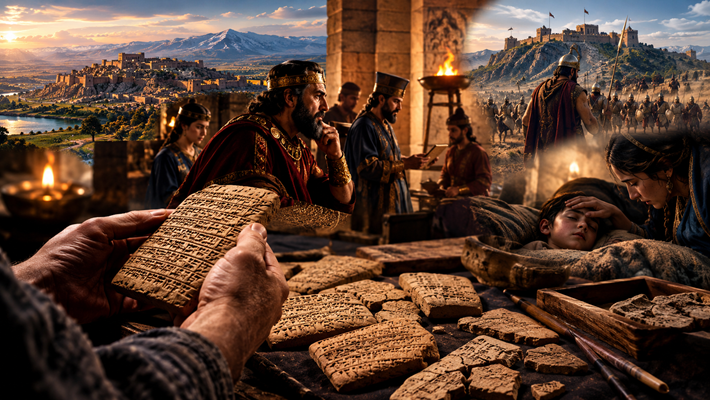
Lost for Three Thousand Four Hundred Years: The Hittite Tablets That Reveal a Hidden Crisis
The Hittite Royal Archive Reveals a Hidden Side of Bronze Age Power
What happens when the official records of an ancient empire preserve not only the decisions of kings, but also the death of a child, the fear of a spreading disease, and the desperate pleas of soldiers fighting on distant frontiers?
A remarkable discovery in central Türkiye is bringing these questions into focus. Archaeologists working at Kayalıpınar have recovered one hundred and thirty-one cuneiform tablets and fragments during the two thousand and twenty-six excavation season. Together with fifty-three pieces found in the same area the previous year, the collection now contains one hundred and eighty-four objects.
The documents date to the reign of King Tudhaliya the Second, approximately three thousand four hundred years ago. They come from the ancient settlement of Šamuḫa, widely identified with modern Kayalıpınar in the Yıldızeli district of Sivas province.
On October eighth, two thousand and twenty-six, Türkiye’s Minister of Culture and Tourism, Mehmet Nuri Ersoy, announced the discovery. According to the ministry and Anadolu Agency, the archive contains texts written in Hittite and Hurrian. Their subjects range from military affairs and religious ceremonies to divination, royal correspondence, and a deadly illness affecting children. Researchers consider the collection the most comprehensive Hittite-language archive discovered in the twenty-first century. <Cite refs={[“turn919001search1″,”turn919001search2”]}/>
Yet the most extraordinary feature of these tablets may not be their number. It is the picture they offer of people living behind the walls of an ancient imperial court.
The Hittites were among the major powers of the Late Bronze Age. Their kingdom, based in Anatolia, competed with Egypt for influence across the eastern Mediterranean and the Near East. Their rulers negotiated treaties, commanded armies, supervised religious festivals, and governed territories populated by different peoples.
Most surviving Hittite documents, however, come from the capital, Hattusa. Thousands of tablets preserve the language of government: laws, diplomatic agreements, religious instructions, and royal decisions. Such records tell us how an empire wanted its institutions to function. But do they reveal what happened when those institutions faced a crisis they could not easily control?
The newly reported archive from Šamuḫa offers an unusually intimate perspective. Its records suggest that a royal court could be simultaneously a political headquarters, a religious center, a military command post, and a household struggling with illness and loss.
Kayalıpınar and Šamuḫa: Why This Hittite Discovery Matters
The archaeological importance of Kayalıpınar extends beyond the discovery of individual tablets. The site offers an opportunity to examine the Hittite world outside its best-known political center.
Excavations have been conducted under the direction of Associate Professor Çiğdem Maner of Koç University’s Department of Archaeology and History of Art since two thousand and twenty-one. The work brings together archaeological evidence and written records to reconstruct the history of an important settlement. <Cite refs={[“turn919001search1″,”turn919001search6”]}/>
Šamuḫa occupied a significant position in Hittite political, military, and religious life. During the reign of Tudhaliya the Second, the city became especially important as the kingdom confronted military pressure in Anatolia.
Its location and role make the archive particularly valuable. Documents from a provincial or regional center can reveal activities that records from the capital do not fully capture. They may preserve correspondence from officials operating far from the king, details of religious practices, and evidence of how the court responded to events unfolding across its territory.
Why does that matter?
Because an empire cannot be understood through royal proclamations alone. Its history also depends on communication between officials, the movement of soldiers and supplies, the interpretation of religious signs, and the decisions made during emergencies.
The tablets from Kayalıpınar could help researchers investigate these connections. They may also provide fresh evidence for the development of Hittite writing, scribal practices, and the relationship between Hittite and Hurrian traditions.
Nevertheless, an important distinction remains. The discovery has been announced, but the complete contents of the archive have not yet been published in a comprehensive scholarly edition. Current interpretations therefore depend on preliminary readings and summaries released by the excavation team and the authorities.
That means the most exciting questions may still be unanswered.
A Deadly Hittite Epidemic: The Mysterious Fever That Threatened Children
Among the most troubling documents are texts describing a high fever that apparently spread from one city to another. According to the published summaries, the illness struck children and infants particularly hard. The records also indicate that the health of young princes, princesses, and children belonging to prominent officials became a serious concern at court. <Cite refs={[“turn919001search1″,”turn919001search9”]}/>
Imagine the uncertainty facing a Bronze Age community as reports of illness arrived from neighboring settlements. A child developed a fever. Another fell sick in a different city. Soon, officials and royal advisers had to consider whether the cases represented isolated tragedies or a wider threat.
The tablets do not provide enough medical information to reconstruct the disease with confidence. They do, however, suggest that the illness crossed local boundaries and caused concern beyond individual households.
What pathogen could have produced such an outbreak?
At present, there is no confirmed answer. The descriptions available to researchers do not establish whether the illness resulted from a bacterial infection, a viral disease, or another cause. Nor do they provide the clinical details needed to identify a specific pathogen.
Any attempt to assign the epidemic a modern medical diagnosis would therefore go beyond the evidence.
Even so, the records reveal something important about ancient disease. An epidemic could become a political problem as well as a medical one. When children of the ruling family and senior officials fell ill, the consequences reached the center of government.
The survival of the royal household mattered for dynastic continuity. The health of officials mattered for administration. Meanwhile, a disease spreading through settlements could disrupt labor, military readiness, trade, and religious life.
The Hittites had no modern epidemiology, laboratory testing, or effective means of identifying microscopic pathogens. Instead, they interpreted uncertainty through the medical knowledge and religious traditions available to them.
That brings us to one of the archive’s most moving records: the illness and death of an infant princess.
The Infant Hittite Princess: A Royal Death Recorded in Clay
One of the most emotionally striking elements of the archive concerns a princess who was still being breastfed when she became ill.
According to reports based on the newly recovered tablets, she fell sick in a settlement called Ziulila. Researchers have not yet established the location of that city. The records describe efforts to determine the child’s prospects through oracle inquiries, followed by an account of her death and the funeral rite performed for her. Her name has not been made public in the available reports. <Cite refs={[“turn919001search6″,”turn919001search10”]}/>
The surviving information is limited. We do not know precisely how long the princess suffered, what symptoms she experienced, or whether her illness was directly connected to the wider epidemic described in the archive.
Nevertheless, the presence of these records is significant.
Why would a royal administration preserve information about the illness and burial of a very young child?
For the Hittites, royal life and religious duty were closely connected. The well-being of the royal family was not simply a private concern. Kingship carried political and sacred responsibilities, and rituals helped maintain the proper relationship between the human community and the gods.
An illness affecting a royal child could therefore demand both practical attention and religious interpretation. Oracle inquiries offered a way to seek guidance when the future appeared uncertain. Funeral rites, meanwhile, provided a formal response to death within the cultural and religious framework of the court.
The tablets do not tell us exactly what the princess’s relatives felt. We should not pretend that an ancient administrative record can reproduce a private conversation or reveal every emotion experienced by a grieving family.
Yet the decision to document her condition, death, and funeral suggests that the event mattered enough to enter the written record of the court.
There is something striking about that survival. The child lived thousands of years ago, in a world of palaces, chariots, gods, and imperial rivalries. Her name may be lost, but the record of her final days has endured.
The tablet cannot restore her life. It can, however, prevent her death from disappearing entirely from history.
Hittite Generals Demand Reinforcements: A Military Crisis Unfolds
While the royal household confronted illness, the kingdom faced another danger beyond the court.
One of the newly reported letters describes Hittite generals operating in western Anatolia. They informed the king that hostile forces had surrounded their territory and requested soldiers, horses, and chariots. Without reinforcements, they warned, the situation could deteriorate and the army might be destroyed. They also made clear that they would not accept responsibility for the consequences if the requested assistance failed to arrive. <Cite refs={[“turn919001search6″,”turn919001search2”]}/>
The tone of this appeal offers a glimpse into the pressures of Bronze Age warfare.
An ancient army required more than trained fighters. Commanders needed horses, chariots, weapons, food, and reliable communication with the center of power. Moving these resources across Anatolia could be difficult, particularly when hostile forces threatened roads and settlements.
A delayed response might leave a regional force isolated. A shortage of horses or chariots could reduce its mobility. If the enemy controlled surrounding territory, even a powerful army could find itself in a dangerous position.
The letter also reveals something about the relationship between the king and his commanders. The generals did not merely report a military emergency. They emphasized the consequences of inaction and attempted to protect themselves from blame.
Were they facing imminent defeat, or were they using the threat of disaster to persuade the king to act quickly? The available summary cannot settle that question.
However, their appeal demonstrates that the royal court depended on information from distant commanders. The king could not personally supervise every frontier. He needed reports, assessments, and requests from men responsible for defending the kingdom.
This is where the military and personal dimensions of the archive begin to intersect. The court was not dealing with one isolated problem. It was receiving news about a dangerous epidemic, the death of a royal child, and military forces that feared they could not hold their positions.
How many decisions had to be made at once? And how much pressure did such simultaneous crises place on the king and his advisers?
The tablets do not provide a complete answer. Nevertheless, they show that ruling a Bronze Age empire involved constant negotiations between limited resources, uncertain information, and urgent demands.
Hittite Bird Divination: Could the Flight of Birds Shape Royal Decisions?
Not every tablet in the archive describes illness or warfare. Some preserve evidence of a religious practice that helped the Hittites interpret uncertainty: divination through the observation of birds.
One document reportedly records the activities of bird diviners who traveled beyond Šamuḫa. It lists the settlements where they stayed, the routes they followed, and the birds they observed. Its diary-like structure offers a rare glimpse into how specialists gathered information for interpreting omens. <Cite refs={[“turn919001search1″,”turn919001search8”]}/>
For modern readers, watching birds to predict the future may seem far removed from rational decision-making. Yet religion played a central role in the political culture of the ancient Near East. Rulers consulted religious specialists because they believed the gods could communicate through signs in the natural world.
Bird movements, unusual behavior, and flight patterns could therefore become part of a structured process of interpretation.
The specialists did not necessarily make random observations. Their work followed established traditions, and the records could preserve details that helped them interpret particular signs. By documenting their movements and observations, the scribes created a record of a practice that connected religious expertise with the needs of the royal court.
Earlier excavations at Kayalıpınar had already uncovered tablets associated with bird divination. Reports published in two thousand and twenty-five described a group of tablets and seal impressions connected with royal and religious figures. The newly announced archive may expand the available evidence considerably. <Cite refs={[“turn919001search7″,”turn919001search8”]}/>
What could these documents reveal about the decisions made by Hittite kings? Could the same religious specialists have been consulted before military campaigns, during illness, or when the future of the royal family seemed uncertain?
These are important research questions, but the evidence must be examined tablet by tablet. The fact that divination was practiced does not establish that every royal decision depended on it. The full texts and their historical contexts will be essential for understanding precisely how these rituals operated.
Even so, the records demonstrate that the Hittite court approached uncertainty through several overlapping systems of knowledge. Political reports supplied information about events. Religious specialists interpreted signs. The king and his advisers had to decide how to respond.
In that world, observing a bird could be part of a much larger process of seeking guidance.
The Earlier Hittite Plague: What Muršili the Second’s Prayers Reveal
The newly reported fever becomes even more intriguing when compared with a better-documented epidemic from a later period of Hittite history.
During the reign of Muršili the Second, the Hittite kingdom suffered a prolonged outbreak remembered in royal prayers. These texts describe a ruler struggling to understand why the gods had allowed so many people to die.
In one prayer, the king refers to deaths that began during his father’s reign and continued through the reign of his brother and into his own time. He expresses profound distress over an epidemic that had afflicted the kingdom for years.
The prayers reveal how Muršili attempted to address the disaster through religious reflection, confession, and appeals to the gods. They also provide valuable evidence of the psychological and political burden that widespread disease could place on a ruler.
The epidemic is often associated with the plague described in Hittite texts from the reign of Muršili the Second, which began decades after the period represented by the Kayalıpınar archive.
However, the distinction is essential. The newly reported fever belongs to the earlier reign of Tudhaliya the Second. Researchers have not demonstrated that the two outbreaks were connected, and they should not be treated as a single historical event.
Could the Hittites have experienced repeated epidemics during the Late Bronze Age? Certainly, infectious disease was a recurring danger in ancient populations. But establishing the relationship between particular outbreaks requires independent evidence.
The comparison remains valuable because it reveals a recurring challenge in Hittite history: disease could persist beyond the control of rulers, while religious texts offered a means of expressing fear and seeking explanations.
The two sets of records also preserve different perspectives. The Kayalıpınar tablets reportedly document the illness of children, the death of a princess, and attempts to determine their prospects through divination. Muršili’s prayers present a king confronting widespread mortality and addressing his gods directly.
Together, they show how written records can illuminate different dimensions of an epidemic without necessarily revealing its biological cause.
What the Hittite Royal Archive Still Cannot Tell Us
Despite the importance of the discovery, several mysteries remain unresolved.
The first concerns the disease itself. The available descriptions indicate a serious fever affecting children and infants, but they do not identify its cause. Without more detailed textual evidence or independent biological material, any precise diagnosis would be speculative.
The second concerns the princess. Her name remains unknown in the published reports, and the location of Ziulila has not been established. Researchers may eventually identify the settlement through geographical references in other texts, but that possibility remains open.
The third concerns the military crisis. The generals’ letter describes a dangerous situation, yet the enemy has not been securely identified in the reports. It is therefore premature to connect the letter to a specific campaign or assume that the threatened army was ultimately destroyed.
There is also a discrepancy in the reported figures for the earlier discoveries. The Ministry of Culture and Tourism and Anadolu Agency identify fifty-three tablets and fragments from the two thousand and twenty-five season, while another archaeological report describes fifty-six tablets alongside twenty-two seal impressions. These figures may reflect differences in classification or counting, but a detailed excavation inventory would be needed to clarify the issue. <Cite refs={[“turn919001search1″,”turn919001search8”]}/>
Finally, the full archive remains a work in progress. Cuneiform tablets can be fragmentary, and understanding them often requires specialists to compare signs, reconstruct damaged passages, establish the language, and examine the historical context.
A single damaged sign can affect the interpretation of a name, a place, or an event. A fragment that initially appears unimportant may become meaningful when researchers connect it with another document.
That is why the discovery should be understood as the beginning of a deeper investigation, rather than the final explanation of a Bronze Age crisis.
A Royal Archive That Preserves Both Power and Grief
The Hittites are often remembered through their armies, monumental architecture, diplomacy, and rivalry with Egypt. Their rulers shaped the political landscape of the Late Bronze Age, and their surviving treaties demonstrate the sophistication of their international relations.
Yet the tablets from Kayalıpınar reveal another dimension of their civilization.
Behind the machinery of government stood people who received frightening news, searched for answers, requested reinforcements, performed religious ceremonies, and mourned the dead. Their world differed greatly from ours, but the problems confronting them remain recognizable: illness, uncertainty, military danger, and the fear of losing those they loved.
The archive does not offer a complete account of the royal family’s experience. Nor does it reveal the precise cause of the epidemic or the final outcome of the military appeal. Nevertheless, it preserves evidence of moments when the institutions of a powerful kingdom confronted events they could not fully control.
Perhaps that is the most important lesson of the discovery.
A royal archive is usually imagined as an instrument of power, designed to preserve decisions and maintain the machinery of government. At Šamuḫa, however, the same archive appears to have preserved traces of vulnerability.
An infant princess died. A fever spread between cities. Generals feared that their forces would collapse without help. Religious specialists watched birds and recorded their observations, seeking signs that might help explain an uncertain future.
Three thousand four hundred years later, these records have returned to the light.
What other stories remain hidden in the fragments still awaiting translation? Could future research identify the disease, locate Ziulila, or reveal what happened to the generals who pleaded for help?
The answers may emerge as scholars decipher the tablets and compare them with other Hittite records. Until then, the archive offers something rare: a glimpse of an ancient empire not only at the height of its authority, but also in moments of fear, uncertainty, and grief.
And perhaps the most enduring mystery is this: when the Hittite court recorded these events in clay, did its scribes realize that thousands of years later, their words would allow strangers to remember the lives behind the empire?
Source: Lost for Three Thousand Four Hundred Years: The Hittite Tablets That Reveal a Hidden Crisis
Sources and Further Reading
Republic of Türkiye, Ministry of Culture and Tourism: Official announcement of the Kayalıpınar discoveries and the Hittite royal archive. Read the ministry announcement.
Anadolu Agency: Reporting on the one hundred and thirty-one tablets, the epidemic, the royal family, and military correspondence. Read the report.
Ancient Cyprus: Detailed coverage of the newly reported archive, including the infant princess and the generals’ appeal. Read the archaeological report.
Anatolian Archaeology: Research reporting on Hittite tablets, royal seals, and bird divination at ancient Šamuḫa. Read the excavation report.
Hürriyet Daily News: Background on the excavation project and earlier discoveries related to Hittite bird divination. Read the report.
Singer, Itamar, ed. Hittite Prayers. Society of Biblical Literature, two thousand and two. A scholarly resource for understanding Hittite royal prayers and religious responses to crisis.
Lost for Three Thousand Four Hundred Years: The Hittite Tablets That Reveal a Hidden Crisis