Shadow of light? Scientists make laser beam cast shadow for the first time
In a discovery that challenges conventional optics, scientists have managed to make a laser beam cast its own shadow—a feat previously thought impossible, as light typically passes through other light without interference.
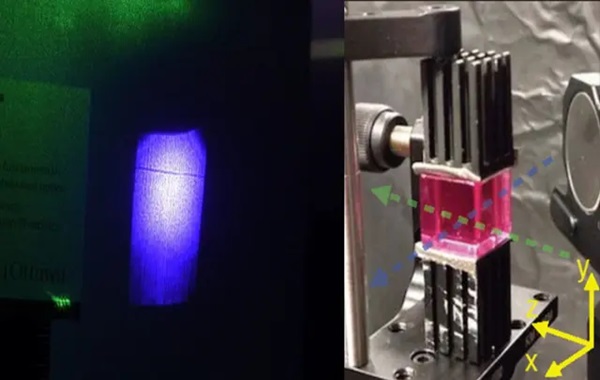
Researchers at Brookhaven National Laboratory, led by physicist Raphael A. Abrahao, achieved this remarkable effect using a nonlinear optical process with a ruby crystal.
Shedding new light on shadows
Shadows, traditionally formed when an object blocks light, are an everyday phenomenon. They result from light’s inability to penetrate opaque objects, creating a region devoid of illumination. However, Abrahao’s team demonstrated that under specific conditions, light itself—specifically, a laser beam—can block another beam, forming a visible shadow.
“Our demonstration of a very counter-intuitive optical effect invites us to reconsider our notion of shadow,” Abrahao explains.
To create this effect, the team directed a high-power green laser through a ruby crystal and illuminated it perpendicularly with a blue laser. When the green laser interacted with the ruby, it altered the crystal’s optical properties, increasing its absorption of the blue light and casting a visible shadow in the shape of the green laser.
This shadow met all criteria: it was visible to the naked eye, matched the laser’s contours, and shifted with the movement of the green laser, akin to the way a traditional shadow behaves.
Nonlinear optics and the role of ruby
This unexpected phenomenon arises from a property known as nonlinear optical absorption. Materials like ruby exhibit nonlinear responses, meaning their interaction with light changes based on the light’s intensity.
In this experiment, the green laser beam raised the absorption rate of blue light in the ruby crystal. As a result, when the blue light exited the ruby, it produced a darker region where the green laser had passed, effectively casting a “shadow” of the green beam.
Ruby, a well-known material in nonlinear optics, was chosen for its ability to amplify, absorb, and modify light under intense conditions. The interaction between the ruby atoms and light created polaritons—quasiparticles formed from the coupling of photons and atoms.
These polaritons, which carry some characteristics of light but have mass, allowed the laser to block part of the blue beam’s path, thus creating the shadow.
“Our understanding of shadows has developed hand-in-hand with our understanding of light and optics,” says Abrahao. “This new finding could prove useful in applications requiring precise light control, such as optical switching, where one light beam controls the behavior of another, or in high-power laser systems.”
Potential applications
The researchers achieved a shadow contrast of around 22%, comparable to the shadow of a tree on a sunny day. They hope this discovery could enable new technologies for controlling light with light, opening doors to advanced fabrication, imaging, and illumination techniques.
The next steps involve exploring other materials and wavelengths to identify additional ways to achieve similar effects.
This research pushes the boundaries of optical science and underscores the potential of light-matter interactions to unlock unconventional applications. While the current focus is primarily on understanding this phenomenon, practical uses may arise in fields that require sophisticated control over light transmission and interaction.
Source: phys.org
Physicists May Have Figured Out How to Safely Transport Antimatter
Shadow of light? Scientists make laser beam cast shadow for the first time