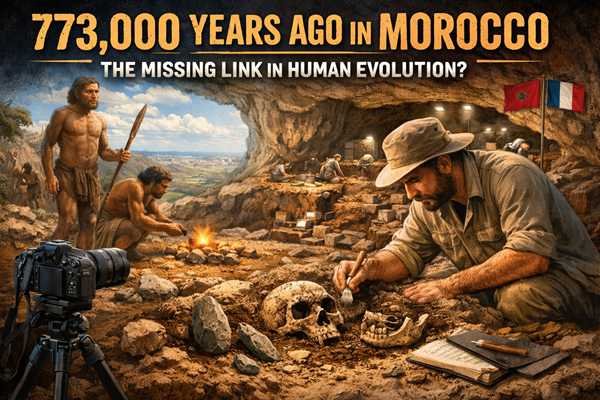
Seven Hundred Seventy-Three Thousand Years Ago in Morocco: The Missing Link Between Homo erectus and Homo sapiens—Was This Humanity’s Turning Point?
Could a cave in Morocco preserve one of the most critical chapters in the story of our species? Recent discoveries suggest that it might. Hominin fossils dating back approximately seven hundred seventy-three thousand years have been uncovered near Casablanca. These remains are reshaping debates about the last common ancestor of present-day Homo sapiens, Neanderthals, and Denisovans.
More importantly, they reinforce Africa’s central role in the evolutionary processes that ultimately shaped modern humanity.
Ancient Moroccan Hominin Fossils and the Deep African Roots of Human Evolution
Excavations have been conducted since nineteen ninety-four at the Grotte à Hominidés, located within Thomas Quarry I, southwest of Casablanca. The long-term research initiative, titled Prehistory of Casablanca, has been led by Morocco’s National Institute of Archaeological Sciences and Heritage in collaboration with the French Ministry for Europe and Foreign Affairs.
Over decades of meticulous excavation, hominin fossils have been recovered alongside thousands of faunal remains and nearly three hundred stone artifacts crafted from quartzite and flint. These tools suggest technological competence consistent with Acheulean traditions. However, the cave itself appears to have functioned as a carnivore den. This interpretation is supported by bite marks found on a hominin femur, likely inflicted by a large hyena.
The human remains are remarkable. They include a nearly complete adult mandible, half of another adult jaw, a juvenile mandible, cervical and thoracic vertebrae, and several isolated teeth. Together, these fossils constitute the oldest securely dated hominin remains ever discovered in Morocco.
Why does this matter so profoundly? Fossils from this interval of the Middle Pleistocene are exceedingly rare across Africa, Europe, and Asia. Consequently, every well-dated specimen becomes invaluable. These Moroccan remains illuminate a poorly understood population that existed between early Homo species and later lineages.
Precise Paleomagnetic Dating and the Seven Hundred Seventy-Three Thousand Year Chronological Marker
Determining the age of ancient fossils is often fraught with uncertainty. However, in this case, dating was achieved with exceptional precision through paleomagnetism—the study of Earth’s ancient magnetic field.
Sedimentary layers within the cave recorded a major geomagnetic reversal. Through high-resolution sampling at intervals of two centimeters, researchers identified the transition from the reversed polarity of the Matuyama chron to the normal polarity of the Brunhes chron. This reversal represents a globally recognized chronological marker.
Because the fossil-bearing layer corresponds directly to this reversal, the remains can be dated to approximately seven hundred seventy-three thousand years ago. This places them precisely at the onset of the Brunhes chron. Few hominin fossils from the Pleistocene—an epoch that began about two million five hundred eighty thousand years ago—are dated with such clarity.
Therefore, the reliability of this chronological framework significantly strengthens the evolutionary interpretations drawn from the site.
Homo Erectus, Evolutionary Divergence, and the African Lineage of Homo Sapiens
At the time these individuals lived, Homo erectus populations were dispersing beyond Africa. Meanwhile, earlier hominin groups such as Australopithecus and Paranthropus had already vanished. This was a pivotal evolutionary moment.
Morphologically, the Moroccan fossils display a mosaic of traits. On the one hand, archaic characteristics typical of Homo erectus are present. On the other hand, more derived features appear—traits that are associated with the lineage leading to Homo sapiens.
This mixture is critical. Paleogenetic evidence suggests that the split between the African lineage leading to modern humans and the Eurasian lineages that later produced Neanderthals and Denisovans occurred during the Middle Pleistocene. Could this Moroccan population have lived near that divergence point?
The fossils lack the fully modern anatomical traits seen in later humans. Yet they are more derived than older Homo erectus specimens found elsewhere in Africa and Asia. Consequently, they may represent an advanced African population close to the branching event that separated African and Eurasian hominin lines.
Until recently, fossils of Homo antecessor from the Gran Dolina site in Spain had been the only specimens showing certain Homo sapiens-like features from this time period. Now, the Moroccan fossils provide a second, and perhaps more geographically central, perspective.
Furthermore, the discoveries invite comparison with the oldest known Homo sapiens fossils from Jebel Irhoud, dated to around three hundred fifteen thousand years ago. Could there be a deep evolutionary continuity between these populations?
North Africa as a Crucial Biogeographical Crossroads in Human Evolution
Northwest Africa has increasingly emerged as a key region for understanding Pleistocene hominin evolution. Alongside eastern and southern Africa, it offers a growing fossil record that fills long-standing gaps.
Geographically, the Mediterranean Sea likely acted as a major biogeographical barrier. It limited gene flow between African and Eurasian populations. Meanwhile, the Sahara Desert did not remain constant in size. Instead, its expansions and contractions structured African populations over time.
During humid phases, corridors may have opened. During arid phases, isolation may have intensified. Such dynamics could have promoted both divergence and innovation.
Therefore, the Moroccan fossils do more than document a local population. They reveal how ecological barriers and shifting climates shaped the evolutionary trajectories of our ancestors.
If Africa was the crucible of human evolution, was northwest Africa one of its most critical laboratories?
Reassessing the African Origin of Modern Humans Through Moroccan Fossil Evidence
The implications of this discovery extend beyond regional archaeology. They strengthen the argument for deep African roots of Homo sapiens. Moreover, they suggest that evolutionary complexity within Africa itself was greater than previously assumed.
Instead of a simple linear progression from Homo erectus to modern humans, the fossil record now suggests branching populations, regional diversification, and gradual morphological shifts. The Moroccan remains fit into this emerging paradigm.
Could it be that multiple African populations contributed to the ancestry of modern humans? Were evolutionary experiments occurring simultaneously across the continent?
As additional evidence accumulates, these questions may move closer to resolution. For now, the Grotte à Hominidés fossils stand as a powerful reminder: Africa’s evolutionary story is deeper, older, and more intricate than once imagined.
Conclusion: A Cave, a Magnetic Reversal, and a Turning Point in Human History
Seven hundred seventy-three thousand years ago, a population of hominins lived in what is now Morocco. Their bones were eventually buried in sediments that recorded a flip in Earth’s magnetic field. Today, that reversal allows scientists to date their existence with extraordinary precision.
These individuals were neither fully archaic nor fully modern. Instead, they occupied a crucial evolutionary threshold. They may have lived near the divergence point between African and Eurasian lineages.
So, what if the key to understanding the emergence of Homo sapiens lies not in a single birthplace, but in a network of evolving African populations—among them, those who once sheltered in a Moroccan cave?
Source: Seven Hundred Seventy-Three Thousand Years Ago in Morocco: The Missing Link Between Homo erectus and Homo sapiens—Was This Humanity’s Turning Point?
1.9 Million-Year-Old Evidence in the Jordan Valley — Were Early Humans More Advanced Than Assumed?
1.9 Million-Year-Old Evidence in the Jordan Valley — Were Early Humans More Advanced Than Assumed?
Sources
Mohib, A., et al. Research publications from the National Institute of Archaeological Sciences and Heritage, Rabat.
Studies on paleomagnetic dating of the Matuyama–Brunhes geomagnetic reversal.
Research on Middle Pleistocene hominin evolution in North Africa.
Findings from Jebel Irhoud excavations and comparative analyses with European Middle Pleistocene sites.