Scientists Thought They Knew How Cosmic Winds Worked — Until XRISM Looked Closer
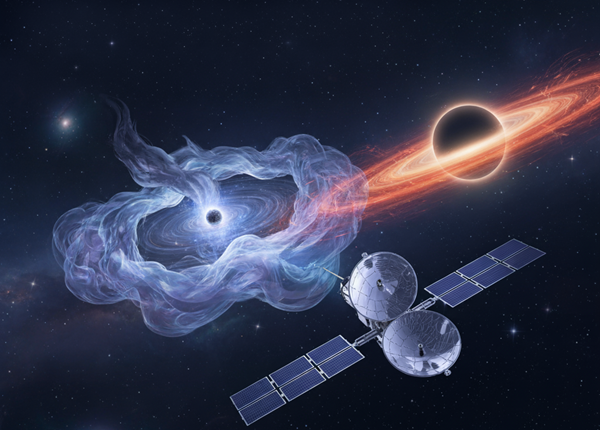
A long-awaited cosmic dream has come true. The X-Ray Imaging and Spectroscopy Mission (XRISM) has detected an unexpected “cosmic fog” — a slow, dense wind streaming from a neutron star — that could transform how scientists understand the forces shaping galaxies.
The discovery reveals a striking contrast between the winds launched from a neutron star’s accretion disc and those surrounding supermassive black holes. Could this be the missing clue to how cosmic winds sculpt the universe?
Unveiling the Source: XRISM’s Glimpse of GX13+1
On February 25, 2024, XRISM’s high-resolution Resolve instrument turned its gaze to GX13+1, a neutron star — the dense core left behind after a massive star’s death.
GX13+1 glows fiercely in X-rays, fueled by a swirling accretion disc of superheated gas spiraling inward. As matter funnels onto the star’s surface, it unleashes powerful radiation and high-speed outflows that ripple across the cosmos.
Yet, the physics behind these winds — why they form and how they vary — has remained an enduring mystery. That’s precisely why GX13+1 became one of XRISM’s first major targets.
Cosmic Winds: The Engines of Galactic Evolution
“When we first saw the wealth of details in the data, we felt we were witnessing a game-changing result,” said Matteo Guainazzi, ESA’s XRISM Project Scientist. “For many of us, it was the realization of a dream we had chased for decades.”
Cosmic winds are not just an astronomical curiosity — they are architects of cosmic change.
Around supermassive black holes, these winds can compress vast molecular clouds to spark new stars or scatter them apart, halting star formation entirely.
This process, known as cosmic feedback, dictates how galaxies evolve. But could similar mechanisms be at work on much smaller, stellar scales?
A Rare Window into the Eddington Limit
GX13+1 gave astronomers a rare opportunity — it unexpectedly flared to the Eddington limit, a natural threshold where radiation pressure from infalling matter balances gravity.
At this point, nearly all the incoming material is blasted outward as wind. XRISM happened to be watching at exactly the right moment.
“We could not have scheduled this if we had tried,” said Chris Done of Durham University, the study’s lead scientist. “The system went from about half its maximum radiation to something far more intense, creating a wind thicker than we’d ever seen before.”
The Mystery of the “Slow” Wind
Surprisingly, the neutron star’s wind moved at just 1 million km/h — fast by human standards, but sluggish compared to the ultrafast winds near supermassive black holes, which can reach 200 million km/h, about 30% the speed of light.
“It’s still astonishing how slow and thick this wind is,” Done said. “It’s like watching the Sun through a fog bank rolling toward us — everything dims as the fog thickens.”
Even more intriguing, XRISM observed that unlike the clumpy, turbulent winds of black holes, GX13+1’s wind was smooth and steady. Why would two systems at the same Eddington limit behave so differently?
Temperature: The Hidden Key to Cosmic Wind Behavior
The XRISM team believes the answer lies in temperature.
While both neutron stars and supermassive black holes can approach the Eddington limit, their accretion discs differ dramatically in size and heat.
Supermassive black holes have enormous, cooler discs that emit mostly ultraviolet light, while the smaller discs around neutron stars blaze with X-rays.
This difference may be crucial: ultraviolet photons interact more efficiently with matter, exerting greater pressure and producing faster, clumpier winds. X-rays, though more energetic, penetrate too deeply, pushing matter less efficiently — explaining the “slow fog” seen around GX13+1.
Redefining Cosmic Feedback and Galactic Evolution
If this temperature-driven model proves correct, it could revolutionize our understanding of how energy and matter interact in extreme cosmic environments — from the hearts of galaxies to the remnants of exploded stars.
Could temperature be the missing variable that connects small-scale stellar winds to galaxy-shaping superwinds?
“The unprecedented resolution of XRISM allows us to explore these questions in exquisite detail,” said Camille Diez, ESA Research Fellow. “It’s a leap toward the next generation of X-ray observatories, like NewAthena, that will probe these mysteries even deeper.”
A New Era of High-Resolution X-Ray Astronomy
XRISM’s discovery of a dense, slow-moving cosmic wind doesn’t just challenge our models — it redefines them.
By revealing how radiation and temperature govern the flow of matter in the universe, it sets the stage for a new era in high-resolution X-ray astronomy.
As the cosmos continues to whisper through winds and fogs of gas and light, one question remains:
If temperature controls the breath of stars and galaxies alike, how far does its influence reach across the universe?
Source: Scientists Thought They Knew How Cosmic Winds Worked — Until XRISM Looked Closer
If Space-Time Isn’t Real, Then What Is Reality Made Of?
Scientists Thought They Knew How Cosmic Winds Worked — Until XRISM Looked Closer