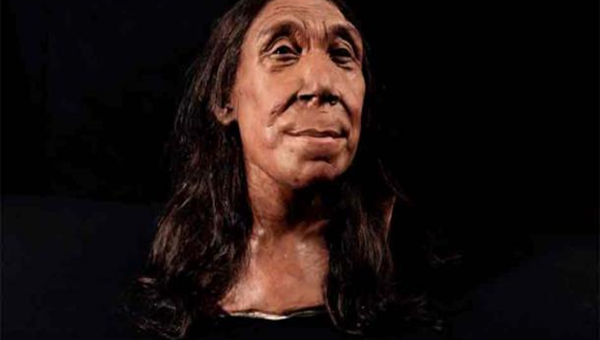
A Face Hidden for 75,000 Years Has Emerged—And It’s Changing Everything We Thought We Knew.
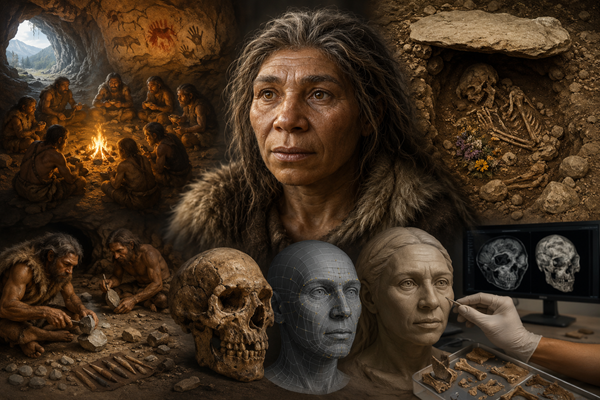
To step into the Shanidar Cave in the foothills of the Zagros Mountains of northern Iraq is to step into the Neanderthal world of 75,000 years ago. Neanderthal cave dwellers gathered around the fire to cook grains, nuts, and wild plants. They roasted meat and enjoyed their family. Near the cave entrance, they made tools and crafted rocks into points for hunting or scrapers for processing animal hides. Deep inside the cave, there was a sacred place where hand prints and animal drawings decorated the walls. In the dark shadows, there was a family cemetery, a well-marked and often visited burial place for generations. According to Cambridge Professor Graeme Barker, who leads the excavations at the cave:
“Our discoveries show that the Shanidar Neanderthals may have been thinking about death and its aftermath in ways not so very different from their closest evolutionary cousins — ourselves.”
American anthropologist Ralph Solecki first excavated Shanidar between 1951 and 1960. In recent years, the Shanidar Cave Project, a collaboration between the University of Cambridge and the Kurdistan Directorate of Antiquities, has continued Solecki’s work, sampling sediment, classifying pollen types, and analyzing ancient DNA from the skeletal remains of the cave’s former inhabitants. During an excavation from 2018 to 2019, the archaeological team recovered ten individuals from the burial site in the cave. One of the individuals with a crushed skull and other skeletal parts of an adult Neanderthal was taken from a shallow scoop grave covered with stones. This was the research team’s first meeting with Shanidar Z, but soon, they met her face-to-face.
The Role of Facial Reconstruction in Archaeology
Facial reconstruction, also known as facial approximation, has become increasingly useful in forensic anthropology and archaeology. Skilled craftsmen bridge art and science as they create a virtual face based on available data, including skull measurements and DNA analysis. Using advanced computer software and artificial intelligence, the team produced a digital 3D model of the skull using exact measurements. Depth markers indicate the thickness of soft tissue, allowing the forensic artist to sculpt facial features and apply skin color and texture for a realistic appearance.
Recreating the Face of Shanidar Z
After working in the organized, homelike atmosphere of Shanidar Cave and studying Neanderthal interbreeding with modern humans, the research team realized that the common harsh vision of Neanderthals was flawed. Professor Barker explained that, “Neanderthals have had a bad press ever since the first ones were found over 150 years ago.” Dr. Emma Pomeroy, a palaeoanthropologist at Cambridge, described the similarities with humans in her project report: “It’s perhaps easier to see how interbreeding occurred between our species,” she added, “to the extent that almost everyone alive today still has Neanderthal DNA.”
Dr. Pomeroy continued. “Neanderthal skulls have huge brow ridges and lack chins, with a projecting midface that results in more prominent noses. But the recreated face suggests those differences were not so stark in life.”
“The greatest challenge of reconstructing Shanidar was her flattened skull that contained 200 bone fragments,” Pomeroy said. After applying glue to strengthen the bone fragments, technicians wrapped each piece in foil. At the lab, they diluted the glue, made CT scans of each bone, and then Dr. Lucía López-Polín painstakingly pieced them together by hand. Paleoartists Adrie and Alfons Kennis modeled her facial features. Cambridge scientists estimated her age in the mid-40s at the time of her death. Her teeth were worn and diseased, and she suffered from mild arthritis. The manner of her burial suggests respect and care. Her burial site, beneath a large stone marker, was filled with clumps of pollen, possibly from her body being placed on bundles of flowers. She was found in a cluster of Neanderthal bodies that all appear to have been buried in the cave around the same time. Researchers note that one of the male Neanderthals had a paralyzed arm. He, too, was advanced in age, between 40 and 50 years old. His age and disability indicate the presence of a caregiver and the empathy of his community.
The Shanidar Cave Today
Access to the site is dangerous due to regional unrest, but excavations proceed, and insights into Neanderthal culture increase. As researchers sift through the cave’s sediment layers, each stone fragment adds detail to our understanding of human evolution. This fundamental research allows us to vastly expand our understanding of human presence in the Neanderthal world of 75,000 years ago.
Source: A Face Hidden for 75,000 Years Has Emerged—And It’s Changing Everything We Thought We Knew.
A Face Hidden for 75,000 Years Has Emerged—And It’s Changing Everything We Thought We Knew.
Sources
University of Cambridge – Shanidar Cave Project
University of Cambridge Department of Archaeology
Dr. Emma Pomeroy Research Reports
Graeme Barker and the Shanidar Cave Excavation Team
Kurdistan Directorate of Antiquities
Journal of Human Evolution
Nature Ecology & Evolution
Proceedings of the National Academy of Sciences (PNAS)
Original excavation records of Ralph Solecki
A Face Hidden for 75,000 Years Has Emerged—And It’s Changing Everything We Thought We Knew.