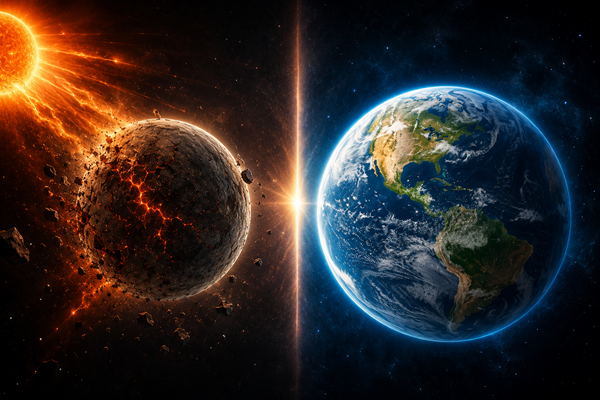
Scientists Just Discovered the Minimum Planet Size for Alien Life — And It Changes Everything
Humanity’s search for another Earth has entered a remarkable new era. Every year, astronomers discover more distant worlds orbiting foreign stars. Some glow beneath red dwarf suns. Others circle stars far larger than our own Sun. Yet one question continues to dominate modern astronomy:
Which of these planets could actually support life?
A groundbreaking new scientific model now offers one of the clearest answers yet. According to researchers from the University of California Riverside, there may be a strict lower size limit for habitable exoplanets. Their findings suggest that planets smaller than roughly zero point eight Earth radii struggle to keep the atmospheres needed for life.
That conclusion could dramatically reshape the future of space exploration. It may also narrow humanity’s search for extraterrestrial civilizations.
But why would a planet’s size determine whether life can survive?
And could countless small rocky worlds across the galaxy already be doomed before life even begins?
Habitable Exoplanets and the Critical Role of Planet Size
For decades, astronomers focused heavily on the “habitable zone.” This is the region around a star where temperatures may allow liquid water to exist on a planet’s surface.
However, temperature alone does not create a living world.
A planet also needs an atmosphere capable of protecting and stabilizing its surface. Without one, radiation from space bombards the ground directly. Water evaporates into space. Temperatures swing violently between scorching heat and freezing cold.
That reality makes atmosphere retention one of the most important factors in planetary habitability.
The new Smaller Than Earth Habitability Model, known as STEHM, explores exactly this problem. The study investigates how small a rocky planet can become before it inevitably loses its atmosphere forever.
The answer appears surprisingly precise.
According to the model, planets at or above zero point eight Earth radii can preserve atmospheres for billions of years. Meanwhile, planets below approximately zero point seven Earth radii rapidly lose their gases to space.
That narrow boundary may separate living worlds from barren cosmic deserts.
Why Small Exoplanets Lose Their Atmospheres So Quickly
At first glance, the explanation seems obvious.
Smaller planets possess weaker gravity. Consequently, atmospheric particles escape into space more easily. Scientists call this process “Jeans escape,” a mechanism where high-energy gas particles exceed a planet’s escape velocity and drift away forever.
Still, gravity is only part of the story.
The STEHM model uncovered another equally devastating problem hidden deep beneath the planet’s surface.
Small planets cool too fast.
Because they have a high surface-area-to-volume ratio, their internal heat escapes rapidly. Over time, their molten interiors solidify. Their lithospheres thicken. Eventually, volcanic activity slows dramatically or stops altogether.
That matters because volcanoes help replenish atmospheres.
On Earth, volcanic outgassing releases gases like carbon dioxide, water vapor, and nitrogen into the atmosphere. These gases sustain climate stability over immense geological timescales.
Without volcanism, an atmosphere slowly disappears and cannot recover.
Therefore, a small planet faces two simultaneous disasters:
- Weak gravity allows gases to escape.
- Rapid cooling shuts down atmospheric replenishment.
Together, those processes create a deadly combination.
Could this explain why so many rocky bodies in our own Solar System became lifeless?
The Dangerous Power of Stellar Radiation on Small Rocky Worlds
Young stars are violent.
During their early stages, they unleash enormous quantities of extreme ultraviolet radiation, often called XUV radiation. This radiation slams into planetary atmospheres with tremendous energy.
Large planets can resist much of that assault. Smaller worlds cannot.
According to the new model, planets smaller than zero point seven Earth radii eventually lose their atmospheres completely under relentless stellar bombardment.
The timeline is astonishingly short on cosmic scales.
A planet measuring only zero point six Earth radii may retain an atmosphere for roughly four hundred million years. Although that sounds lengthy, it may not provide enough time for complex biology to evolve protective mechanisms.
Even more dramatic, a planet with half Earth’s radius could lose its atmosphere in only thirty million years.
In astronomical terms, that is almost instantaneous.
Life may barely have enough time to emerge before the atmosphere vanishes forever.
What happens afterward?
The world becomes an airless rock drifting silently through space.
Could Mars and Mercury Reveal the Fate of Tiny Exoplanets?
Our own Solar System may already contain examples supporting the model’s conclusions.
Mars once possessed rivers, lakes, and possibly even oceans. Yet today, its atmosphere is incredibly thin compared to Earth’s. Scientists believe Mars gradually lost much of its atmospheric protection over billions of years.
Its smaller size likely contributed heavily to that transformation.
Meanwhile, Mercury barely possesses an atmosphere at all. Its weak gravity and intense solar exposure stripped most gases away long ago.
Earth, by contrast, sits safely above the proposed size threshold. Its stronger gravity and sustained internal heat allowed volcanic recycling and atmospheric stability to continue for billions of years.
Could Earth’s size be more special than humanity ever realized?
Perhaps the emergence of life required not only water and chemistry, but also a planetary “sweet spot” large enough to survive cosmic erosion.
Rare Exceptions That Might Allow Tiny Exoplanets to Survive
The researchers also identified several unusual circumstances where smaller planets might avoid atmospheric collapse.
However, these cases appear extremely rare.
One possibility involves planets born with unusually large carbon reserves. Massive carbon inventories could continuously replenish atmospheric carbon dioxide over immense periods.
Another scenario involves planets with unusually tiny cores or even no metallic core at all. Such worlds retain larger mantles, which could sustain volcanic outgassing longer than expected.
Finally, the study explored the concept of a “cold start.”
In this scenario, a planet’s mantle heats slowly over time instead of beginning intensely hot. As a result, volcanic activity occurs later, after the host star has already calmed down and reduced its destructive XUV radiation output.
This delayed atmospheric formation could help smaller planets survive much longer.
Still, researchers emphasize that these exceptions are likely uncommon throughout the galaxy.
Most tiny rocky worlds probably cannot escape atmospheric destruction.
How the New Habitability Model Could Change the Search for Alien Life
Modern telescopes now discover exoplanets at extraordinary speed. Missions like James Webb Space Telescope and Kepler Space Telescope have transformed astronomy forever.
Yet telescope time remains incredibly valuable.
Scientists cannot analyze every exoplanet in detail. Therefore, narrowing the search becomes essential.
The STEHM model offers astronomers a powerful new filter.
If a rocky planet falls below the zero point eight Earth-radius threshold, it may immediately become a lower priority target in the search for biosignatures.
Instead, astronomers may focus on worlds large enough to sustain atmospheres over billions of years.
This shift could save enormous observational resources while improving the chances of finding genuine habitable planets.
But it also raises an unsettling possibility.
If small planets dominate the galaxy numerically, could truly habitable worlds be far rarer than previously believed?
Could Alien Life Exist on Worlds Very Different From Earth?
Despite the model’s conclusions, the universe still loves surprises.
Scientists continue discovering exotic planetary systems that challenge old assumptions. Some moons beneath frozen crusts may hide underground oceans. Some planets orbit dim red dwarf stars for trillions of years. Others may possess atmospheric chemistries unlike anything seen on Earth.
Therefore, the new study does not prove that life cannot exist on smaller worlds.
Instead, it suggests such worlds face enormous physical challenges.
Could alien biology evolve rapidly enough to survive atmospheric collapse?
Could underground ecosystems persist beneath barren surfaces?
Could some planets continuously regenerate atmospheres through unknown geological processes?
Astronomy repeatedly teaches humanity one lesson above all others:
The universe is often stranger than expected.
The Future of Exoplanet Research and the Search for Earth Two Point Zero
The dream of discovering another living world continues to captivate scientists and the public alike.
Every new exoplanet discovery raises profound questions:
- Are we alone?
- How rare is Earth?
- Is intelligent life common across the galaxy?
- Or did our planet win an extraordinarily unlikely cosmic lottery?
The Smaller Than Earth Habitability Model adds an important new piece to that puzzle. It suggests planetary size may act as a hidden gatekeeper for life itself.
Worlds too small simply cannot hold onto the atmospheres needed for biology to flourish.
If the model proves correct, then countless tiny exoplanets scattered across the Milky Way may already be ruled out as potential homes for life.
Yet somewhere beyond our skies, another Earth-sized world may still wait.
Perhaps oceans crash against alien shores beneath thick blue atmospheres. Perhaps civilizations gaze back toward our Sun asking the same questions humanity asks today.
And perhaps the answer depends on something as deceptively simple as planetary size.
Source: Scientists Just Discovered the Minimum Planet Size for Alien Life — And It Changes Everything
Webb Space Telescope Reveals Rare Planet Pair That Shouldn’t Exist
Webb Space Telescope Reveals Rare Planet Pair That Shouldn’t Exist
Scientists Just Discovered the Minimum Planet Size for Alien Life — And It Changes Everything
Scientific Sources and References
arXiv Preprint Server
University of California Riverside
NASA Exoplanet Exploration Program
European Space Agency Exoplanet Science
James Webb Space Telescope Official Site
Scientists Just Discovered the Minimum Planet Size for Alien Life — And It Changes Everything