Scientists discover strongest known magnetic fields inside nuclear matter
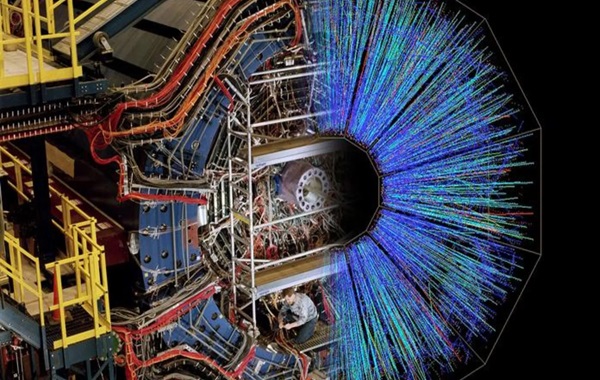
An international collaboration of scientists working with data generated at the Relativistic Heavy Ion Collider (RHIC) at the Brookhaven National Laboratory in the US has found the strongest known magnetic field inside nuclear matter.
The field is generated due to the electric current induced in the quarks and gluons that are set free after particles are mashed up in the collider.
Neutron stars, the densest objects known in the universe, are considered to have the strongest magnetic fields, measuring 1014 gauss. On the other hand, the magnetic field around our planet that protects us from cosmic radiation and particles emitted by the Sun is a mere 0.5 Gauss.
Scientists, however, have long believed that off-center collisions of heavy atomic nuclei like gold can generate powerful magnetic fields predicted to measure 1018 gauss, making it probably the strongest magnetic field in our universe.
However, the field does not last for very long and dissipates in 10-23 seconds, which is ten millionths of a billionth of a billionth of a second, making it almost impossible to observe.
Indirect observation
If a magnetic field is present it is bound to impact the movement of charged particles and also induce electromagnetic fields.
“We wanted to see if the charged particles generated in off-center heavy ion collisions were being deflected in a way that could only be explained by the existence of an electromagnetic field in the tiny specks of QGP (quarks and gluons plasma) created in these (heavy ion) collisions,” said Aihong Tang, a physicist at the Brookhaven Lab who was involved in the research.
The researchers then used sophisticated detector systems to track the collective motion of different charged particles. They also wanted to ensure that deflections caused by charged quarks were ruled out in their observations. Luckily, these charged quarks produced a pattern in the opposite direction, making it easier to distinguish between the two.
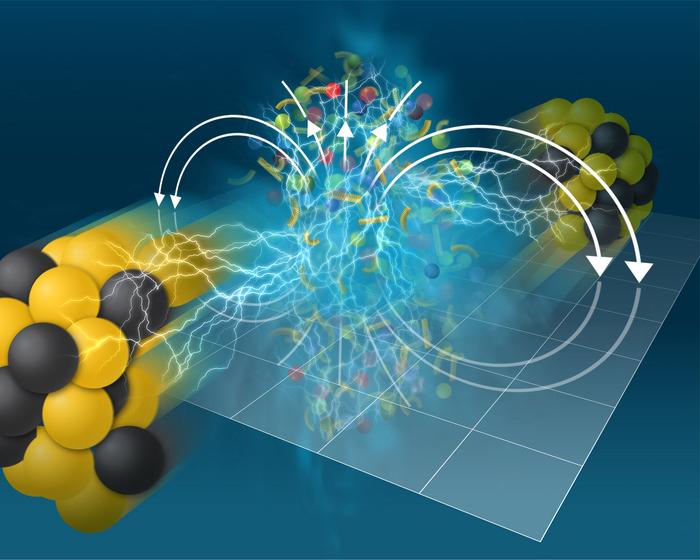
Interestingly, the researchers observed these signals not only in off-center collisions of heavy nuclei like gold at high energy but also in those of smaller nuclei such as ruthenium-ruthenium and zirconium-zirconium at low energy of 200GeV. This was also observed when gold nuclei collided at 27 GeV, making the effect universal.
How does this help?
Now that scientists have observed Faraday induction – magnetic fields induce an electromagnetic field – in QGP, they can now use it to probe the conductivity of QGP, something that nobody has done before. The measurement is pretty straightforward since the deflection of particles is directly proportional to the strength of the magnetic field and the conductivity of QGP.
Knowing the magnetic and electromagnetic properties of QGP can also help scientists determine the conditions under which free quarks and gluons coalesce to form hadrons – protons and neutrons that make up atomic nuclei.
“We want to map out the nuclear ‘phase diagram,’ which shows at which temperature the quarks and gluons can be considered free and at which temperature they will ‘freeze out’ to become hadrons,” said Gang Wang, a physicist at the University of California, Los Angeles, who is also involved with the collaboration.
“Those properties and the fundamental interactions of quarks and gluons, which are mediated by the strong force, will be modified under an extreme electromagnetic field. We can investigate these fundamental properties in another dimension to provide more information about the strong interaction.”
Source: Interesting Engineering
Physicists Have Figured Out a Way to Measure Gravity on a Quantum Scale
Scientists discover strongest known magnetic fields inside nuclear matter