Sci-fi-like skin tech brings real sensations to virtual worlds, visually impaired
A new wearable device can now stimulate the skin to provide various sensations.
Northwestern University researchers designed this thin, flexible device that gently clings to the skin. It can deliver precise sensations, from gentle vibrations to stronger pressure, and even twisting motions.
It is designed to provide more realistic and immersive sensory experiences for gaming and virtual reality applications.
Beyond this, this technology has the potential in the healthcare sector.
It can give tactile feedback to individuals with visual impairments, helping them navigate their surroundings. For amputees, it can offer sensory feedback from prosthetic limbs, enhancing their sense of touch.

New skin tech consists of actuators
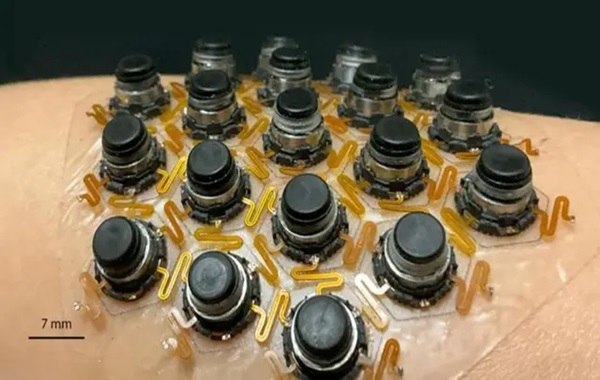
The device consists of a hexagonal array of 19 tiny magnetic actuators encased in a flexible silicone mesh. The actuators are capable of delivering a diverse array of sensations, including pressure, vibration, and twisting.
The device uses Bluetooth to receive information from a smartphone and convert it into tactile sensations. Once connected, it can receive information about the user’s surroundings, such as the presence of obstacles or changes in terrain.
This information is then translated into tactile sensations, which are delivered to the user through the device.
Despite using a small battery, the device is highly energy-efficient — thanks to its “bistable” design.
Interestingly, it can remain in two stable positions without requiring constant power.
As the actuators exert downward pressure, energy is stored within the skin and the device’s internal components. The stored energy is released as the actuators spring back.
As a result, the device only consumes energy during these transitions, leading to significant energy savings and extended battery life.
“Instead of fighting against the skin, the idea was ultimately to actually use the energy that’s stored in skin mechanically as elastic energy and recover that during the operation of the device,” said Matthew Flavin, the paper’s first author.
“Just like stretching a rubber band, compressing the elastic skin stores energy. We can then reapply that energy while we’re delivering sensory feedback, and that was ultimately the basis for how we create this really energy-efficient system,” Flavin explained.
Shows promise in testing
To put the haptic device to the test, researchers blindfolded subjects and had them navigate obstacles. They also assessed their ability to adjust their foot placement and maintain balance.
It helped participants avoid collisions and navigate the course successfully.
The researchers found that users could quickly adapt to using the device. With minimal training, they were able to use tactile feedback to navigate their surroundings effectively.
The device works in a similar way to a white cane, which is a tool used by visually impaired people to detect obstacles. However, the device offers a more sophisticated level of sensory information.
“As one of several application examples, we show that this system can support a basic version of ‘vision’ in the form of haptic patterns delivered to the surface of the skin based on data collected using the 3D imaging function (LiDAR) available on smartphones,” said John A. Rogers, who led the development.
“This sort of ‘sensory substitution’ provides a primitive, but functionally meaningful, sense of one’s surroundings without reliance on eyesight — a capability useful for individuals with vision impairments,” Rogers concluded in the press release.
Source: Interesting Engineering
New Discovery Paves The Way to Generating Energy From Body Heat
Sci-fi-like skin tech brings real sensations to virtual worlds, visually impaired