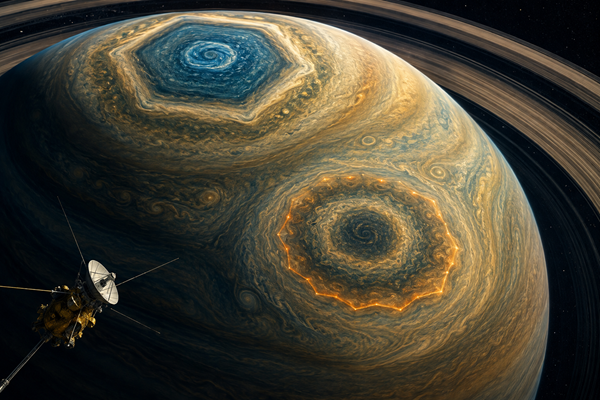
Saturn’s Famous Hexagon Had No Rival for Decades—Until a Ten-Sided Decagon Suddenly Emerged. What Triggered This Hidden Pattern?
Astronomers have detected a ten-sided polygon swirling around Saturn’s south pole, revealing that the gas giant’s atmosphere may harbor a hidden talent for forming geometric shapes. For decades, the planet’s north pole featured a famous six-sided hexagon, a bizarre weather pattern unlike anything else in the Solar System. Now, a second polygonal wave has emerged, raising fresh questions about the forces shaping Saturn’s polar regions.
This discovery, led by Agustín Sánchez-Lavega of the University of the Basque Country in Spain, suggests that Saturn’s atmosphere can produce polygonal waves in both hemispheres. “The hexagon is not as extraordinary as previously thought,” Sánchez-Lavega told ScienceAlert. “Conditions in Saturn’s atmosphere allow such shapes to form around both poles.”
Saturn’s Hexagon: A Familiar Six-Sided Mystery
Saturn’s most iconic feature after its rings is undoubtedly the hexagon at its north pole. First spotted in images from the Voyager probes in nineteen eighty and nineteen eighty-one, this vast atmospheric wave sits at roughly seventy-eight point five degrees latitude. It has remained stable for at least forty-four years, as confirmed by the Hubble Space Telescope and the Cassini-Huygens mission.
But why does it have six sides? Scientists still cannot explain the almost perfect geometry. The hexagon is a weather phenomenon, but its persistence and symmetry defy simple models. Could it be linked to the planet’s powerful jet streams? Or does some deeper dynamical process force the atmosphere into this shape? Despite decades of study, the hexagon remains an enigma.
A Surprise Discovery: The Ten-Sided Decagon
In twenty twenty-four, amateur astronomers noticed a dark, undulating line near Saturn’s south pole. Follow-up work in twenty twenty-five confirmed the sighting. Using polar projections from images captured by Trevor Barry of Broken Hill Observatory in Australia and Jean-Paul Oger of the French Astronomy Association, the team identified ten sides forming an unmistakable polygon. High-quality Hubble images traced the feature back to twenty twenty-three.
“We were surprised because neither earlier Hubble images nor Cassini data from two thousand four to two thousand seventeen had shown it,” Sánchez-Lavega said. The decagon appears to be a vast atmospheric wave riding on a powerful eastward jet stream. That jet races around the planet at roughly four hundred twenty kilometers per hour—about two hundred sixty miles per hour—while the decagon itself moves at a comparatively leisurely ten kilometers per hour.
Observations at different wavelengths revealed traces of the polygon at various altitudes and latitudes. This suggests a vertically layered structure embedded deep within Saturn’s atmosphere, not merely a pattern across the visible cloud tops.
How the Decagon Differs from the Hexagon
Although fundamentally the same kind of phenomenon, the two polygons are not mirror images. The decagon has ten sides instead of six. It sits at a less polar latitude—about sixty degrees south compared to the hexagon’s seventy-eight point five degrees north. And the decagon appears less robust, having formed only recently.
Why these differences? “It may be linked to the difference in latitude, to the background wind structure, or perhaps to the presence of a high-pressure vortex at nearby latitudes that could be forcing the formation of the wave,” Sánchez-Lavega explained. The hexagon has endured for decades, yet the decagon emerged only a few years ago. Could the southern polygon be a younger, less stable cousin? Or does it represent a different class of atmospheric wave altogether?
What Could Explain Saturn’s Polygonal Patterns?
One plausible suspect lies just north of the decagon: a roughly four-thousand-kilometer-wide anticyclone, a high-pressure vortex that researchers call a Red Spot. This storm is smaller and temporary compared to Jupiter’s famous Great Red Spot. Interestingly, the decagon appears most pronounced near the vortex and least distinct on the opposite side of the planet.
The team ran simulations to test whether this storm—or some other disturbance—could have triggered the decagon. None of their scenarios reproduced the observed shape exactly. Moreover, a similar vortex existed near the hexagon when it was discovered in nineteen eighty, but that vortex later disappeared while the hexagon remained. “The hypothesis that a nearby anticyclone is driving the oscillation is attractive,” Sánchez-Lavega said. “But the hexagon persisted even after its nearby vortex vanished.”
So what other mechanisms might be at work? Could interactions between the planet’s rapid rotation and its deep atmospheric layers generate standing waves that naturally form polygons? Or do seasonal changes in solar heating play a role?
The Role of Seasons and Future Observations
Saturn takes about twenty-nine point five Earth years to orbit the Sun, and its axis is tilted. This gives the planet long seasons lasting roughly seven point five years each. Currently, the southern hemisphere is moving through spring toward summer, tilting increasingly toward the Sun.
The increase in solar radiation hitting the southern hemisphere—and the decagon—could cause interesting changes. As the south pole tilts further into view, astronomers will have an increasingly good vantage point. “We need to understand how the decagon evolves,” Sánchez-Lavega said. “Will it become unstable and break up, or become more stable and robust as solar radiation increases?”
This is a rare opportunity. With the hexagon, we only learned of its existence well after it was established. Now, scientists have a front-row seat to watch Saturn build a polygon in real time. Will the decagon persist for decades like its northern counterpart? Or will it dissipate as the seasons shift? Every new observation will bring us closer to answering these questions.
Conclusion: A Front-Row Seat to Planetary Weather
The discovery of a ten-sided structure in Saturn’s atmosphere transforms our understanding of planetary meteorology. It shows that polygonal waves are not a one-off anomaly but a recurring phenomenon. The hexagon and decagon may be different expressions of the same fundamental process, shaped by latitude, wind shear, and perhaps nearby storms.
Yet many mysteries remain. Why ten sides instead of six? Why did the decagon form so recently? What role do the planet’s long seasons play? And could other gas giants—Jupiter, Uranus, Neptune—host similar polygons that we have not yet detected?
As Saturn’s southern summer approaches, astronomers will watch the decagon with keen interest. Whatever happens, it promises to be a spectacular show. The answers may lie in the coming years of careful observation, computer modeling, and perhaps a future mission to the ringed planet.
Source: Saturn’s Famous Hexagon Had No Rival for Decades—Until a Ten-Sided Decagon Suddenly Emerged. What Triggered This Hidden Pattern?
Dead Sea Scrolls May Solve a Decades-Old Mystery About the Qumran Calendar
Dead Sea Scrolls May Solve a Decades-Old Mystery About the Qumran Calendar
Saturn’s Famous Hexagon Had No Rival for Decades—Until a Ten-Sided Decagon Suddenly Emerged. What Triggered This Hidden Pattern?
Sources:
- Sánchez-Lavega, A. et al. (2025). Discovery of a ten-sided polygon in Saturn’s south polar atmosphere. Geophysical Research Letters (in review).
- ScienceAlert interview with Agustín Sánchez-Lavega, March 2025.
- NASA/JPL-Caltech/SSI Cassini mission data (2004–2017).
- Hubble Space Telescope observations of Saturn (2023–2025).
- Amateur astronomer reports: Trevor Barry (Broken Hill Observatory) and Jean-Paul Oger (French Astronomy Association).
Saturn’s Famous Hexagon Had No Rival for Decades—Until a Ten-Sided Decagon Suddenly Emerged. What Triggered This Hidden Pattern?