Rivers and Seas on Saturn’s Satellite Titan Have Different Compositions
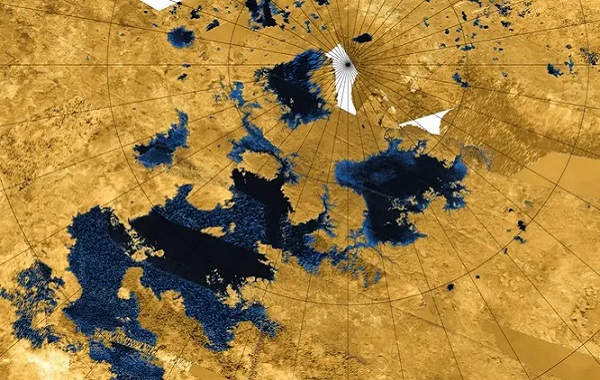
A detailed analysis of the rivers and seas of Saturn’s satellite Titan has revealed a difference between rivers and seas similar to Earth’s. The study found that Titan’s seas have waves and currents.
Titan is very similar to Earth. in size, mass, and atmospheric pressure. Except it’s very cold. But man can be quite comfortable there.
He needs oxygen, of course, and a heating suit. But that suit doesn’t have to be perfectly airtight. There’s a DragonFly mission planned for Titan in 2028. It will fly there and tell us how life is.
Unlike Earth’s oceans, Titan’s lakes are made up of methane and ethane, which are liquid at an average surface temperature of about -179 °C.
Measurements made by NASA’s Cassini spacecraft, which orbited Saturn from 2004 to 2017, noticed differences in the properties of the lakes, such as their composition and waves on the surface. But there wasn’t enough information in the signals to distinguish them.
Now Valerio Poggiali of Cornell University, New York, and colleagues have mapped the composition and surface of Titan’s seas using a different radar technique.
They showed that the amount of ethane increases as you move around the planet from its north pole to its equator. “The further north you are, the cleaner and clearer the seas are; they are more methane,” Poggiali says.

Previous radar measurements of Titan’s surface were made using signals emitted and received at the same location, the Cassini probe. This meant that the reflected radio waves were polarized in the same direction.
A new study by an international team of astronomers analyzed signals from Cassini’s radar that were reflected off the surface of Titan’s lakes and seas and then received by NASA’s Deep Space Network radio antennas on Earth.
Another angle of reflection included two kinds of polarized waves, which gave Poggiali and his colleagues more information about the properties of the lakes.
Titan’s rivers and seas
Scientists found that many rivers and deltas that fed the lakes had uneven surfaces, probably caused by wind waves. This could be a sign of active tides or currents as they flowed into lakes and seas, says Poggiali.
“Activity on the surface of the seas is very important if you want to plan a future mission, such as the Titan submarine, and also to better understand Titan’s environment in terms of winds and atmospheric characteristics.”
Poggiali and his colleagues found that rivers have a higher methane composition before they flow into lakes. This could help track the methane-ethane cycle on Titan, says Ingo Müller-Wodarg of Imperial College London.
The scientist notes: “When a river flows into a large salty ocean on Earth, you will see that near the point of flow, the salinity of the water decreases. On Titan, something similar is happening, only it’s not the salt content, but the relative proportion of methane and ethane.”
Source: Rivers and Seas on Saturn’s Satellite Titan Have Different Compositions