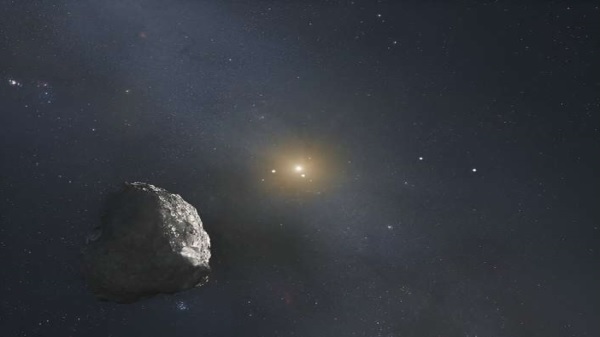
Revolutionary Twist in Search for Ninth Planet: Is the Solar System to Blame?
A pair of theoretical physicists report that the same observations that influenced the hunt for the ninth planet could be evidence of the solar system instead of a modified law of gravity originally developed to understand the rotation of galaxies.
Researchers Hirsch Matur, a professor of physics at Case Western Reserve University, and Catherine Brown, an associate professor of physics at Hamilton University, argued after studying the effects of the Milky Way on objects outside the solar system, when the law of gravity is governed by a theory known as modified Newtonian mechanics (or Mondo).
Mondo proposes that Isaac Newton’s famous law of gravity is valid to a certain point. That is, if the gravitational acceleration predicted by Newton’s law is small enough, then the Mondo can take over different gravitational behaviors.
The success of Mondo’s observations on a galactic scale has led some scientists to consider it an alternative to “dark matter”, and physicists are interested in the hypothesis of a substance that has a gravitational effect but does not emit light.
“Mondo is really good at explaining galaxy-scale observations, but we didn’t expect it to have any noticeable effect outside the solar system.”
“Impressive” alignment
Matur and Brown had previously studied Mondo’s influence on galaxy dynamics. But they became interested in the more local effects of Mondo after astronomers announced in 2016 that only a handful of objects in the exoplanet system showed orbital anomalies that could be explained by the 9th Planet.
The peculiarities of the orbit have led to previous historical discoveries: Neptune was discovered by a gravitational tug-of-war in the orbit of a nearby object, Mercury’s micro-precession provided early evidence to support Einstein’s theory of general relativity, and astronomers recently used orbital mechanics to infer the presence of a supermassive black hole at the center of our galaxy. We have a lot to offer.
Brown realized that Mondo’s predictions might be at odds with observations motivated by the search for the 9th Planet. “We wanted to see if the data supporting the Planet Nine hypothesis effectively excluded Mondo,” she said.
Instead, Mathur and Brown found that mond accurately predicted the clustering observed by astronomers. They claim that for millions of years the orbits of some objects outside the solar system will be dragged to align with the gravitational field of the galaxy itself.
“The alignment was impressive,” Matur said when he plotted the orbits of objects from the Planet 9 dataset against the galaxy’s own gravitational field.
The authors note that the current data set is small and that several other possibilities may prove correct.For example, other astronomers claim that the specificity of the orbit is the result of observation bias.
“Regardless of the results, the study highlights the potential for exoplanets to test gravity and serve as a laboratory for studying fundamental problems in physics.”.
Can you write a few headlines that will attract attention and hits?
Source: Revolutionary Twist in Search for Ninth Planet: Is the Solar System to Blame?
Forget Alien Megastructures. New Study Says We Need to Look For ‘Service Worlds’