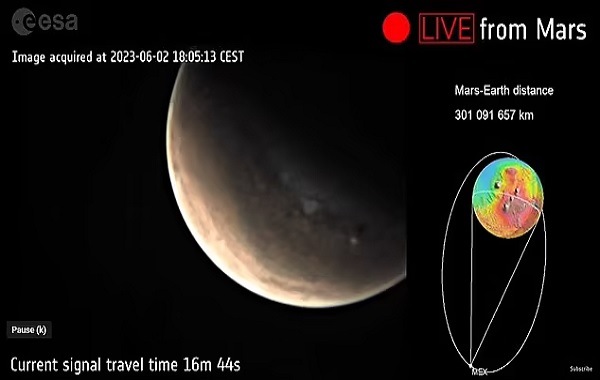
Reporting live… from Mars: Scientists recorded first ever live-stream of Red Planet today
Scientists were able to capture ‘live’ footage of Mars for the the first time today.
The images were streamed to YouTube by the European Space Agency for a full hour.
Mars has only been previously seen in the past, through images from orbiters and landers exploring it, usually days after the shots were taken.
But to celebrate the 20th birthday of ESA’s Mars Express (MEX) deep-space probe orbiting the Red Planet, experts spent weeks developing tools that would allow images from the probe’s camera to be streamed, live, for a full hour.
Around noon Eastern, 12pm ET (5pm UK time), new pictures were beamed down approximately every 50 seconds.
The Visual Monitoring Camera on Mars Express has previously discovered the evolution of a rare elongated cloud formation hovering above one of Mars’ most famous volcanoes – the 20 km-high Arsia Mons.
‘This is an old camera, originally planned for engineering purposes, at a distance of almost three million kilometres from Earth,’ said James Godfrey, Spacecraft Operations Manager at ESA’s Mission Control Centre in Darmstadt, Germany.
‘This hasn’t been tried before and to be honest, we’re not 100 percent certain it’ll work.
‘But I’m pretty optimistic. Normally, we see images from Mars and know that they were taken days before.
‘I’m excited to see Mars as it is now – as close to a martian ‘now’ as we can possibly get!’
Because of the vast distance between Earth and Mars – around 140 million miles on average – there was actually a slight delay in the transmission: a little over 16 minutes per image.
As past estimate from ESA said that the time between the images being taken from orbit around Mars and appearing on screen would be about 18 minutes.
ESA said: ‘That’s 17 minutes for light to travel from Mars to Earth in their current configuration, and about one minute to pass through the wires and servers on the ground.’

There are only a few historical examples when humans on Earth have seen live images or video from space, including NASA’s DART mission that crashed a probe into a moonlet and the Apollo missions.
Mars Express, so called because of the rapid and streamlined development time, represents the European Space Agency’s (ESA’s) first visit to another planet in the solar system.
The spacecraft, launched in 2003, borrowed technology from ESA’s Rosetta and Mars 96 missions.
Since beginning science operations in 2004, the durable orbiter has given scientists an entirely new view of Earth’s intriguing neighbor.
It is now helping to answer fundamental questions about the geology, atmosphere, surface environment, history of water and potential for life on Mars.
Source: daily mail
Hundreds of Mystery Structures Found at The Heart of The Milky Way
Hundreds of Mystery Structures Found at The Heart of The Milky Way
Reporting live… from Mars: Scientists recorded first ever live-stream of Red Planet today