Record-setting neutrino opens ‘new energy window on the universe’
A flash of light 3.5 kilometers down in the Mediterranean Sea has signaled a record-breaking cosmic visitor: a neutrino with 30 times the energy of any previously recorded. Although researchers couldn’t pinpoint where this elusive particle came from, its detection raises hopes that more will soon be captured, bearing clues to some of the universe’s most violent events.
“We’ve opened a new energy window on the universe,” says physicist Paschal Coyle of the Marseilles Particle Physics Centre, former spokesperson for the Cubic Kilometre Neutrino Telescope (KM3NeT), which captured the event, reported today in Nature, on 13 February 2023. “It’s the first time astronomy at this energy is possible.”
Physicist Elisa Resconi of the Technical University of Munich agrees: “It’s super-exciting.”
Neutrinos are elusive byproducts of many nuclear interactions that whizz through space at close to the speed of light, barely interacting with normal matter and unaffected by magnetic fields. Unlike cosmic rays—charged particles whose paths bend in the universe’s magnetic fields—neutrinos follow arrow-straight trajectories. Based on their arrival directions, physicists hope to trace the most energetic back to violent corners of the universe and resolve theories about their origin.
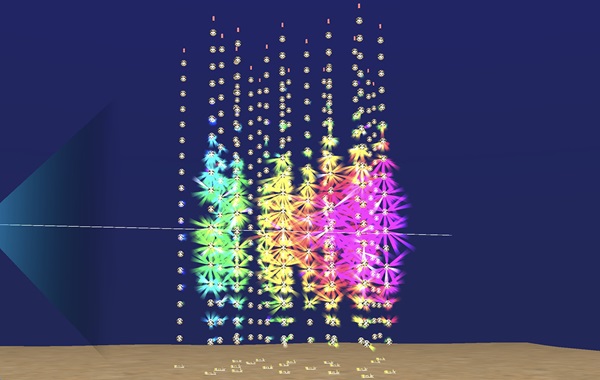
Physicists can detect neutrinos by watching for their extremely rare collisions with atomic nuclei in large volumes of ice or water. The collisions spawn other particles, such as electrons or their heavier cousins, muons, which emit a cone of blue light as they are slowed by the water or ice. From the shape, brightness, and orientation of the cone, determined by an array of light detectors, physicists can estimate the direction and energy of the original neutrino.
IceCube, a U.S.-backed detector that monitors 1 cubic kilometer of ice more than 1.5 kilometers below the South Pole, has detected a wealth of neutrinos including a handful with energies above 1 million billion electron-volts (PeV)—hundreds of times the collision energy in the Large Hadron Collider, the world’s most powerful accelerator. A few have been traced back to active galactic nuclei (AGNs)—distant galaxies that host gigantic black holes, consuming matter at a voracious rate and spewing out particles and energy.
KM3NeT, a European project at two sites in the Mediterranean off the coasts of France and Sicily, relies on water instead. It will eventually have more than 200 strings of spherical light detectors floating in the water, anchored to the seabed. Early in 2023, when the Sicilian array was just 10% complete, the detectors were flooded with light as a particle streamed horizontally through the array 3.5 kilometers below the surface. The brilliance “was a surprise to us and we didn’t believe it at first,” Coyle says. “But it passed all our many, many checks.”
The group now believes the passing particle was a muon sparked by a neutrino that struck an atom in seawater or rock, possibly tens of kilometers away. “It’s quite convincing, in my opinion, that this is a neutrino-induced event,” says Resconi, who is leading an effort to build another water-based neutrino detector called P-ONE off the west coast of Canada. The KM3NeT team estimated the energy of the original neutrino at a record-smashing 220 PeV.

Because the KM3NeT team had not yet deployed a system to pinpoint the array’s position and orientation, it couldn’t trace the neutrino precisely enough to identify a potential source. But the array, now 16% complete, should be finished in the next 5 years and the location system deployed later this year. If more such ultra–high-energy neutrinos can then be found and tracked, they could reveal the locations of the universe’s most powerful particle accelerators.
AGNs are one candidate: If the supermassive black hole is highly magnetized, its swirling field can whip up particles, such as protons or small nuclei, to enormous speeds. When these so-called cosmic rays escape, they can collide with other, slower moving particles, spawning neutrinos.
Some theorists argue for other more short-lived transient events, such as stellar explosions called supernovae, merging neutron stars, or tidal disruption events, in which a supermassive black hole tears a star apart. “There’s extremely strong evidence now that the highest energy cosmic rays, which would then be the candidates for the source of this kind of thing, are produced in transients,” says theorist Glennys Farrar of New York University. In the future, KM3NeT will deploy a system to alert other observers of the possible source location of a high-energy neutrino, in as little as 20 seconds after its detection, so they can chase any transient events there.
A more provocative idea for the source of such high-energy neutrinos is that they come from cosmic rays colliding with photons in the cosmic microwave background, the all-pervasive afterglow of the Big Bang. No one has observed such “cosmogenic” neutrinos before, but one could be inferred if KM3NeT, say, zoomed in on its source to find empty space. The KM3NeT team suggests this might explain the neutrino’s extraordinary energy. Farra suspects the astrophysics community will be very intrigued by that idea, even if it can’t yet be proven.
Excited is indeed the common refrain. “This is kind of the bleeding edge of science we’re dealing with,” says physicist Naoko Kurahashi Neilson of Drexel University, a member of the IceCube team. “We’re starting to learn about it, which is, you know, the dawn before the daylight, right?”
Source: science.org
US scientists design thinner-than-hair sensors to detect high-energy particles
Record-setting neutrino opens ‘new energy window on the universe’/Record-setting neutrino opens ‘new energy window on the universe’