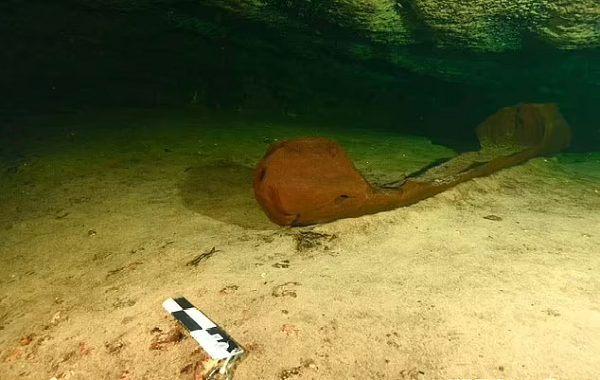
Rare 1100-year-old Maya canoe is found submerged in a freshwater pool in southern Mexico along with a human skeleton, knife and mural painting
A remarkably well-preserved Maya canoe — built for use some 1,100 years ago — has been found in a freshwater pool, or ‘cenote’, in the Yucatán, southern Mexico.
The wooden artefact — more than five feet in length — was found near the ruined city of Chichen Itza by Instituto Nacional de Antropologia e Historia experts.
The archaeologists believe that the canoe was likely used either to aid in extracting water from the cenote, or to help deposit offerings there during rituals.
Alongside the canoe, the pool and adjacent water bodies yielded other finds — including a human and ceramic skeleton, and a hand mural on a rock ceiling.
This mural appears to be significantly older than the canoe, dating back to the Maya Late Postclassic Period, which ran from 1200–1500 CE.
Additionally, the researchers explained, the discoveries of a sculpted stone stela, ritual knife and 40 broken vessels indicate that the cenote was long a site for rituals.
A remarkably well-preserved Maya canoe (pictured) — built for use some 1,000 years ago — has been found in a freshwater pool, or ‘cenote’, in the Yucatán, southern Mexico.
The archaeologists believe that the canoe was likely used either to aid in extracting water from the cenote (pictured), or to help deposit offerings there during rituals.
Alongside the canoe, the pool and its surrounds have yielded other finds — including a human and ceramic skeleton, as well as a mural of painted hands on a rock ceiling. Pictured: the researchers explore underground at the cenote site.
Additionally, the researchers explained, the discoveries of a sculpted stone stela, ritual knife and 40 broken vessels indicate that the cenote was long a site for rituals.
THE CANOE: STATS
Length: 5.2 feet (160 centimetres)
Width: 2.6 feet (80 centimetres)
Height: 1.3 feet (40 centimetres)
Age: Estimated at 1191–1071 years
Material: Hardwood
Provenance: Yucatán, Mexico
This is discernible, she explained, ‘not only because of the intentionally fragmented pottery, but also because of the remains of charcoal that indicate their exposure to fire and the way they placed stones on top of them to cover them.’
Furthermore, Ms Barba Meinecke noted, the fact that the pottery remains come in various different styles dating from different time periods indicates that the site was used for rituals over the course of many centuries.
‘The relevance lies in the fact that it is the first canoe of this type that is complete and so well preserved in the Mayan area,’ she continued.
‘There are also fragments of these boats and oars in Quintana Roo, Guatemala and Belize.’
Source: daily mail
Startling Discovery Reveals Mysterious Citadel Hidden in Ancient Maya City
Startling Discovery Reveals Mysterious Citadel Hidden in Ancient Maya City
Rare 1100-year-old Maya canoe is found submerged in a freshwater pool in southern Mexico along with a human skeleton, knife and mural painting/Rare 1100-year-old Maya canoe is found submerged in a freshwater pool in southern Mexico along with a human skeleton, knife and mural painting