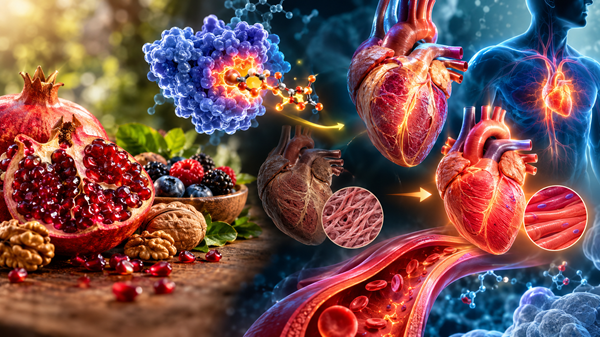
Pomegranates Unlock New Heart Failure Treatment: Urolithin A Improves Heart Function by 80%
Heart Failure with Preserved Ejection Fraction: A Growing Challenge
Could a simple fruit hold the key to treating a devastating condition? Heart failure with preserved ejection fraction (HFpEF) affects roughly half of all heart failure cases in the UK—nearly five hundred thousand people. Unlike classic heart failure, the heart pumps normally but fails to relax and fill properly between beats. This stiffness leads to breathlessness, fatigue, and poor quality of life. Treatment options remain frustratingly limited. Why? Because HFpEF arises from multiple factors: aging, high blood pressure, and diabetes. Conventional therapies often fall short. Clinicians instead manage underlying conditions and recommend lifestyle changes. But what if a natural compound could directly target the root problem?
Urolithin A: A Compound Produced After Eating Pomegranates
Scientists at King’s College London turned their attention to urolithin A. This compound is produced by the body after consuming pomegranates, walnuts, and some berries. Previous research linked urolithin A to healthy aging and mitochondrial function. However, its role in heart relaxation was unknown. The team discovered something remarkable: urolithin A activates a protein called PKGlα. This protein contributes to blood vessel function and heart muscle relaxation. Specifically, the compound acts on a particular amino acid within PKGlα, triggering a cardiovascular benefit pathway. Could this be the missing link in HFpEF treatment?
Experimental Models Show Up to 80% Improvement in Heart Function
In animal models of HFpEF, urolithin A improved measures of heart function by up to eighty percent compared to untreated controls. How? The compound helped heart tissue relax more effectively. It also reduced fibrosis—the harmful buildup of scar tissue. Furthermore, it limited enlargement of heart muscle cells, preserving normal cellular function. These changes directly address the stiffness that defines HFpEF. But would the same effects occur in human tissue? The researchers tested urolithin A on engineered human heart tissue made from stem cells. This laboratory model closely mimics human heart muscle structure and function. Remarkably, treatment significantly improved relaxation in this tissue too. Consequently, the evidence strongly suggests relevance to human heart function.
A Safe Compound Already Tested in Humans
Unlike many experimental compounds, urolithin A has already undergone human studies. It shows a favorable safety profile. This advantage could accelerate translation into clinical practice. Nevertheless, more research is required before doctors can prescribe it. The findings identify both a novel therapeutic target—PKGlα—and a naturally derived compound that activates it. Dr. Joseph Burgoyne, senior author and cardiovascular scientist at King’s College London, stated: “This type of heart failure remains one of the most challenging forms of heart disease to treat. Our findings identify a completely new therapeutic target and show that urolithin A can activate this pathway to improve heart relaxation and reduce disease severity.” He added: “While there isn’t enough evidence to suggest that people should eat pomegranates to treat heart failure, these findings raise the possibility that dietary approaches that enhance urolithin A production may help alleviate this condition.”
Questions That Remain: From Lab to Clinic
How soon might patients benefit? Human trials are the next essential step. Researchers need to determine optimal dosing, long-term effects, and whether urolithin A works across diverse patient groups. Professor James Leiper, Director of Research at the British Heart Foundation, cautioned: “This early-stage study in experimental models suggests that urolithin A may help to improve the heart tissue’s ability to relax and fill with blood between beats. While these findings are promising, clinical trials involving people are needed to test if this approach is effective for patients.” He also emphasized that a healthy, balanced diet remains vital—no single food can prevent or treat heart disease alone.
Expanding the Science: How Urolithin A Works at the Molecular Level
To understand the mechanism, consider the protein PKGlα. This enzyme regulates smooth muscle relaxation in blood vessels and cardiac muscle. In HFpEF, oxidative stress impairs PKGlα function. Urolithin A directly modifies a specific cysteine residue within PKGlα, restoring its activity. This activation then triggers a cascade that reduces calcium sensitivity in heart muscle cells, allowing them to relax more fully. Additionally, urolithin A reduces inflammation and oxidative stress, which contribute to fibrosis and stiffness. In essence, the compound addresses multiple pathological pathways simultaneously. That makes it a promising candidate for a complex, multifactorial disease.
Source: Pomegranates Unlock New Heart Failure Treatment: Urolithin A Improves Heart Function by 80%
JWST Captures Stunning Evidence of How Supermassive Black Holes Feed
JWST Captures Stunning Evidence of How Supermassive Black Holes Feed
Sources and Further Reading
King’s College London press release (2025). Pomegranates Could Unlock a New Treatment for Heart Failure.
British Heart Foundation commentary by Professor James Leiper.
Burgoyne, J. et al. (2025). Urolithin A activates PKGlα to improve diastolic function in HFpEF. Journal of Cardiovascular Research.