
Physicists Observe Matter in Two Places at Once in Mind-Bending Quantum Experiment
ANU researchers show that atoms can exhibit quantum entanglement, advancing efforts to unify physics.
Quantum physicists at the Australian National University (ANU) have achieved a major milestone by directly observing atoms behaving in an entangled state while in motion, providing strong evidence that quantum effects are not limited to light particles, but also apply to matter with mass.
Quantum entanglement is a phenomenon in which particles become linked so that the state of one instantly influences the state of another, no matter how far apart they are. While this effect has been widely demonstrated using photons (particles of light), extending it to atoms, objects with mass that interact with gravity, has proven far more difficult.
“It’s really weird for us to think that this is how the Universe works,” says Dr Sean Hodgman from the ANU Research School of Physics. “You can read about it in a textbook, but it’s really weird to think that a particle can be in two places at once.”
In this experiment, the team used helium atoms to demonstrate entanglement, marking a significant step forward compared to earlier studies that focused mainly on photons, which are particles of light.
Unlike photons, helium atoms possess mass and are influenced by gravity, making them far more challenging to study in quantum experiments.
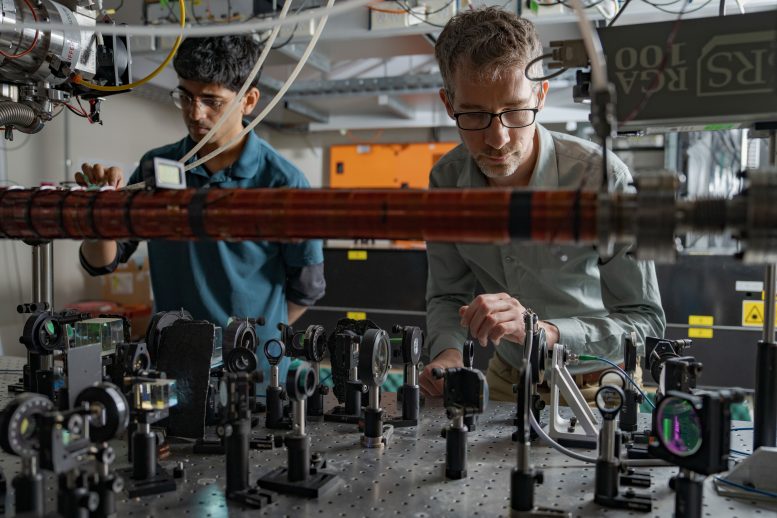
Massive atoms extend quantum tests
“Experimentally, it’s extremely hard to demonstrate this,” says lead author and PhD researcher, Yogesh Sridhar. “Several people have tried in the past to show these effects, and they have always come short.”
This achievement opens new possibilities for investigating one of the most fundamental questions in physics: how quantum mechanics at the smallest scales connects with gravity and general relativity at the scale of the universe.
“This result confirms the predictions of over a century ago that matter can be in two locations at once, and it can interfere with itself even in those locations,” says Dr Sean Hodgman.
Findings point toward unified physics
By demonstrating quantum entanglement in atoms, scientists may be moving closer to understanding whether a unified framework of physics, often referred to as the “Theory of Everything,” is achievable.
Source: SciTechDaily
Femtosecond Collapse of Quantum States: Decoding the Invisible Bridge to Reality
Physicists Observe Matter in Two Places at Once in Mind-Bending Quantum Experiment