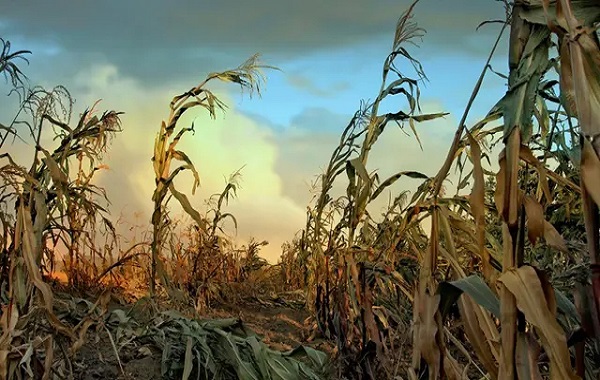
Nuclear winter could decimate 87% of global corn, trigger catastrophic global famine: Study
A recent study modeled the catastrophic impact of a nuclear winter on global corn production.
A nuclear winter could occur after a large-scale nuclear war.
If this kind of war ever occurs, then the resulting firestorms would inject massive amounts of smoke and soot into the atmosphere. This dense, dark cloud would act like a global blanket, blocking out the sun.
As a result, there would be a dramatic drop in global temperatures, potentially lasting for over a decade.
And with that drop, most agriculture as we know it would vanish, leaving survivors to face widespread famine.
The Penn State team peered into this grim future.
They modeled how various nuclear winter scenarios could impact global production of corn, which is one of the most widely planted grain crops around the globe.
“We simulated corn production in 38,572 locations under the six nuclear war scenarios of increasing severity — with soot injections ranging from 5 million to 165 million tons,” said Yuning Shi, first author and associate research professor in Penn State’s Department of Plant Science.
“This investigation advances our understanding of global agricultural resilience and adaptation in response to catastrophic climatic disruptions,” Shi said.
Global war impact
The findings suggest that a regional nuclear war might eject about 5.5 million tons of soot into the atmosphere. It could slash worldwide annual corn production by 7%.
That might not sound catastrophic, but even a 7% drop would severely impact the global food system and economy, escalating food insecurity and hunger for millions.
Furthermore, an 80% decrease in annual corn yields could result from a major global war, which would inject an immense 165 million tons of soot into the atmosphere.
The simulations were made possible by the Cycles agroecosystem model.
This model uses high-performance computing to conduct detailed, multi-year simulations of crop growth by precisely tracking how carbon and nitrogen move through the soil, plants, and atmosphere.
The researchers also considered another terrifying factor: UV-B radiation.
Nuclear war would unleash nitrogen oxides into the stratosphere, rapidly destroying the ozone layer – our planet’s natural UV shield.
This would unleash harmful UV-B radiation, damaging plant tissue and further impacting food production.
Researchers estimated that UV-B radiation could cause an additional 7% reduction in corn production, driving the worst-case scenario to an 87% overall drop. They predict this radiation would peak six to eight years after a global war.
Agricultural resilience kits
So, is there any hope? The Penn State team offers a glimmer.
The team says that the current corn varieties would be destroyed, but utilizing faster-growing, cold-adapted crops could increase global food production by 10% compared to doing nothing.
Moreover, they propose “agricultural resilience kits.”
These would be pre-prepared kits containing region- and climate-specific seeds for crop varieties that can thrive in cooler conditions with shorter growing seasons.
“These kits would help sustain food production during the unstable years following a nuclear war, while supply chains and infrastructure recover,” said Armen Kemanian, professor of production systems and modeling and corresponding author.
Kemanian added, “The agricultural resilience kits concept can be expanded to other disasters — when catastrophes of these magnitude strike, resilience is of the essence.”
Shi acknowledged that while global cooperation on these kits is improbable, raising awareness alone could improve preparedness. He stressed that readiness for even unimaginable events is crucial for survival.
Source: Interesting Engineering
Japan eyes nuclear revival with first new reactor plan since Fukushima disaster
Nuclear winter could decimate 87% of global corn, trigger catastrophic global famine: Study