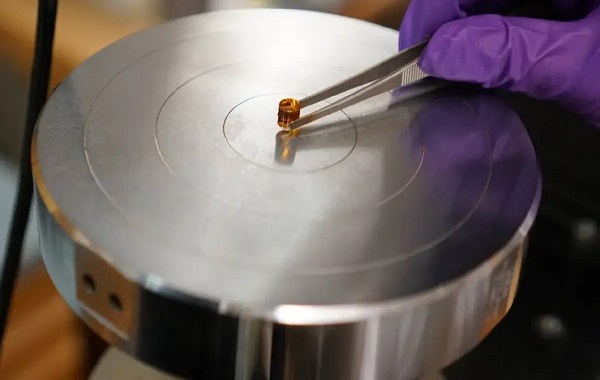
New gel could produce biodegradable implants for joint injuries
Human articular cartilage is essential to smooth joint movement. Once damaged it can lead to pain, reduced function, and even arthritis.
Today, scientists treat this condition by implanting artificial scaffolds made of proteins that help the cartilage regenerate itself as the scaffolds biodegrade. In order to see the cartilage successfully regenerate, however, the scaffold must be able tomimic the biological properties of cartilage, something that has proven difficult to do.
Now, researchers have come up with a method to achieve these properties found in nature in a man-made biodegradable gel.
This is according to a press release by the University of British Columbia published Wednesday.
“Cartilage is tricky,” says senior author Dr. Hongbin Li, a professor in the UBC department of chemistry. “
Biodegradable cartilage implants must be tough enough to resist being bent or deformed but soft enough to be useful in a joint. This is a combination that is hard to achieve.
Dr. Li and his team engineered a new method for stiffening a soft protein gel without sacrificing its toughness, by physically tangling together the chains of a particular protein that make up the gel’s network.
“These entangled chains can move, which allows energy, for instance, the impact from jumping, to be dissipated, just like shock absorbers in bikes. In addition, we combined this with an existing method of folding and unfolding proteins, which also allows for energy dissipation,” explained first author Dr. Linglan Fu, who conducted the research as a doctoral student at UBC’s department of chemistry.
The outcome was a gel with some pretty neat properties. It could resist compression at the same level as actual articular cartilage and could rapidly recover its original shape after compression.
The researchers then implanted rabbits with the gel. The animals showed notable signs of repair of articular cartilage 12 weeks after implantation.
The scientists however noted that they needed to balance stiffness and softness as the stiffest gel did not work as well.
“This just shows how complex this area of research is, and the need to take into account the many different physical and biochemical cues and factors when designing these scaffolds,” said co-author Dr. Qing Jiang, a professor and surgeon at Nanjing University.
The research is still too premature for human trials but next steps will consist of fine-tuning the current gel composition and adding additional biochemical cues to further promote cell regeneration.
“By optimizing both biochemical and biomechanical cues together, we will see in the future whether these new scaffolds can lead to even better outcomes,” Dr. Li concluded in the statement.
Source: Interesting Engineering
Scientists Find Cannabis Compound Inside a Totally Different Plant
Scientists Find Cannabis Compound Inside a Totally Different Plant
New gel could produce biodegradable implants for joint injuries