NASA’s Insight mission has ENDED: Mars lander declared a ‘dead bus’ after its solar-powered batteries ran out of energy
NASA has bid farewell to Insight after more than four years of service.
Mission controller announced the demise of the Mars lander Wednesday after two failed attempts to contact the craft.
The team at NASA’s Jet Propulsion Laboratory (JPL) said the cause of death was the craft’s batteries that ran out of power – a state engineers call a ‘dead bus.’
The last time the lander communicated with Earth was December 15, but mission control had previously decided to declare the mission over if Insight missed two communications attempts.
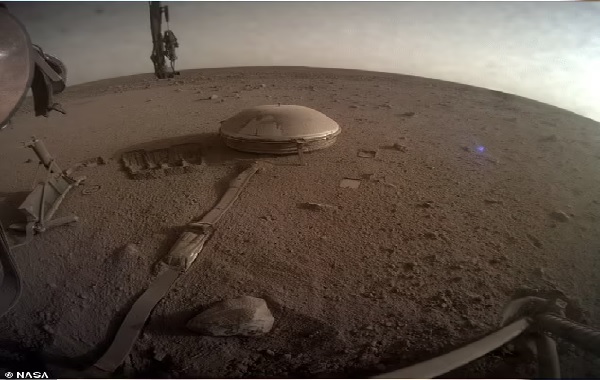
The official Insight Twitter account posted Tuesday what was believed to be the last photo snapped by the Mars lander.
Insight detected more than 1,300 marsquakes with its French-built seismometer, including several caused by meteoroid strikes, since landing on Mars in 2018.
Thomas Zurbuchen, associate administrator of NASA’s Science Mission Directorate in Washington, said in a statement: ‘I watched the launch and landing of this mission, and while saying goodbye to a spacecraft is always sad, the fascinating science InSight conducted is cause for celebration.
‘The seismic data alone from this offers tremendous insights not just into Mars but other rocky bodies, including Earth.’
Insight’s final image shows its seismometer, the Seismic Experiment for Interior Structure (SEIS), a round, dome-shaped instrument.
SEIS has been sitting on the Martian surface to take its ‘pulse,’ or seismic vibrations, and provide a glimpse into the planet’s internal activity.
InSight also carries two engineering cameras – one mounted on the arm (known as IDC) and the other on the front of the lander (known as ICC), which took this final image.
Earlier this summer, the lander had so little remaining power that the mission turned off Insight’s other science instruments to keep the seismometer running.
NASA even turned off the fault protection system that would otherwise automatically shut down the seismometer if the system detected that the lander’s power generation was dangerously low.
Insight was tasked with studying the deep interior of Mars to learn how all celestial bodies with rocky surfaces formed, including those on Earth and the moon.
It was only meant to operate for two years, but its mission was extended to four years after it was found to have ‘produced exceptional science’ by an independent review panel.
Even from the mission’s outset, it was clear to NASA staff that it wouldn’t be as long-lasting as some of the agency’s other projects.
After more than four years, 1,300 marsquakes, and countless scientific discoveries, our @NASAInSight lander has reached the end of its mission.
InSight may be retiring, but its legacy—and its findings from the deep interior of Mars—will live on: https://t.co/8884Slrbxr pic.twitter.com/UKozd4P28g
— NASA (@NASA) December 21, 2022
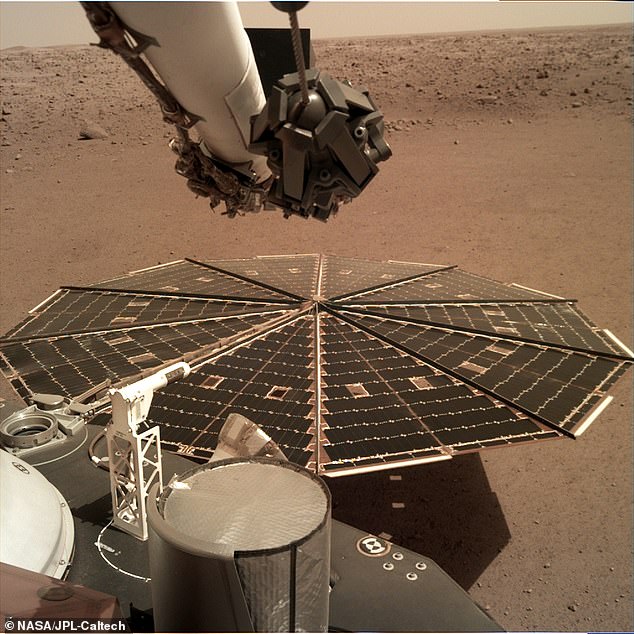
It was known that its solar panels would eventually get covered in Martian dust, making it hard to generate power.
NASA said fitting it with some mechanism that removed the dust ‘would have added cost, mass and complexity’ that could have hindered its success.
The American space agency said the scientific results and discoveries obtained by Insight ‘has answered many questions, and posed new ones for future explorers.’
These include the detection of the first quakes on another planet, including the most recent one in May this year.
This marsquake had an estimated magnitude of 5, with vibrations reverberating through the planet for at least six hours.
Insight also showed that the planet’s crust is thinner than expected – about 15 to 25 miles (25 to 40 kilometers) thick, comprising three internal layers.
Laurie Leshin, director of JPL, which manages the mission, said: ‘InSight has more than lived up to its name.
‘As a scientist who’s spent a career studying Mars, it’s been a thrill to see what the lander has achieved, thanks to an entire team of people across the globe who helped make this mission a success.
‘Yes, it’s sad to say goodbye, but InSight’s legacy will live on, informing and inspiring.’
Source: daily mail
What it would take to discover life on Saturn’s icy moon Enceladus
What it would take to discover life on Saturn’s icy moon Enceladus
NASA’s Insight mission has ENDED: Mars lander declared a ‘dead bus’ after its solar-powered batteries ran out of energy