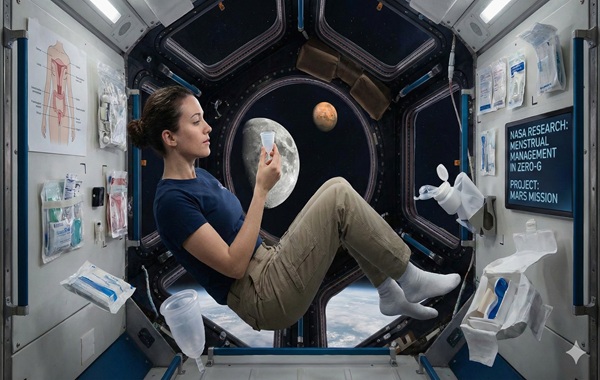
NASA’S BLOODIEST OVERSIGHT: The Taboo “Bio-Hazard” That Could Doom a Trip to Mars
We can land rovers on asteroids and telescope into the beginning of time. Yet, for decades, NASA has struggled to solve a basic biological reality that affects half the human race.
As the agency gears up for the Artemis moon base and the inevitable voyage to Mars, engineers are scrambling to fix a messy, logistical nightmare that was ignored for far too long: How do you handle menstruation in a tin can floating in a vacuum?
The “Retrograde” Panic
For years, the “Period Problem” was shrouded in silence and bad science. In the early days of spaceflight, male engineers genuinely feared that in zero gravity, menstrual blood might flow upward into the abdomen (retrograde menstruation), potentially killing female astronauts.
Spoiler alert: They were wrong. The blood flows just fine. The real problem isn’t physiology—it is waste management.
The Math of a Mars Mission Nightmare
Here is the unglamorous reality of deep space travel: There are no trash cans, and every ounce of cargo costs millions.
For a three-year round trip to Mars, a menstruating astronaut would need approximately 1,100 tampons or pads. That isn’t just a storage issue; it is a bio-hazard ticking time bomb. In the sealed, recycled ecosystem of a spacecraft, storing pounds of blood-soaked waste for months on end poses a massive hygiene risk. You can’t just open a window and toss it out.
The “Pause Button” vs. The “Space Cup”
Until recently, the preferred solution was drastic: Chemical suppression. Most female astronauts currently take continuous hormones to simply turn their periods off. But relying on a lifetime supply of pills in deep space is risky. What if the supply degrades? What are the long-term bone density side effects?
Enter NASA’s new hope: The Menstrual Cup. It sounds simple, but in zero-g, it’s revolutionary. A reusable medical-grade silicone cup solves the waste problem instantly. But it introduces a new one: Water. Cleaning a cup requires precious water, and in a spaceship where urine is recycled into drinking water, every drop counts.
Dignity in the Void
NASA is finally admitting that “Man” on the Moon was literal for too long. The new report highlights that this isn’t just about plumbing; it’s about autonomy and dignity.
If humanity wants to become a multi-planetary species, we have to accept that our biology comes with us. The rocket science is ready. The question remains: Is the plumbing ready for women?
Source: timesofindia
NASA’S BLOODIEST OVERSIGHT: The Taboo “Bio-Hazard” That Could Doom a Trip to Mars