NASA Mars rover begins collecting rock in search of alien life
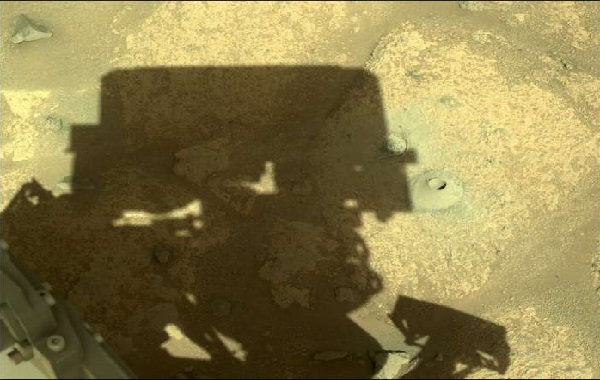
NASA’s Perseverance rover has begun drilling into the surface of Mars and will collect rock samples to be picked up by future missions for analysis by scientists on Earth.
The US space agency published images Friday of a small mound with a hole in its center next to the rover—the first ever dug into the Red Planet by a robot.
“Sample collection has begun!” tweeted Thomas Zurbuchen, associate administrator for NASA’s science mission directorate.
The drill hole is the first step of a sampling process that is expected to take about 11 days, with the aim of looking for signs of ancient microbial life that may have been preserved in ancient lakebed deposits.
Scientists also hope to better understand the Martian geology.
The mission took off from Florida a little over a year ago and Perseverance, which is the size of a large family car, landed on February 18 in the Jezero Crater.
Scientists believe the crater contained a deep lake 3.5 billion years ago, where the conditions may have been able to support extraterrestrial life.
NASA plans a mission to bring around 30 samples back to Earth in the 2030s, to be analyzed by instruments that are much more sophisticated than those that can be brought to Mars at present.
Source:https://phys.org/news/2021-08-nasa-mars-rover-alien-life.html
Mars has right ingredients for present-day microbial life beneath its surface, study finds
As NASA’s Perseverance rover begins its search for ancient life on the surface of Mars, a new study suggests that the Martian subsurface might be a good place to look for possible present-day life on the Red Planet.
The study, published in the journal Astrobiology, looked at the chemical composition of Martian meteorites—rocks blasted off of the surface of Mars that eventually landed on Earth. The analysis determined that those rocks, if in consistent contact with water, would produce the chemical energy needed to support microbial communities similar to those that survive in the unlit depths of the Earth. Because these meteorites may be representative of vast swaths of the Martian crust, the findings suggest that much of the Mars subsurface could be habitable.
NASA Mars rover begins/NASA Mars rover begins