
Mysteries of the Mongolian Arc: Gaps hint at unexpected purpose of ancient wall
A team of archaeologists from the Hebrew University of Jerusalem in Israel, collaborating with a researcher from the National University of Mongolia, has undertaken a comprehensive study of the enigmatic 405-kilometer wall system in eastern Mongolia, known as the Mongolian Arc. This study, published in the Journal of Field Archaeology, aims to shed light on the historical context and purpose of this intriguing structure.
The Mongolian Arc, an extension of the Great Wall of China that stretches into Mongolia, has long been a subject of curiosity due to its shape and limited exploration. Unlike its more renowned counterpart in China, this section of the wall has received minimal scholarly attention until now. To delve into its history and significance, the research team employed diverse methodologies and technologies.
Their investigation involved mapping the wall’s trajectory, spanning from Dornod Province to Sukhbaatar Province, tracing the border between Mongolia and China. Previous research indicates that this wall consists of 34 structures, constructed using earthen walls and trenches. However, historical records regarding its construction timeframe remain unclear, dating its origin between the 11th and 13th centuries.
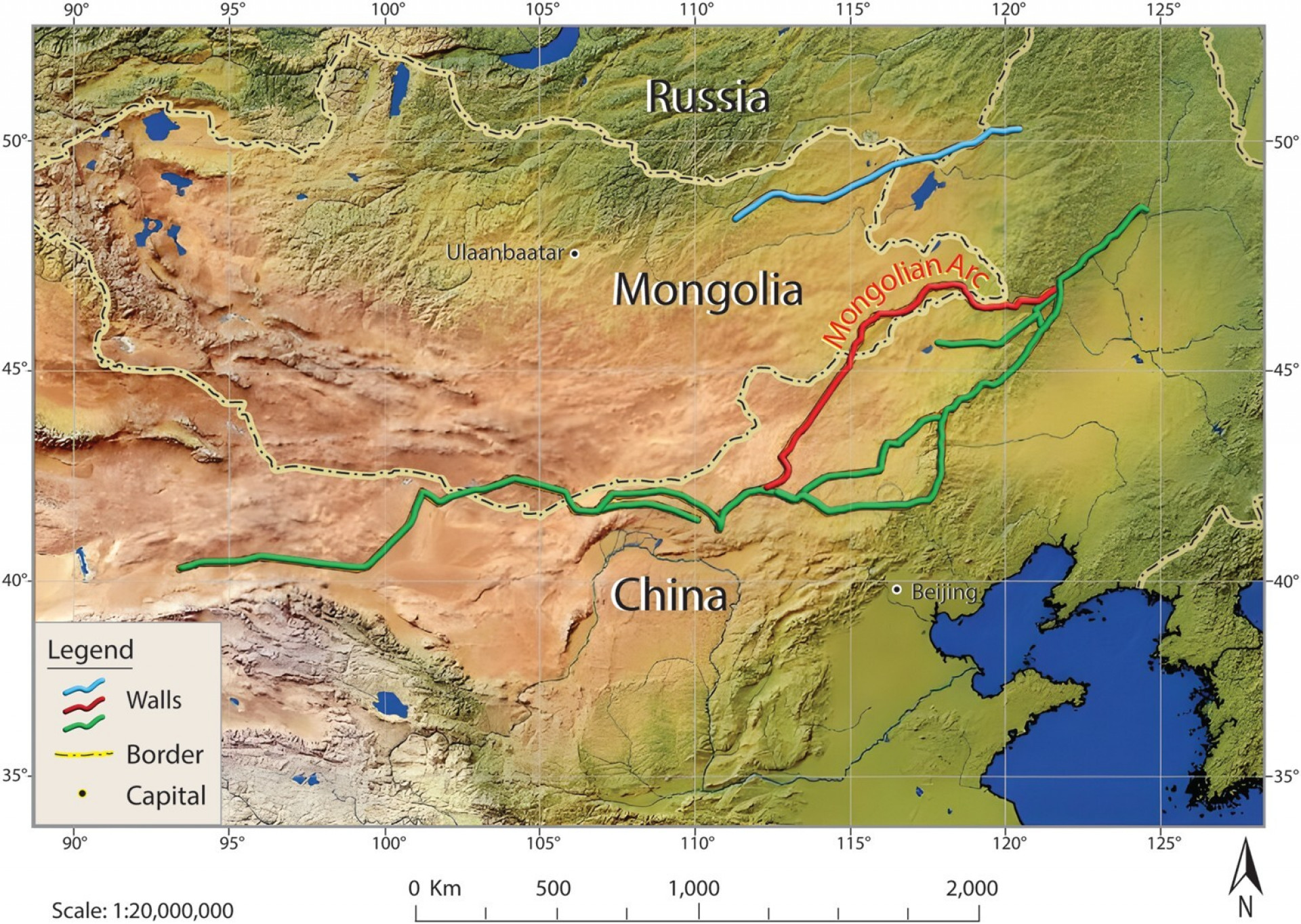
The team’s interdisciplinary approach encompassed examining weather records, and satellite imagery, and conducting on-site field studies to assess the wall’s composition, condition, and relationship with the surrounding terrain. Their findings uncovered intriguing insights, revealing unexpected gaps in the wall that imply a purpose distinct from being a comprehensive barrier against invaders. These lacunae suggest rapid construction in response to specific threats rather than serving as an impenetrable defense.
The team’s discoveries present compelling theories about the wall’s potential function, including its role in controlling the movement of people or animals or even its involvement in a taxation system. Notably, the placement of many outposts along the wall in areas with limited visibility into the surrounding territory adds complexity to understanding its purpose.
Absence of definitive answers.
Despite their efforts, the researchers acknowledge the absence of definitive answers regarding the wall’s construction rationale and an accurate timeline. However, they remain committed to further exploration, intending to unravel more mysteries surrounding this historical structure.
This study of the Mongolian Arc resonates with broader discussions about the historical construction of border walls worldwide. Drawing parallels to contemporary examples like the “Trump Wall” on the US-Mexico border and internal borders within the European Union, these findings underscore the enduring relevance of understanding ancient border constructions.
The investigation into the Mongolian Arc, part of a larger project studying extensive wall systems in China and Mongolia, aims to address fundamental questions about the motivations behind constructing such monumental barriers. By employing geographic information systems (GIS) and leveraging historical sources, the research seeks to unravel the socio-political, economic, and environmental impacts of these ancient structures, offering crucial insights into their functionality, duration of use, and eventual abandonment.
This research, albeit with mysteries, marks a significant step towards unraveling the complexities of historical border constructions and their enduring legacies in shaping societies and landscapes.
Source: Interesting Engineering
Evidence of 8,500-Year-Old Head Surgery Excavated at Çatalhöyük
Mysteries of the Mongolian Arc: Gaps hint at unexpected purpose of ancient wall