Modern-Day Alchemy: Transforming Sugar Into Hydrocarbons To Power Future Cars
In a new study, genetically engineered E. coli eat glucose, then help turn it into molecules found in gasoline
It sounds like modern-day alchemy: Transforming sugar into hydrocarbons found in gasoline.
But that’s exactly what scientists have done.
In a study in Nature Chemistry, researchers report harnessing the wonders of biology and chemistry to turn glucose (a type of sugar) into olefins (a type of hydrocarbon, and one of several types of molecules that make up gasoline).
The project was led by biochemists Zhen Q. Wang at the University at Buffalo and Michelle C. Y. Chang at the University of California, Berkeley.
The paper, which was published on November 22, 2021, marks an advance in efforts to create sustainable biofuels.
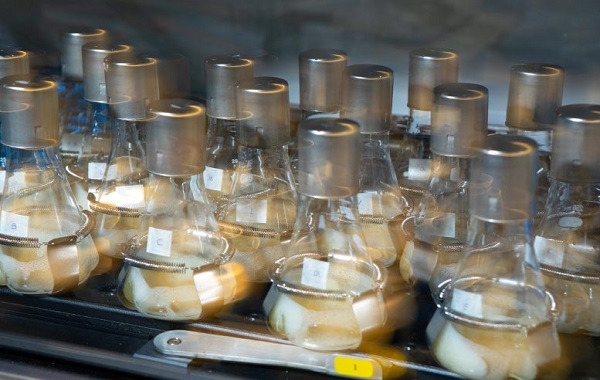
To complete the study, the researchers began by feeding glucose to strains of E. coli that don’t pose a danger to human health.
“These microbes are sugar junkies, even worse than our kids,” Wang jokes.
The E. coli in the experiments were genetically engineered to produce a suite of four enzymes that convert glucose into compounds called 3-hydroxy fatty acids. As the bacteria consumed the glucose, they also started to make the fatty acids.
The scientists identified the enzymes and catalyst through trial and error, testing different molecules with properties that lent themselves to the tasks at hand.
“We combined what biology can do the best with what chemistry can do the best, and we put them together to create this two-step process,” says Wang, PhD, an assistant professor of biological sciences in the UB College of Arts and Sciences. “Using this method, we were able to make olefins directly from glucose.”
Glucose comes from photosynthesis, which pulls CO2 out of the air
“Making biofuels from renewable resources like glucose has great potential to advance green energy technology,” Wang says.
“Glucose is produced by plants through photosynthesis, which turns carbon dioxide (CO2) and water into oxygen and sugar. So the carbon in the glucose — and later the olefins — is actually from carbon dioxide that has been pulled out of the atmosphere,” Wang explains.
More research is needed, however, to understand the benefits of the new method and whether it can be scaled up efficiently for making biofuels or for other purposes. One of the first questions that will need to be answered is how much energy the process of producing the olefins consumes; if the energy cost is too high, the technology would need to be optimized to be practical on an industrial scale.
Scientists are also interested in increasing the yield. Currently, it takes 100 glucose molecules to produce about 8 olefin molecules, Wang says. She would like to improve that ratio, with a focus on coaxing the E. coli to produce more of the 3-hydroxy fatty acids for every gram of glucose consumed.
Source: SciTechDaily
Key to carbon-free cars? Look to the stars
Modern-Day Alchemy: Transforming Sugar Into Hydrocarbons To Power Future Cars