
MIT captures first image of free-range atoms, can help visualize quantum phenomena
Scientists from the Massachusetts Institute of Technology (MIT) in the U.S. have made a groundbreaking achievement after they captured the first images of individual atoms freely interacting in space.
The images, which show interactions between free-range particles that had only been theorized until now, will reportedly allow the scientists to directly observe quantum phenomena in real space.
To capture detailed images of the atomic interactions, the team, led by Martin Zwierlein, PhD, an MIT physicist and lead author of the study, developed a novel technique that allows the atoms to move freely before briefly freezing and illuminating them to capture their positions.
The team used the technique to observe clouds of various atom types, capturing several groundbreaking images for the first time.
“We are able to see single atoms in these interesting clouds of atoms and what they are doing in relation to each other, which is beautiful,” Zwierlein said.
Exploring the cloud
Atoms are among the tiniest building blocks of the universe, each just one-tenth of a nanometer wide or roughly a million times thinner than a strand of human hair. They additionally follow the strange rules of quantum mechanics making their behavior incredibly difficult to observe and understand.
It’s impossible to know both an atom’s exact position and its speed at the same time – a fundamental principle of quantum physics known as the Heisenberg uncertainty principle.
This uncertainty has long challenged scientists trying to observe atomic behavior directly, however, traditional imaging methods, such as absorption imaging, provide only a blurry view, capturing the overall shape of an atom cloud but not the atoms themselves.
Now, to overcome the challenge, the team developed a new approach called atom-resolved microscopy, which begins by allowing a cloud of atoms to move and interact freely within a loose laser trap.
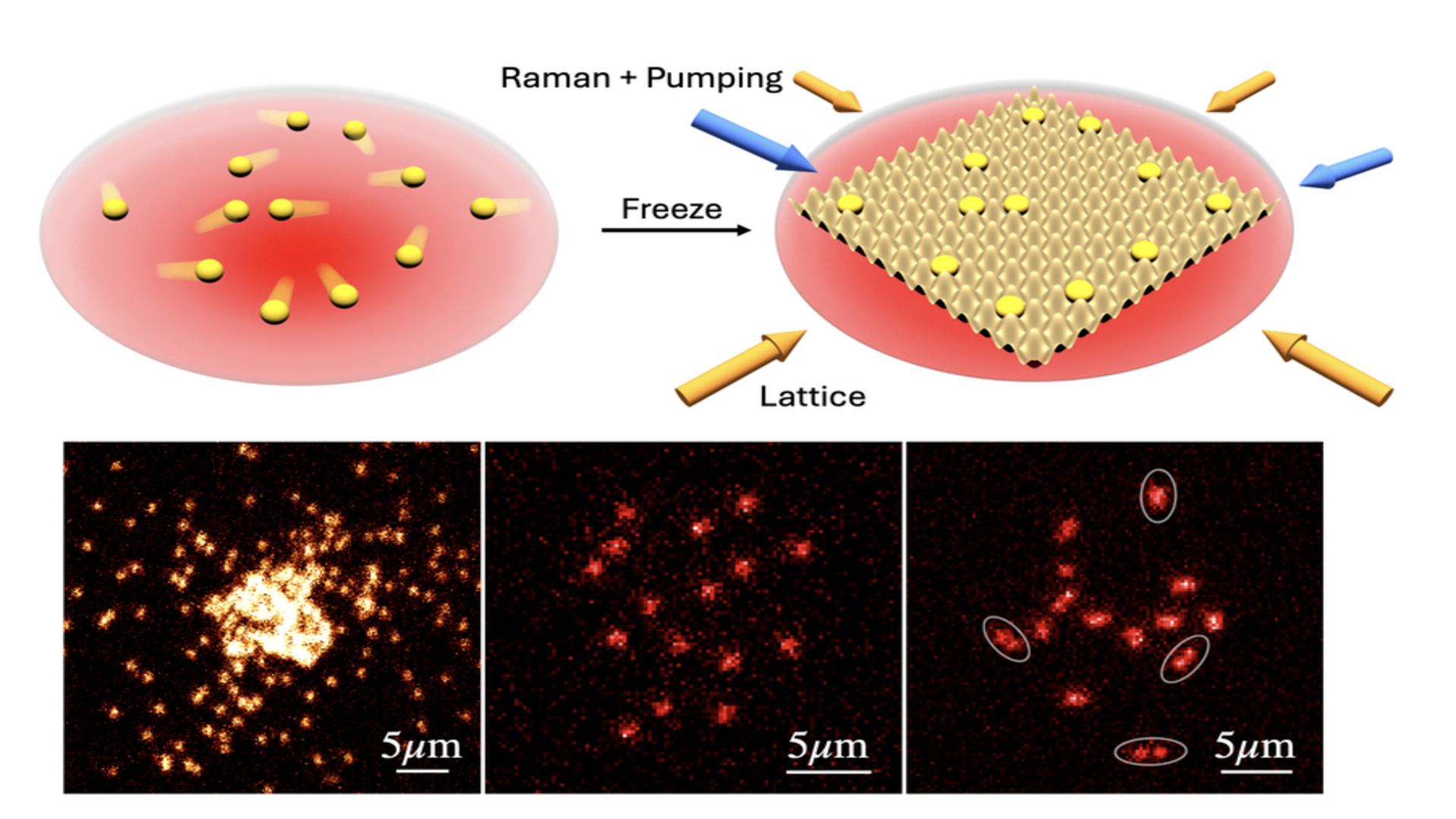
The researchers then switch on a lattice of light to freeze the atoms in place and use a finely tuned laser to illuminate them, causing the atoms to fluoresce – a state when an atom or molecules relaxes through vibrational relaxation to its ground state after being electrically excited – and reveal their exact positions.
Capturing this light without disturbing the delicate system was no small feat. “You can imagine if you took a flamethrower to these atoms, they would not like that,” Zwierlein explained. “So, we’ve learned some tricks through the years on how to do this.”
According to the physicist, what truly makes the technique more powerful than previous methods is that it’s the first time they’ve done it in situ by freezing atoms’ motion as they strongly interact and observing them one after another.
Quantum snapshots
Zwierlein and his colleagues used their new imaging technique to capture quantum interactions between two fundamental types of particles: bosons and fermions.
Bosons – among which photons, gluons, the Higgs boson, and the W and Z bosons – which tend to attract, were observed bunching together in a cloud of sodium atoms at low temperatures, forming a Bose-Einstein condensate (BEC) where all particles share the same quantum state.
This confirmed a long-standing prediction based on Louis de Broglie’s theory that boson bunching is a direct result of their ability to share one quantum wave – a hypothesis known as the de Broglie wave, which helped spark the rise of modern quantum mechanics.
“We understand so much more about the world from this wave-like nature,” Zwierlein stated. “But it’s really tough to observe these quantum, wave-like effects. However, in our new microscope, we can visualize this wave directly.”
The researchers also imaged a cloud with two types of lithium atoms, each a fermion that typically repels others of its kind but can strongly interact with specific other fermion types. They then captured these opposite fermions pairing up, revealing a key mechanism behind superconductivity.
They now plan to apply the technique to explore more complex and less investigated quantum states, including the puzzling behaviors seen in quantum Hall physics. These include scenarios where interacting electrons exhibit unusual correlated behaviors under the influence of a magnetic field.
“That’s where theory gets really hairy – where people start drawing pictures instead of being able to write down a full-fledged theory because they can’t fully solve it,” Zwierlein concludes in a press release. “Now we can verify whether these cartoons of quantum Hall states are actually real. Because they are pretty bizarre states.”
Source: Interesting Engineering
Physicists develop new molecule that could shrink and speed up computers even more
MIT captures first image of free-range atoms, can help visualize quantum phenomena