
Merging quasars from 900 million years after Big Bang discovered
The most distant pair of merging quasars have been spotted only 900 million years after the Big Bang.
This period, called Cosmic Dawn, saw the birth of the first stars and galaxies, filling the previously dark universe with light. It was also when these young galaxies were more likely to bump into each other and merge.
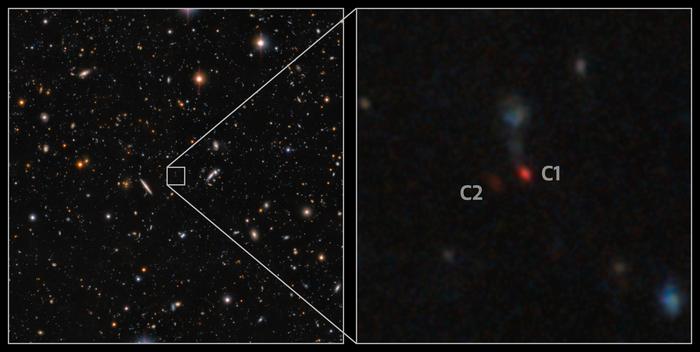
Using the Subaru Telescope, researchers discovered a faint red patch that turned out to be a pair of quasars. Follow-up observations with strong instruments on Gemini North confirmed their nature.
“While screening images of quasar candidates I noticed two similarly and extremely red sources next to each other. The discovery was purely serendipitous,” said Yoshiki Matsuoka, an astronomer at Ehime University in Japan and lead author.
Quasars are incredibly bright and powerful objects powered by supermassive black holes feeding on gas and dust.
First merging quasars from cosmic dawn
After the Big Bang, the universe was just a fraction of its current size. The galaxies were much closer together in the early universe. With closer proximity, galaxies were more likely to collide and merge due to gravitational forces.
Earlier, astronomers predicted that this merger may trigger the formation of quasars. However, the space community was surprised to find no such merging quasar pairs in the early universe — until this discovery.
Interestingly, this is the first confirmed case of two merging quasars in the Cosmic Dawn. The Cosmic Dawn began around 50 million years ago and continued up to one billion years after the Big Bang. During this timeframe, the young universe witnessed the formation of the first stars and galaxies.
This epoch, known as the Reionization Era, marked a turning point in cosmic evolution. This discovery of merging quasars might shed light on how these powerful objects influenced this period.
“The statistical properties of quasars in the Epoch of Reionization tell us many things, such as the progress and origin of the reionization, the formation of supermassive black holes during Cosmic Dawn, and the earliest evolution of the quasar host galaxies,” explained Matsuoka.
As per the press release, astronomers have spotted around 300 quasars from the Epoch of Reionization, but notably, none were ever found as a merging pair.
Use of powerful ground-based telescopes
The Subaru Telescope’s Hyper Suprime-Cam instrument captured the first images of a “faint patch of red.” Follow-up spectroscopy observations were carried out using the Subaru Telescope’s Faint Object Camera and Spectrograph (FOCAS) and Gemini North’s Gemini Near-Infrared Spectrograph (GNIRS).
“What we learned from the GNIRS observations was that the quasars are too faint to detect in near-infrared, even with one of the largest telescopes on the ground,” said Matsuoka in the press release.
The researchers also estimate that the two black holes are 100 million times more massive than our Sun.
Moreover, they found the “presence of a bridge of gas stretching between the two quasars.” This strongly suggests these quasars and their host galaxies are locked in a massive merger.
The discovery confirms what astronomers theorized and opens doors for future discoveries with powerful telescopes like the upcoming Vera C. Rubin Observatory.
Source: Interesting Engineering
Ancient Star Seen Zooming Through Space at 600 Kilometers Per Second
Merging quasars from 900 million years after Big Bang discovered