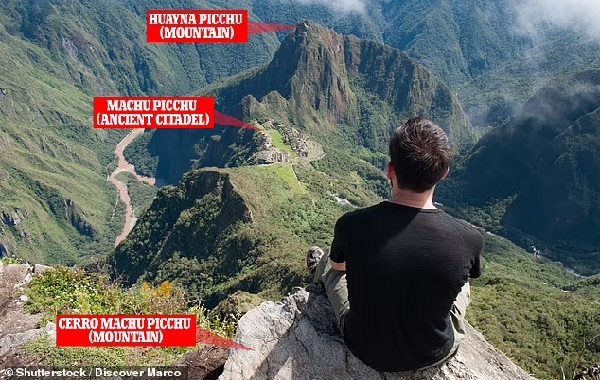
Machu Picchu has gone by the wrong name for over 100 YEARS: Ancient Inca town was known by inhabitants as ‘Huayna Picchu’
Machu Picchu is among the most recognised archaeological sites in the world
But a new paper suggests it’s been going by the wrong name for over a century
It was abandoned before being found by explorer Hiram Bingham back in 1911
Researchers performed a new analysis of Bingham’s documents from the time
Results suggest the historic tourist attraction should be known as Huayna Picchu
It’s one of the most recognised archaeological sites in the world and a lasting symbol of the Inca Empire.
But according to a new paper, the ancient citadel of Machu Picchu in Peru has gone by the wrong name ever since its ‘rediscovery’ more than a century ago.
The historic site, high in the Peruvian Andes, was built in the 15th century and later abandoned before being found by American explorer Hiram Bingham in 1911.
Researchers reviewed Bingham’s original field notes, early 20th century maps of the region, and centuries-old land documents from different archives.
Their findings suggest that the Incas originally called it ‘Huayna Picchu’, for the rocky summit that lies nearest to the site, slightly further north, and not ‘Machu Picchu’, which is the name of the highest mountain near the ancient city, in the south
The new paper has been authored by historian Donato Amado Gonzales from the Ministry of Culture of Peru and archaeologist Brian Bauer from the University of Illinois Chicago.
‘We began with the uncertainty of the name of the ruins when Bingham first visited them and then reviewed several maps and atlases printed before Bingham’s visit to the ruins,’ said Professor Bauer.
‘There is significant data which suggest that the Inca city actually was called Picchu or more likely, Huayna Picchu.’
For the new paper, the authors examined three data sources – the field notes of Hiram Bingham, names on 19th century maps and information recorded in 17th century documents.
The researchers found that the ruins of an Inca town called Huayna Picchu is mentioned in a 1904 atlas that was published seven years before Bingham arrived in Peru.
Additionally, they show that Bingham was told in 1911 of ruins called Huayna Picchu along the Urubamba River before he left Cusco to search for the remains.
A landowner’s son later told Bingham in 1912 that the ruins were called Huayna Picchu, but still the erroneous name stuck.
The results ‘uniformly’ suggest that the Inca city was originally called Picchu, or more likely Huayna Picchu, and that the name Machu Picchu became associated with the ruins starting in 1911 with Bingham’s publications.
According to Professor Bauer, the most definitive connections to the original name of the Inca city are preserved within accounts written by Spaniards relatively soon after the region came under their control in the late 16th century.
‘We end with a stunning, late 16th-century account when the indigenous people of the region were considering returning to reoccupy the site which they called Huayna Picchu,’ he said.
Built in the 15th century, before the arrival of the Spanish invaders, Machu Picchu is perhaps the most familiar icon of the Inca World.
It is situated on a mountain ridge above the Urubamba Valley in Peru, 50 miles (80km) north-west of Cusco and through which the Urubamba River flows.
Most archeologists believe that the citadel was built as an estate for the Inca emperor Pachacuti (1438-1472).
Unfortunately, most cities built by the Inca civilization were destroyed by the Spanish conquest.
However, Machu Picchu was in a hidden location high up in the mountains, invisible from below, so it was not discovered by the invading forces.
When Bingham first visited the ruins in 1911, they were little known even among those who lived in Peru’s Cusco region.
Though Bingham was not the first to visit the ruins, he was considered the scientific discoverer who brought Machu Picchu to international attention.
Bingham organised another expedition in 1912 to undertake major clearing and excavation.
His book ‘Lost City of the Incas’ became a bestseller upon its publication in 1948. Bingham himself has been cited as a possible inspiration for the character Indiana Jones.
Source: daily mail
Unknown symbols written by the lost ‘painted people’ of Scotland unearthed
Unknown symbols written by the lost ‘painted people’ of Scotland unearthed
Machu Picchu has gone by the wrong name for over 100 YEARS: Ancient Inca town was known by inhabitants as ‘Huayna Picchu’