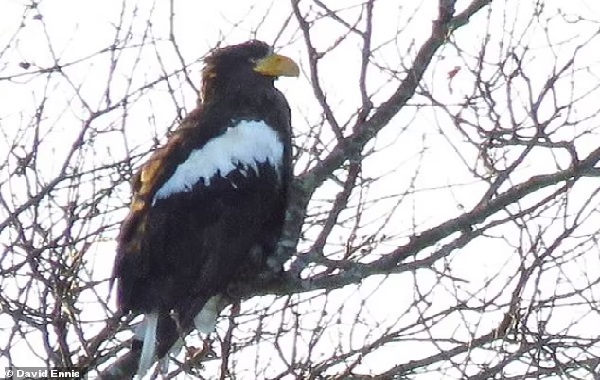
Lost Steller’s sea eagle that is native to Asia is spotted in Massachusetts: 20lb bird with an 8ft-long wingspan was caught in a storm that pushed it more than 5,000 miles away from home
A Stellar’s sea eagle was spotted around the Taunton River in Massachusetts
The bird is native to China, Japan and Russia, but experts say it was blown off course by a storm
This Stellar’s sea eagle was first seen in Alaska last year and parts of Canada this summer before landing in Massachusetts
A Steller’s sea eagle was spotted by 200 bird watchers around the Taunton River in Massachusetts on Monday, but what makes this spectacle so exciting is that the bird’s home is more than 5,000 miles away.
Native to China, Japan and Russia, the large bird weighs up to 20 pounds and has a giant wingspan of around eight feet.
This particular Stellar’s sea eagle appears to be making a trip through North America, as it was first spotted in Alaska last summer and then in Texas and Nova Scotia last month before landing in Massachusetts.
Birders are sure it’s the same eagle because it has unique white markings on its wings.
Andrew Vitz, Massachusetts’ ornithologist, said in a statement: ‘We’ve never had one here in this area of the world: the Northeast coast of North America or Massachusetts.
‘This is like the bird of the decade for people around here.’
Vitz said the bird most likely arrived in North America after it got caught in a weather-related storm.
The state has no plans to capture or tag the bird, he said.
Jonathan Goff, 24, drove from Millville when he heard of the sighting on social media.
‘It’s one of the largest eagles in the world and I would love to see it,’ said Goff.
‘It’s a once-in-a-lifetime opportunity. They’re usually found in the Arctic, but since it’s here, that’s why I drove the 45 minutes.’
And many are sure it is the same bird spotted on Alaska’s Denali highway, about 4,700 miles away from its native range, in August 2020, the New York Times reports.
The bird was then observed in New Brunswick and Quebec, Canada this past July.
It is believed the storm blew the bird off course and now the creature is lost, as it is likely become vagrant.
Vagrancy occurs when a bird wonders off its normal route, which could be due to a navigation error or a major storm scooping it up.
However, vagrancy is a normal occurrence – records show some albatrosses spend decades off their normal course.
Experts suspect the lone traveler may migrate with native bald eagles along the coastline, make its way back to its normal ranges in northeastern Asia or stick around and brace Nova Scotia’s brutal winters. It is possible that the sea eagle may die while out of range, the New York Times reports.
Alexander Lees, an avian vagrancy expert at the Manchester Metropolitan University, told the New York Times: ‘It’s like an avian soap opera.
‘We’re all rooting for it. Will it make it home? Or is it doomed to never see another species of its own in its lifetime?’
Source: daily mail
Scientists have shed new light on how organs evolve – thanks to a type of beetle
Scientists have shed new light on how organs evolve – thanks to a type of beetle
Lost Steller’s sea eagle that is native to Asia is spotted in Massachusetts: 20lb bird with an 8ft-long wingspan was caught in a storm that pushed it more than 5,000 miles away from home