Less than a million years old, fifty-five times farther out than allowed—what unseen hand built this planet against every law of formation?
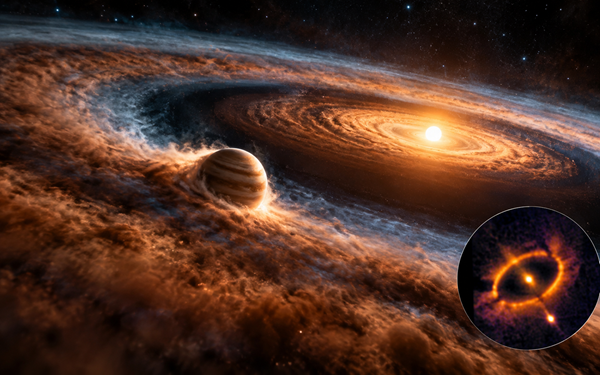
Astronomers have confirmed a world less than one million years old as the youngest known planet. Named Elias 2-24 b, this infant world still whirls within its natal disk of gas and dust. How could such a young planet exist when our best models predict formation times of at least five million years? This discovery, published in The Astrophysical Journal Letters, forces scientists to rethink everything they understood about planetary birth.
The Challenge with Planet Formation Models
“Our planet-formation models already struggled to explain the previous record holders,” explains Lucas Cieza, a professor at the Instituto de Estudios Astrofísicos in Chile and co-author of the study. Those earlier champions—two planets orbiting PDS 70 and two around WISPIT 2—are all older than five million years. Yet here sits Elias 2-24 b, barely a million years old and already as massive as Jupiter. Therefore, Cieza notes, “Elias 2-24 b shows us that even our best planet-formation models are still missing some important processes.”
How do planets actually assemble so quickly? The galaxy churns out new stars and planets continuously, so many worlds exist at every stage of evolution. However, most telescopes remain blind to these baby planets because thick dust shrouds them. This gap in detection leaves theorists guessing.
A Decade-Old Mystery Finally Solved
The confirmation of Elias 2-24 b resolves a puzzle that puzzled astronomers for ten years. Approximately a decade ago, observations from ALMA (the Atacama Large Millimeter/submillimeter Array) in Chile revealed a striking gap in the dusty disk surrounding the young star Elias 2-24. Shortly afterward, the European Southern Observatory’s Very Large Telescope detected a faint point of light sitting directly within that gap.
Was that dot actually a planet? According to standard planet-formation theories, such gaps appear too early and too far from their stars for planets to have formed. Specifically, current models predict that forming a Jupiter-size planet at Jupiter’s distance from the sun requires about five million years—and even longer at greater distances. Yet the glowing dot orbited fifty-five times farther from its star than Earth is from the sun. Why would a planet exist there if physics says it should not?
How the Keck Archive Revealed the Truth
To answer this question, Andrea Bernardi, a doctoral candidate at Universidad Diego Portales in Chile, led a team that searched the Keck Observatory Archive. This archive is a partnership between the W. M. Keck Observatory and the NASA Exoplanet Science Institute at Caltech/IPAC. They found the same faint point of light in observations from 2018 and 2020. By stitching those images together, they analyzed its motion over time.
The movement behaved like a planet, not like an imaging defect or a background star. Consequently, the team confirmed the object as Elias 2-24 b—the youngest known planet ever detected. “We usually hear about telescopes working separately,” Bernardi remarks, “but this confirmation was possible only by using multiple telescopes together.”
Active Accretion: A Planet Still Growing
What makes Elias 2-24 b even more remarkable is its ongoing growth. Material from the surrounding disk actively accretes onto the Jupiter-mass planet. This accretion process supports the leading theory of giant planet formation, known as core accretion. In this model, a rocky core forms first and then gravitationally pulls in gas from the disk. However, Elias 2-24 b’s extreme youth suggests that core accretion might happen much faster than previously thought.
Could there be other mechanisms at play? For instance, alternative theories propose that giant planets can form directly from gravitational instabilities in the disk. This baby planet provides a perfect laboratory to test such ideas.
Searching for More Baby Planets
Most exoplanets discovered so far—over six thousand confirmed worlds—were found using the transit method. That technique detects planets when they pass in front of their star and temporarily dim the light we receive. However, transits are difficult to detect when planets are still deeply buried in dust or orbit far from their stars. Therefore, the overwhelming majority of known exoplanets are billions of years old and very close to their stars.
Elias 2-24 b, in contrast, is about ten times farther from its host star than Jupiter is from the sun. How many other such baby planets are hiding in plain sight? Bernardi’s team focused on seven stars with debris disks, each containing structures and gaps that hint at forming planets. By using the coronagraph at Keck Observatory—which blocks light from the host star—they could search for fainter companions embedded in those disks.
“The planets should be found within the gaps, since they are carving them,” Bernardi explains. “And that’s exactly where we found Elias 2-24 b.”
A Time Machine to Our Own Solar System
Studying this system offers a time machine of sorts. Approximately four and a half billion years ago, our own solar system likely looked similar—a young Sun surrounded by a swirling disk of gas and dust, with infant planets still growing. What conditions allowed Earth to form? How did Jupiter acquire its mass? Elias 2-24 b provides a direct window into those early stages.
The star Elias 2-24 lies about four hundred fifty light-years from Earth. That proximity makes it an ideal target for detailed follow-up observations. Future telescopes, such as NASA’s Nancy Grace Roman Space Telescope (launched on August 30), are equipped with even more powerful coronagraphs. Roman could spot planets in much smaller orbits, including true Jupiter analogs that are currently impossible to see through the glare.
“This is just the beginning of a new era of discovery,” Cieza says. “It’s incredible that with modern technology, we are actually able to see planet formation in action, and Roman will take planet hunting to the next level.”
Key Questions That Remain
Despite this breakthrough, many questions linger. How common are such ultra-young planets? Do they form primarily through core accretion or disk instability? Why does the gap around Elias 2-24 appear so early—can planets carve gaps in less than a million years? Moreover, what role does the star’s environment play? Could nearby stars or passing clouds trigger rapid planet formation?
Answering these questions will require more observations and improved models. For now, Elias 2-24 b stands as a landmark discovery—a baby world that challenges our assumptions and reminds us that the universe still holds surprises.
Source: Less than a million years old, fifty-five times farther out than allowed—what unseen hand built this planet against every law of formation?
Could the Clues to Ancient Alien Civilizations Be Hiding in Moon Dust? A New SETI Strategy
Could the Clues to Ancient Alien Civilizations Be Hiding in Moon Dust? A New SETI Strategy
Less than a million years old, fifty-five times farther out than allowed—what unseen hand built this planet against every law of formation?
Sources and Further Reading
- Bernardi, A., et al. (2024). “Confirmation of a Young, Jupiter-Mass Planet in the Elias 2-24 Disk.” The Astrophysical Journal Letters.
- Cieza, L., et al. (2024). “Planet Formation in the Era of Direct Imaging.” Annual Review of Astronomy and Astrophysics (in press).
- W. M. Keck Observatory Press Release: “Youngest Exoplanet Ever Found Confirmed with Keck Archive Data.” August 2024.
- NASA Exoplanet Science Institute. “Keck Observatory Archive (KOA).” Caltech/IPAC.
- ALMA Observatory. “Gap in Elias 2-24 Disk Hints at Forming Planet.” ESO Press Release, 2014.