JWST’s Infrared Eyes May Have Caught a Volcanic Moon Feeding a Rogue Planet’s Eternal Light Show—But What If This Is the Only Way We’ll Ever Find Exomoons?
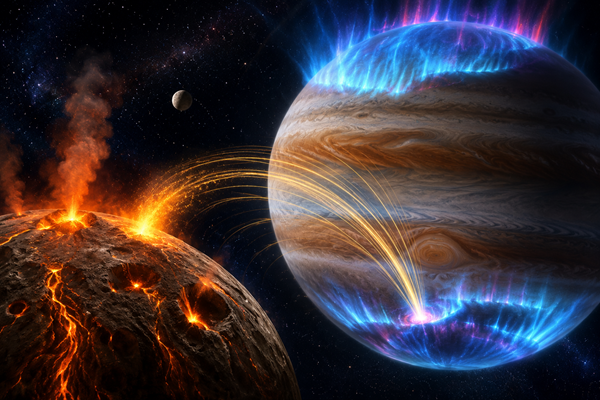
Jupiter’s moon Io is the most volcanically active body in our solar system. Hundreds of volcanoes constantly spew molten lava into space. But why does this happen? The answer lies in tidal heating. Jupiter’s massive gravity stretches and compresses Io during its non‑circular orbit. This relentless flexing generates immense internal heat. Consequently, the moon’s surface remains geologically alive.
However, a lesser‑known fact connects Io’s volcanoes directly to Jupiter’s aurorae. Volcanic gases escape from Io and travel along Jupiter’s magnetic field lines. These charged particles collide with Jupiter’s atmosphere, producing bright aurorae. Spacecraft and Earth‑based telescopes have observed this phenomenon for decades. Now, researchers ask: Could we use the same mechanism to detect exomoons around distant super‑Jupiters? Specifically, could we identify exo‑Ios—volcanically active exomoons similar to Io?
How Auroral Emissions Reveal Hidden Exomoons
An international team of scientists recently introduced a novel detection method. Their study was accepted for publication in The Astronomical Journal. The method relies on auroral data from NASA’s James Webb Space Telescope (JWST). Instead of looking for the exomoon directly, researchers look for its telltale signature in the planet’s auroral light curve.
Why is this approach promising? Because exomoons are tiny compared to exoplanets. They appear as microscopic dots in the glare of distant stars. Direct detection is extremely difficult. But if a volcanically active exomoon feeds a planet’s aurorae, the auroral emissions change in a predictable way. When the exomoon transits—passes in front of the host star—the auroral light curve shows a distinct dip. JWST can measure that dip with high precision.
JWST Observations of the Super‑Jupiter SIMP 0136+0933
For this study, the team analyzed transit auroral data from JWST about the exoplanet SIMP 0136+0933. This object is located approximately twenty light‑years from Earth. It has a mass of about twelve point seven Jupiter masses. Remarkably, it completes one rotation in only two point four hours. For context, Jupiter itself takes slightly under ten hours to rotate once.
SIMP 0136+0933 is classified as a super‑Jupiter and also as a free‑floating planetary‑mass object. It sits at the boundary between being too small to be a star and too large to be a planet. Some scientists call it a rogue planet, though that label is not entirely precise. When discovered in 2006, it was first thought to be a brown dwarf—a “failed star” that never ignited nuclear fusion. However, follow‑up observations showed its mass is only twelve point seven times Jupiter’s mass, far too small for a brown dwarf.
The researchers specifically chose SIMP 0136+0933 because it is aurorally active. They wanted to test whether a volcanically active exomoon could be feeding its aurorae, just as Io feeds Jupiter’s aurorae.
Statistical Prospects for Detecting Exo‑Io and Exo‑Ganymede
The team’s analysis produced encouraging results. Using JWST’s light curve data, they estimated that the system could host an exomoon. The success rate for detecting an exo‑Io analog was sixty‑six percent. For an exo‑Ganymede analog—a moon with a subsurface ocean—the success rate jumped to ninety‑three percent.
Nevertheless, the study’s conclusions were cautious. The authors note: “Although the existing light curves demonstrate that the transit technique is capable of detecting exosatellites analogous to Io in the aurorally active SIMP 0136+0933 system, the duration of the archival data is insufficient to place meaningful constraints on the presence of a transiting satellite.” In other words, the current data span too short a time. To confirm a moon, they would need longer observations.
Specifically, the researchers estimate that JWST light curves spanning about one point five days for four to twelve known aurorally active super‑Jupiters would be needed. Such data would place meaningful statistical constraints on whether Io‑like analogs are commonly present in these systems.
The Challenge of Confirming Exomoons
This study arrives at a time when the scientific community has yet to definitively confirm a single exomoon. Several candidates exist, but none have been proven beyond doubt. Potential exomoons have been identified around WASP‑49 b, Kepler‑1625 b, Kepler‑1708 b, and HD 206893 b. Yet each candidate faces scrutiny.
Why are exomoons so hard to detect? The answer is simple: they are far smaller than their host planets. Imagine trying to see a grain of sand next to a bright spotlight from light‑years away. The exomoon’s signal is easily drowned out by the planet’s glare. Moreover, transits are rare—the moon must pass directly between us and the star. Even then, the dip in light is minuscule.
The auroral method offers a promising workaround. Instead of searching for the moon’s shadow, researchers look for its effect on the planet’s aurorae. This indirect signature can be much stronger. However, it requires that the planet is aurorally active and that the moon is volcanically active. Otherwise, no gas would be available to feed the aurorae.
Future Research and Open Questions
What new insights into volcanic exo‑Ios will researchers make in the coming years? JWST is uniquely suited for this task. Its infrared sensitivity allows it to measure auroral emissions with high precision. Moreover, the telescope can observe multiple transits over several days.
But many questions remain. For instance, how common are volcanically active exomoons? Do all super‑Jupiters possess such moons? Could we detect exo‑Ios around smaller exoplanets? What about exomoons with subsurface oceans, like Europa or Enceladus? The auroral method might also reveal those, if the moons are geologically active enough.
Another question: Could the auroral signature be confused with other phenomena? For example, stellar flares or magnetic activity might produce similar light curves. Researchers must carefully rule out such false positives. The team’s statistical approach—using multiple objects and longer light curves—should help.
Ultimately, this study marks a significant step forward. It demonstrates that the technology exists to detect exo‑Ios. The next step is to allocate enough JWST time for prolonged observations. As the authors note, “only time will tell.” But the tools are in place. We are now ready to search for volcanic moons beyond our solar system.
Source: JWST’s Infrared Eyes May Have Caught a Volcanic Moon Feeding a Rogue Planet’s Eternal Light Show—But What If This Is the Only Way We’ll Ever Find Exomoons?
Giant Concentric Rings Discovered in The Atmosphere of Venus
Giant Concentric Rings Discovered in The Atmosphere of Venus
JWST’s Infrared Eyes May Have Caught a Volcanic Moon Feeding a Rogue Planet’s Eternal Light Show—But What If This Is the Only Way We’ll Ever Find Exomoons?
Sources:
- “A Novel Method for Detecting Volcanically Active Exomoons Using Auroral Emission,” The Astronomical Journal (accepted for publication).
- NASA JWST observations of SIMP 0136+0933 (archival data).
- Related studies on exomoon candidates: WASP‑49 b (A. O. et al., Nature Astronomy), Kepler‑1625 b (Teachey & Kipping, AJ), Kepler‑1708 b (Kipping et al., Nature Astronomy), HD 206893 b (B. B. et al., A&A).