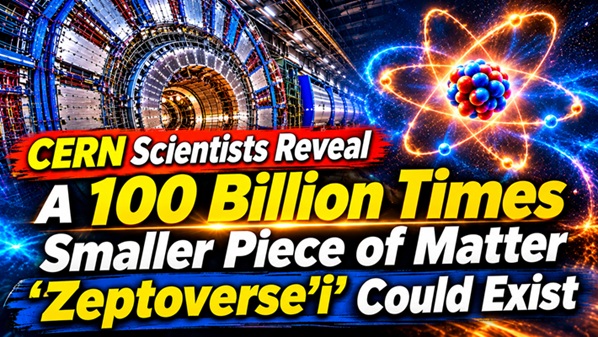
It evokes a sense of mystery and the unknown in physics through the concept of the Zeptoverse.
Rare Particle Decay: After Forty-Two Years of Searching, Have Physicists Finally Opened the Door to the Zeptoverse?
For more than four decades, physicists have pursued a phenomenon so extraordinarily rare that billions of particle transformations can occur without producing even a single detectable example. Now, an international research collaboration at CERN has reached a remarkable milestone. Scientists have found the first experimental evidence of a particle decay predicted to occur only once in approximately ten billion beauty particles.
Although this result does not yet represent a confirmed discovery, it could mark an important turning point in humanity’s attempt to understand the fundamental structure of the Universe.
What makes this achievement particularly fascinating is not simply the rarity of the process. It is what this elusive transformation might reveal about the invisible world of quantum physics.
Could particles that have never been directly observed be influencing the behavior of matter? Are unknown forces operating at distances far smaller than anything we can ordinarily imagine? And could the answers to some of the Universe’s greatest mysteries be hiding inside a particle that survives for barely a trillionth of a second?
The discovery brings scientists closer to investigating a mysterious frontier known as the Zeptoverse.
The Zeptoverse: Could an Unknown World Exist Beyond the Limits of Particle Physics?
Modern physics has developed extraordinarily successful theories describing the fundamental particles and forces that govern our Universe. However, despite decades of experimental progress, some of the most important questions remain unanswered.
What exactly happened during the earliest moments following the Big Bang? Why does the observable Universe contain so much more matter than antimatter? What particles make up dark matter? And could additional fundamental forces exist beyond those currently recognized by science?
The Standard Model of particle physics provides an impressive mathematical framework for explaining elementary particles and three of the four known fundamental interactions. Nevertheless, it cannot fully explain several major cosmological mysteries.
This is where the concept of the Zeptoverse becomes particularly intriguing.
A zeptometer is an unimaginably small unit of distance, equivalent to one billionth of a trillionth of a metre. At these scales, physicists investigate processes that may reveal the influence of particles and interactions inaccessible through ordinary observations.
To appreciate the scale, imagine dividing the width of a human hair into thousands of trillions of much smaller sections. The distances explored in this emerging frontier are vastly smaller than the dimensions of atoms and even their constituent particles.
However, the Zeptoverse should not be understood as a confirmed hidden universe or a newly discovered dimension. Rather, it describes a frontier of extremely short-distance physics where unknown particles, interactions or forces might reveal themselves through subtle experimental effects.
What if the particles we currently understand represent only a small portion of a much deeper physical reality?
Scientists believe that extremely rare particle transformations could provide one of the most sensitive ways to investigate this possibility.
Forty-Two Years of Searching: The Extraordinary Hunt for a One-in-Ten-Billion Particle Decay
The latest achievement emerged from the Large Hadron Collider beauty experiment, better known as LHCb, located at CERN near Geneva.
The search for the particular decay began in nineteen eighty-four, long before modern particle detectors possessed the sensitivity required to investigate it effectively.
For decades, researchers attempted to identify a specific transformation involving a particle known as the neutral beauty meson, or B-zero meson.
The predicted process is extraordinarily uncommon. According to the Standard Model, it occurs approximately once in every ten billion beauty-particle decays.
Why is this particular transformation so difficult to observe?
The answer lies in the complicated behavior of fundamental particles.
Particle collisions produce enormous numbers of different subatomic particles. Most disappear almost immediately, transforming into other particles through processes governed by the fundamental forces of nature.
Among these transformations, the overwhelming majority follow ordinary decay pathways. The process researchers were searching for is exceptionally suppressed, making its signal almost impossible to distinguish from the enormous background of other particle interactions.
Imagine searching for one specific grain of sand in an enormous desert while countless new grains are continuously appearing and disappearing.
That is approximately the experimental challenge facing the LHCb researchers.
Nevertheless, advances in detector technology, computing power and artificial intelligence have finally allowed scientists to approach the problem with unprecedented precision.
On November third, twenty twenty-six, the LHCb Collaboration announced that it had obtained the first evidence from a single experiment for this extraordinarily rare decay.
The result represents a major achievement in a scientific search that has lasted more than forty years.
What Is a Beauty Quark? The Mysterious Particle Behind the Discovery
To understand the discovery, we first need to examine the unusual particles involved.
Matter is built from fundamental constituents called quarks and leptons. Quarks are particularly important because they combine to form larger particles such as protons and neutrons.
Scientists have identified six different types, or flavors, of quarks:
Up quark
Down quark
Charm quark
Strange quark
Top quark
Bottom quark, also known as the beauty quark
Up and down quarks form the familiar building blocks of ordinary atomic matter. Protons contain two up quarks and one down quark, while neutrons contain one up quark and two down quarks.
The remaining quarks are considerably heavier and generally appear only in high-energy environments or during extremely short-lived particle interactions.
The beauty quark belongs to this more exotic family.
It is far heavier than the up and down quarks that make up ordinary matter. Although beauty quarks were abundant in the extremely hot conditions of the early Universe, they do not naturally survive as stable constituents of the matter surrounding us today.
However, modern particle accelerators can recreate the conditions necessary to produce them.
When protons collide at enormous energies inside the Large Hadron Collider, their internal constituents interact and generate showers of new particles. Among these products are beauty quarks and other exotic particles.
These quarks can then combine with antiquarks to form short-lived composite particles called mesons.
The particular particle involved in the latest research is the neutral B-zero meson.
It consists of a beauty quark and a down antiquark.
But what happens when this unusual combination of matter and antimatter begins to disappear?
The answer is at the center of the discovery.
The B-Zero Meson Decay: How Can a Particle Transform Into Two Muons?
The researchers investigated a process in which a neutral B-zero meson transforms into two particles called muons.
One is a positively charged muon, while the other is its negatively charged antiparticle.
Muons resemble electrons in many respects. Both belong to a family of elementary particles called leptons and carry an electric charge. However, a muon is approximately two hundred times heavier than an electron.
Unlike stable electrons, muons are unstable. They typically survive for approximately two millionths of a second before decaying into lighter particles.
The B-zero meson has an even shorter existence, surviving for approximately one and a half trillionths of a second.
Within this extraordinarily brief interval, it can undergo several possible transformations.
Most follow relatively common decay pathways. However, the transformation into a positive and negative muon is exceptionally rare.
Why does nature suppress this particular process so dramatically?
The explanation involves the fundamental rules governing the interactions between quarks.
According to the Standard Model, the beauty quark and the down antiquark can annihilate through a highly suppressed quantum process. The resulting interaction produces a pair of muons.
Importantly, this is not an ordinary direct collision between the two constituent particles. The transformation proceeds through quantum-level interactions involving intermediate particles and forces.
The process is particularly suppressed because of the structure of the weak nuclear interaction and a phenomenon known as helicity suppression.
In simple terms, the fundamental properties of the particles and the mathematical structure of the weak interaction make this particular transformation extremely unlikely.
Consequently, even an enormous number of beauty mesons may produce only a handful of detectable examples.
And this extraordinary rarity is precisely what makes the decay scientifically valuable.
Why an Extremely Rare Particle Decay Could Reveal New Physics
One of the most fascinating aspects of modern particle physics is that scientists do not always need to discover an entirely new particle directly.
Sometimes, the behavior of familiar particles can reveal the presence of something previously unknown.
This is the principle behind the investigation of rare particle decays.
Imagine that a particle follows a particular transformation at a frequency predicted by the Standard Model. Scientists calculate that frequency using the known fundamental interactions and the properties of the particles involved.
Now imagine that an undiscovered particle exists.
Even if this hypothetical particle is too massive to be produced directly inside the Large Hadron Collider, it could still influence the quantum interactions responsible for the decay.
Its contribution might slightly change the probability of the transformation.
In other words, an invisible particle could leave a measurable fingerprint on the behavior of a particle that scientists already understand.
This is why rare decays are sometimes described as golden channels in the search for new physics.
The rarer the predicted process, the more sensitive its measured frequency can become to certain additional contributions.
A small disagreement between experimental measurements and theoretical predictions could therefore reveal an entirely new aspect of fundamental physics.
Could dark matter particles be influencing these interactions? Might additional forces exist beyond the known framework? Could an unknown particle alter the balance between matter and antimatter?
The latest LHCb result does not answer these questions. However, it demonstrates that scientists can now investigate extraordinarily suppressed quantum processes with increasing precision.
CERN’s LHCb Detector: How Artificial Intelligence Helped Find the Elusive Signal
Finding a particle decay that occurs approximately once in ten billion events requires more than an extremely powerful accelerator.
It requires a detector capable of separating an exceptionally weak signal from an overwhelming amount of background activity.
This is the responsibility of the LHCb experiment.
Unlike some other experiments at CERN, which investigate particle collisions across a broad range of phenomena, LHCb specializes in studying particles containing beauty and charm quarks.
Its detector has been designed to reconstruct particle trajectories, identify different particle species and examine the extremely short distances over which unstable particles decay.
One of its most important components is the Vertex Locator, commonly called VELO.
This highly sensitive detector sits just a few millimetres from the circulating proton beams. Its proximity allows researchers to reconstruct the precise locations where particles are produced and where their decay products emerge.
By examining these microscopic trajectories, scientists can identify the characteristic signatures of short-lived particles.
However, the latest breakthrough would have been much more difficult without a major technological improvement.
In twenty twenty-four, the upgraded LHCb detector began collecting data during the collider’s third operating run. The upgraded experiment can record collisions at up to five times the previous rate.
This improvement dramatically increases the number of particle interactions available for analysis.
At the same time, researchers introduced sophisticated machine-learning techniques to distinguish potential signals from background events.
Artificial intelligence can recognize complex patterns across enormous datasets, helping scientists identify combinations of particle characteristics that might otherwise remain buried beneath ordinary collision activity.
The system can examine information about particle trajectories, energy measurements and detector responses to determine which events are most consistent with the rare decay being investigated.
Without these improvements, the signal might have remained hidden among billions of unrelated interactions.
The achievement therefore represents not only progress in fundamental physics but also a remarkable demonstration of how advanced computing and experimental technology can expand the boundaries of scientific observation.
Three Point Two Sigma: Has CERN Discovered a New Particle Physics Phenomenon?
Although the latest result is extremely promising, one important scientific distinction must be understood.
The LHCb researchers reported a statistical significance of three point two standard deviations, commonly described as three point two sigma.
In particle physics, statistical significance measures how strongly an observed signal stands out from the background expected if the phenomenon were absent.
A result reaching approximately three sigma is generally considered evidence for a phenomenon.
However, physicists normally require five sigma before announcing a discovery.
Why such a demanding standard?
Because particle collisions produce enormous quantities of data, and random statistical fluctuations can occasionally imitate the signature of a genuine physical process.
At three sigma, the probability of obtaining an equally large or larger background-only fluctuation is approximately three tenths of one percent under the conventional one-sided Gaussian interpretation.
At five sigma, that probability becomes dramatically smaller, approximately one in three and a half million.
The difference is enormous.
The LHCb experiment initially obtained a significance of three sigma using the new data collected during twenty twenty-four and twenty twenty-five.
When researchers combined these measurements with earlier LHCb data collected between twenty eleven and twenty eighteen, the statistical significance increased to three point two sigma.
This crossed the accepted evidence threshold but remained below the level required for a confirmed discovery.
It is therefore important to understand what scientists have actually achieved.
They have obtained the first single-experiment evidence for the B-zero meson decaying into a positive and negative muon.
They have not yet established the process at the five-sigma discovery level.
Further observations will be necessary to determine whether the signal continues to strengthen as additional data become available.
Could this be the beginning of a discovery that changes our understanding of fundamental physics? Or will future measurements reveal that the current evidence was only a statistical fluctuation?
For now, the scientific answer remains open.
The Standard Model and the Mystery of Dark Matter: What Is Still Missing?
Perhaps the most important consequence of the experiment lies in what it can teach scientists about the Standard Model.
Developed throughout the twentieth century, the Standard Model describes the fundamental particles and their electromagnetic, weak and strong interactions.
It has successfully predicted numerous experimental results, including the existence of particles that were subsequently discovered.
Nevertheless, the theory remains incomplete.
It does not explain the gravitational interaction within its quantum framework. It also fails to identify the substance responsible for dark matter, which appears to account for a substantial proportion of the matter in the Universe.
Another major mystery concerns the imbalance between matter and antimatter.
According to our understanding of the early Universe, the Big Bang should have produced matter and antimatter in nearly equal quantities.
When matter encounters antimatter, the two can annihilate, converting their mass into energy.
If both had existed in perfectly equal amounts and behaved identically, almost all ordinary matter could have disappeared.
Yet galaxies, stars, planets and living organisms exist today.
Somehow, a tiny excess of matter survived the earliest stages of cosmic evolution.
Scientists have identified certain differences between the behavior of matter and antimatter, but the known effects within the Standard Model do not appear sufficient to explain the observed cosmic imbalance.
Could rare particle transformations provide another piece of this puzzle?
Although the newly observed decay does not directly explain dark matter or the matter-antimatter asymmetry, measurements of this kind help scientists test whether the Standard Model describes nature with sufficient accuracy.
If future experiments reveal a persistent discrepancy, researchers may have to reconsider some of their assumptions about the fundamental laws governing the Universe.
However, the present results remain consistent with Standard Model expectations.
In fact, this agreement is scientifically important because it places stronger constraints on possible extensions of existing theories.
Sometimes, progress comes not from discovering something unexpected but from eliminating possibilities that once seemed plausible.
The B-Zero and B-S Meson Decays: Why Comparing Two Rare Processes Matters
The latest LHCb analysis contains another important achievement.
Alongside the evidence for the B-zero meson decay, researchers also produced the most precise measurements yet of a related process involving the strange beauty meson, known as the B-s-zero meson.
This particle contains a beauty quark and a strange antiquark.
Its decay into a positive and negative muon had already been observed in twenty fifteen through a combined analysis by the LHCb and CMS collaborations.
Why is this second measurement important?
Because comparing different rare decay processes can reveal patterns that might remain invisible when examining only one particle.
The two mesons contain different antiquarks, and their decay probabilities are affected by different combinations of fundamental interactions.
Consequently, measuring both processes provides complementary information about the behavior of beauty quarks.
If an unknown particle contributes to these interactions, it could influence the two decay rates differently.
Researchers can therefore compare experimental measurements with precise theoretical calculations to investigate possible deviations.
The new measurements are consistent with the Standard Model.
Nevertheless, they significantly improve the experimental limits on certain theoretical models that attempt to extend our current understanding of particle physics.
In this sense, the experiment has accomplished something more substantial than simply finding an exceptionally rare transformation.
It has created a more powerful framework for testing the fundamental laws of nature.
The Next Generation of Particle Colliders: Could the Twenty-Thirties Reveal the Zeptoverse?
The latest result may represent only the beginning of a much more ambitious scientific investigation.
The Large Hadron Collider is expected to undergo further improvements during the coming years.
The High-Luminosity Large Hadron Collider programme, planned to begin operations around twenty thirty, aims to increase the number of collisions available for scientific analysis.
More collisions mean more opportunities to produce short-lived particles and observe extremely rare transformations.
Meanwhile, another major upgrade of the LHCb experiment is planned for the middle of the next decade.
These developments could increase its data-collection capabilities by another order of magnitude compared with the relevant earlier operating conditions.
Such improvements will be particularly important for investigating processes that occur only a tiny fraction of the time.
With larger datasets, researchers can improve the statistical precision of their measurements, investigate additional decay channels and test increasingly restrictive theoretical predictions.
The ultimate objective is to determine whether the behavior of fundamental particles reveals anything beyond the Standard Model.
Perhaps the most exciting possibility is that the next breakthrough will not involve the direct discovery of a new particle.
Instead, it might emerge from a tiny discrepancy between two measurements, a subtle deviation in a decay probability or an unexpected pattern hidden within millions of apparently ordinary events.
Could the next generation of experiments reveal particles that are too heavy to produce directly? Could the Zeptoverse contain interactions that have influenced the evolution of the cosmos since its earliest moments?
These questions are among the reasons why scientists are investing in increasingly sophisticated particle detectors and accelerators.
Beyond the Forty-Two-Year Search: Are Physicists Finally Approaching a New Reality?
The discovery of evidence for the B-zero meson decay represents an extraordinary achievement in experimental physics.
For more than forty years, researchers pursued a process that seemed almost impossible to isolate from the overwhelming activity of particle collisions.
Now, thanks to upgraded detector technology, improved particle identification and machine-learning methods, the LHCb collaboration has reached the first significant experimental milestone in that search.
Yet the most important questions remain unanswered.
The result is consistent with the Standard Model. It does not establish the existence of a new particle, demonstrate a previously unknown force or solve the mysteries of dark matter.
Nevertheless, it provides scientists with a new opportunity to investigate the fundamental interactions that govern matter at extraordinarily small distances.
Every rare decay carries information about the invisible quantum processes that determine how particles behave.
And sometimes, the smallest deviations can point toward the biggest discoveries.
Perhaps the Universe is not hiding its deepest secrets in distant galaxies or the darkest regions of space. Perhaps some of those answers are concealed within the briefest interactions of particles that disappear almost as soon as they are created.
After forty-two years of searching, physicists have finally obtained evidence for one of nature’s most elusive particle transformations.
But is this simply another confirmation of the laws we already know, or could it be the first step toward uncovering an entirely new layer of physical reality?
Have scientists finally begun to unlock the Zeptoverse, and what extraordinary secrets might be waiting beyond the boundaries of the Standard Model?
Source: It evokes a sense of mystery and the unknown in physics through the concept of the Zeptoverse.
Scientists build whole-Earth simulation to help find life on other planets
Scientists build whole-Earth simulation to help find life on other planets
It evokes a sense of mystery and the unknown in physics through the concept of the Zeptoverse.