Is This NASA-Funded Tool Our Last Chance to Find Life Beyond Earth?
Mars remains one of the most likely destinations for humanity’s first interplanetary colony. But what if the Red Planet already harbors evolutionarily distinct, living organisms? The discovery of extant Martian life could radically alter — or even halt — plans for large-scale colonization.
Astrobiologists are now in a race against time. Before human settlers, spacecraft, and terrestrial microbes reshape Mars into an Earth-like biosphere, scientists hope to answer one of humanity’s most profound questions: Does life, separate from our own, exist on Mars right now?
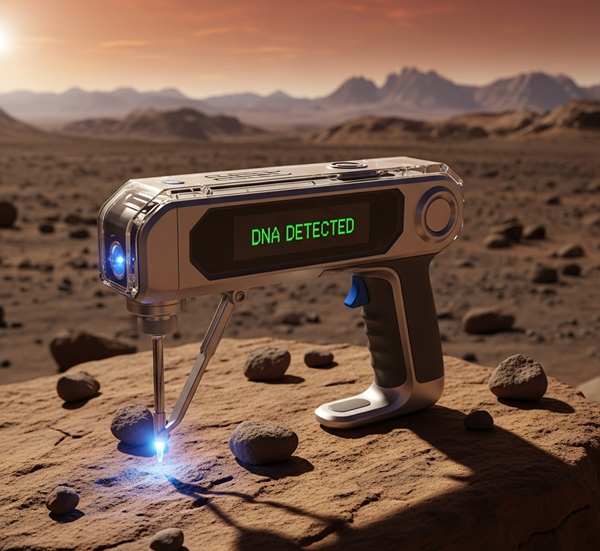
A promising answer may come from an unlikely source — a compact, highly specialized device designed by the Agnostic Life Finder (ALF) team. In a new paper, Christopher Temby and Jan Spacek describe how this instrument could identify life through one of biology’s most fundamental signatures: polyelectrolyte polymers such as DNA.
Why Detecting Martian DNA — or Its Equivalent — Matters
DNA isn’t the only polyelectrolyte in Earth’s biosphere; RNA also fits the category. These molecules are vital because they store and transmit genetic information across generations.
If life on Mars evolved independently from Earth’s, it might not use DNA or RNA exactly as we know them. Yet, scientists suspect it would still rely on something similar — a charged, information-carrying polymer capable of preserving life’s blueprint.
This makes polyelectrolytes an important rung on NASA’s “Ladder of Life Detection,” a framework outlined in a landmark 2018 paper. But detecting them on Mars comes with challenges.
Overcoming the First Challenge: Dilute Biosignatures in Martian Samples
One major obstacle is concentration. If Martian life exists in only tiny quantities — far less dense than Earth’s biomass — the molecules could fall below the detection threshold.
The ALF instrument addresses this with electrodialysis and nanopore filtration. First, scientists would mix a soil sample with water. Then, applying an electric field causes charged particles to move. While salts like potassium and magnesium pass through nanopores, larger polyelectrolytes are trapped in a chamber, concentrating them in one location.
This approach could boost the signal enough for detection, even if the original sample contained only trace amounts of life’s building blocks.
The “Weakness” That Becomes Proof of Life
The second challenge, according to NASA’s framework, is that polyelectrolytes degrade quickly in liquid water due to hydrolysis. But the ALF team sees this not as a drawback, but as a critical clue.
If such molecules are detected in Martian samples, it would imply they were produced recently — perhaps still being generated by living organisms. Ancient remnants would have broken down long ago.
Could this mean that a confirmed detection is not just a hint, but near-definitive evidence of ongoing Martian biology?
A Narrowing Window for Discovery
As plans for Mars colonization advance, the opportunity to study untouched Martian ecosystems is shrinking. Human activity, even with strict protocols, risks contaminating the planet with Earth’s microbes. Once that happens, distinguishing native Martian life from imported organisms could become impossible.
The ALF system, initially supported by a NASA Innovative Advanced Concepts (NIAC) grant, is a leading contender for this search. But its future remains uncertain amid shifting budgets.
If funding continues, scientists may one day hold direct evidence of Martian DNA or its alien counterpart. If not, we may lose our chance to answer a question that has lingered for generations: Are we truly alone in the universe? Or has life been waiting, just across the cosmic street, for us to find it?
Source: Is This NASA-Funded Tool Our Last Chance to Find Life Beyond Earth?
Is This the First Evidence of a Star Exploding While Eating a Black Hole?
Is This the First Evidence of a Star Exploding While Eating a Black Hole?