Is There a Hidden Civilization in the TRAPPIST-1 Star System?
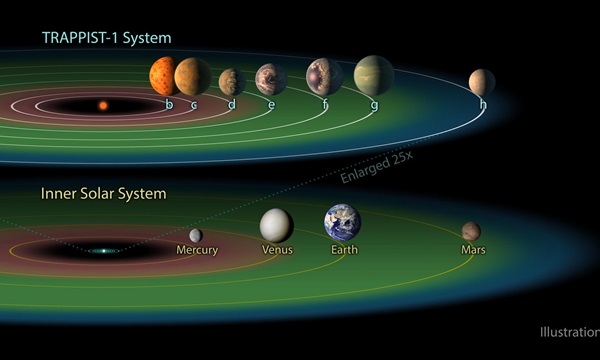
If you’re searching for intelligent life beyond Earth, the TRAPPIST-1 star system stands as a prime candidate. Despite its imperfections—such as the tendency of red dwarf stars to emit harmful flares and X-rays during their youth—TRAPPIST-1 is only 40 light-years away and boasts seven Earth-sized planets. Notably, three of these planets reside within the habitable zone, where liquid water could potentially exist. Moreover, their close proximity to one another suggests that tidal forces might keep these worlds geologically active, increasing the chances for life to thrive. If intelligence emerges naturally in the cosmos, TRAPPIST-1 could harbor such a civilization.
Searching for Technosignatures: Detecting Alien Radio Signals
Detecting intelligent life from a distant star system like TRAPPIST-1 is no easy feat. Any signal we receive from an advanced civilization would likely be faint, similar to the stray radio waves Earth emits. Scientists aim to detect technosignatures, or artificial signals, that can be distinguished from the natural emissions of stars and planets. In a recent effort, researchers used the Allen Telescope Array to monitor TRAPPIST-1 for 28 hours in search of these elusive signals.
Planetary Messages: Interplanetary Communication Hypothesis
The study operated on a few key assumptions. The first was that an intelligent civilization in TRAPPIST-1 might span multiple planets due to the system’s compactness. Travel between these planets could be as feasible as traveling from Earth to the Moon. Based on this, the researchers hypothesized that if civilizations exist, they might send radio transmissions between worlds. These interplanetary messages would generate the clearest technosignatures detectable from Earth, particularly during a planet-planet occultation (PPO)—when two planets align from our perspective. During such events, radio transmissions from one planet to another could “spill over” and be detected here on Earth.
Sifting Through Signals: Narrowing Down the Search
With the data collected, the team filtered out over 11,000 candidate signals that appeared stronger than typical natural emissions. Using computer models, they identified seven possible PPO events during the observation period. This narrowed the number of potential technosignatures to 2,200. Further analysis aimed to determine whether any of these signals were statistically unusual enough to indicate an intelligent origin.
No Evidence Yet: What the Findings Mean
Unfortunately, none of the signals observed were unusual enough to suggest intelligent life. While the search didn’t reveal any signs of alien civilizations in the TRAPPIST-1 system, this study remains significant. It marks the longest continuous survey of TRAPPIST-1 to date and showcases how far we’ve come in the search for life beyond Earth. The ability to conduct such detailed studies on known exoplanets is, in itself, a remarkable achievement.
Source: Is There a Hidden Civilization in the TRAPPIST-1 Star System?
Truly Supermassive Black Hole Has Jets Spanning 23 Million Light-Years, The Biggest Ever Seen
Truly Supermassive Black Hole Has Jets Spanning 23 Million Light-Years, The Biggest Ever Seen