Is the Milky Way Home to Alien-Powered Starships?
Researcher Suggests Aliens May Be Using Star Systems as Giant Spaceships
Astronomers have long observed stars accelerating through space at unexpected speeds. While such phenomena are usually attributed to gravitational forces or natural stellar emissions, one researcher offers a bold, alternative explanation: advanced alien civilizations could be turning entire star systems into fast-moving spaceships.
Could Solar Systems Be Alien Spaceships?
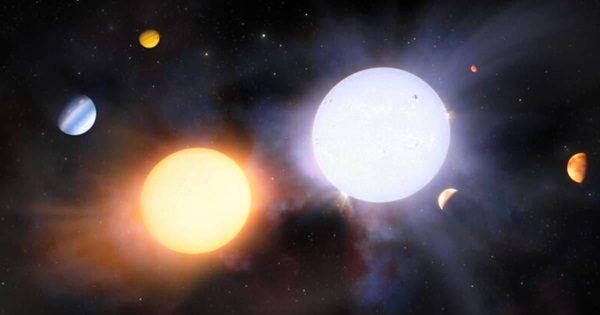
Clement Vidal, a philosopher and researcher from Vrije University Brussels, suggests that advanced extraterrestrial civilizations might be using stars as “stellar engines” to propel their solar systems through space. In a concept outlined in a non-peer-reviewed paper, Vidal explores the possibility of aliens converting binary star systems into vehicles for interstellar travel.
These civilizations, Vidal argues, might have compelling motivations for undertaking such a colossal engineering feat. Potential reasons include:
Survival: Escaping a nearby supernova or other catastrophic events.
Resource Scarcity: Relocating to resource-rich areas of the galaxy.
Exploration and Adventure: Expanding knowledge and satisfying their curiosity.
Defense: Evading threats from hostile alien species.
Instead of constructing traditional spaceships, Vidal speculates that an advanced species might opt to move their entire solar system, creating a generational voyage for the whole civilization.
How a Star Could Become a Rocket Engine
The concept of a “stellar engine” isn’t new. Originally envisioned by science fiction writer Olaf Stapledon in 1937, the idea suggests harnessing the energy of stars for propulsion. Vidal’s focus, however, is on binary star systems—specifically “spider pulsars” and “redback pulsars.”
These systems consist of:
A dense neutron star with powerful gravitational fields.
A smaller companion star losing material due to the neutron star’s pull.
By controlling the ejected material from the companion star, an advanced civilization could create propulsion forces. Adjusting the direction of these ejections would allow them to “steer” the solar system like a massive spaceship, Vidal theorizes.
Why Binary Star Systems Make the Best Candidates
Vidal identifies binary star systems as the most promising candidates for stellar engines. Among these, pulsar systems stand out due to their unique dynamics:
Energy Output: Neutron stars emit immense energy through rapid rotation and gravitational interactions.
Material Ejections: The smaller companion star sheds mass, creating forces that could be manipulated for propulsion.
Two specific systems, PSR J0610-2100 (a “black widow” pulsar) and PSR J2043+1711 (a “redback” pulsar), have already been flagged by Vidal as potential candidates for investigation.
Investigating Hypervelocity Stars for Signs of Alien Engineering
Astronomers have previously studied hypervelocity stars—objects ejected from the Milky Way’s center after close encounters with black holes. Although 16 such stars have been identified, none exhibit movement patterns suggesting intelligent control.
However, recent discoveries add to the intrigue. NASA’s Chandra X-ray Observatory identified five more binary pulsar systems within the Omega Centauri globular cluster, located 17,000 light-years away. Vidal believes these systems should be closely monitored for irregular behaviors, such as:
Accelerations beyond predicted rates.
Changes in direction or speed.
A Call for Scientific Investigation
Vidal’s proposal, while speculative, offers an exciting avenue for scientific inquiry. By examining these anomalous binary systems, astronomers could uncover evidence of advanced extraterrestrial engineering—or at least gain new insights into the dynamics of pulsar systems.
The Ultimate UFO Sighting?
If Vidal’s theory proves correct, a visiting alien civilization might one day “park” their stellar spaceship near our Sun. Such an event would mark the most spectacular mass UFO sighting in human history—and potentially the first contact with intelligent extraterrestrial life.
For now, the idea of moving solar systems may sound like science fiction. But with advancing observational tools and open-minded exploration, the boundary between fiction and reality might one day blur.
Source: Is the Milky Way Home to Alien-Powered Starships?
Is Our Universe an Outlier in the Multiverse? The Surprising Role of Dark Energy
Is Our Universe an Outlier in the Multiverse? The Surprising Role of Dark Energy