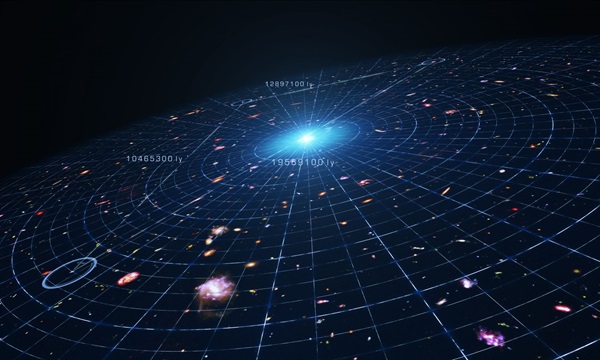
Is Our Universe an Outlier in the Multiverse? The Surprising Role of Dark Energy
The Drake Equation: A Milestone in the Search for Extraterrestrial Life
In 1960, Frank Drake, an astronomer at Cornell University, introduced the now-famous Drake Equation. Designed for the first Search for Extraterrestrial Intelligence (SETI) conference, this equation summarized the complexities of estimating detectable extraterrestrial civilizations in the Milky Way. Though not a scientific law, it became a foundational framework for SETI research.
The equation:
N = R × fp × ne × fl × fi × fc × L*
Here:
N represents the number of detectable civilizations.
R* is the average rate of star formation.
fp is the fraction of stars with planets.
ne is the number of habitable planets per system.
fl, fi, fc, and L correspond to planets developing life, intelligent life, communication capabilities, and the time civilizations broadcast signals, respectively.
Cosmic Expansion and the Revised Drake Equation
A recent study led by Durham University astrophysicists introduces a new model for understanding life’s emergence. This model emphasizes the Universe’s accelerating expansion (determined by the Hubble Constant) and star formation rates. Since stars are critical to life’s origins, these parameters could refine our understanding of life in the Universe and even in potential multiverse scenarios.

Key Researchers and Study Publication
The study was spearheaded by Dr. Daniele Sorini of Durham University’s Institute for Computational Cosmology, alongside collaborators from Edinburgh and Geneva. Funded by the European Research Council, their findings were published in the Monthly Notices of the Royal Astronomical Society.
The Lambda-Cold Dark Matter Model and Star Formation
Using the widely-accepted Lambda-Cold Dark Matter (LCDM) model, the team analyzed the relationship between cosmic star formation and Dark Energy. In this framework:
Dark Matter and Dark Energy constitute 95% of the Universe’s matter-energy density.
The remaining 5% (ordinary matter) includes stars and planets necessary for life.
Their calculations revealed that 27% of ordinary matter density would be optimal for star formation, slightly higher than the observed 23% in our Universe. This positions our Universe as an outlier compared to a hypothetical multiverse.
Implications for Life and the “Fine-Tuned Universe” Debate
The findings challenge assumptions about the Universe’s fine-tuning for life. As Dr. Sorini explained:
“Even a significantly higher Dark Energy density would still be compatible with life, suggesting we may not live in the most likely of Universes.”
This insight reshapes questions surrounding cosmic conditions for life, offering a broader context for exploring potential universes with diverse properties.
How Cosmic Expansion Affects the Development of Life
Dark Energy drives cosmic expansion, affecting how matter coalesces into stars and galaxies. For life to evolve:
Matter must clump together to form stable systems over billions of years.
The balance between expansion and clustering determines conditions for life.
The team’s model illustrates that star formation and large-scale structure evolve toward an equilibrium over time. This equilibrium points to optimal values for Dark Energy density, enabling both star formation and life’s emergence.

A Potentially Expanded Drake Equation
The study suggests expanding the Drake Equation to include parameters like:
Lambda energy density (ld): Reflecting the impact of Dark Energy.
Multiverse considerations (mv): Accounting for differing cosmic conditions.
These additions could deepen our understanding of life’s emergence, linking astrophysics with biological evolution.
Reimagining Life Across the Cosmos
Prof. Lucas Lombriser summarized the excitement surrounding this model:
“It will be exciting to explore the emergence of life across different universes and reinterpret some fundamental questions about our own Universe.”
By analyzing how cosmic factors like Dark Energy shape life, this research invites us to reconsider our place in the cosmos.
The Enduring Relevance of the Drake Equation
Though conceived as a thought experiment, the Drake Equation continues to inspire scientific inquiry into life’s cosmic origins. With refinements incorporating Dark Energy and multiverse scenarios, it remains a timeless guide in the search for extraterrestrial intelligence.
Source: Is Our Universe an Outlier in the Multiverse? The Surprising Role of Dark Energy
Astronomers Discover Complex Carbon Molecules in Interstellar Space
Astronomers Discover Complex Carbon Molecules in Interstellar Space