In an Astonishing Feat, Astronomers Present Evidence of an Extra-Galactic Planet
In a galaxy 31 million light-years away, astronomers believe they have just found evidence of a planet.
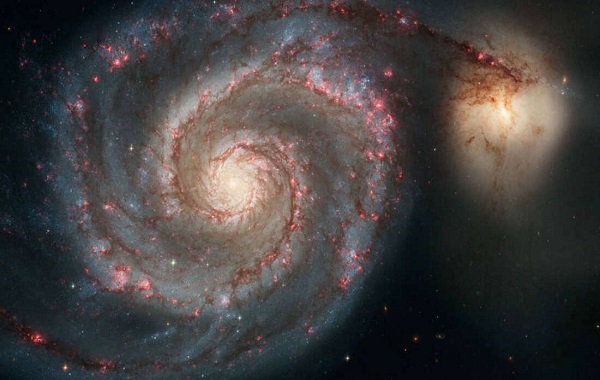
After a painstaking research effort combing through thousands of signals, a team led by Rosanne Di Stefano of the Harvard & Smithsonian Center for Astrophysics has determined that a huge dip in X-ray light from the Whirlpool Galaxy is best explained by an extragalactic planet.
“We feel privileged to have been able to contribute this piece of work,” Di Stefano told ScienceAlert.
“It demonstrates a new method that can be used by the community to find new planets both in the Milky Way and in other galaxies. And we feel humble about the fact that the discovery of a candidate extroplanet in another galaxy connects this work with a long and interesting history.”
Detecting exoplanets in the Milky Way galaxy is challenging enough. Most of the time, we determine the presence of planets orbiting Milky Way stars by inference – by seeing the effect they have on the star itself, rather than detecting the exoplanet directly.
One of these methods is the transit method. When an exoplanet passes between us and its star as it orbits, we can detect faint changes in the star’s brightness, known as a light curve. This is called a transit, because it doesn’t fully block the star’s light (not even close, in the case of exoplanetary transits!).
“Of course we didn’t know whether planets typically orbit X-ray binaries, but there were some reasons to think that it makes sense to look for them,” Di Stefano said.
“The search requires a great deal of time and care, especially to find a first example, which needs to be especially carefully tested and scrutinized. The next summer I had some visiting students working with me and their participation provided a good opportunity to begin the search.”
The team used observations of three galaxies – the Whirlpool Galaxy (M51), the Pinwheel Galaxy (M101) and the Sombrero Galaxy (M104) – taken using two space X-ray observatories, Chandra and XMM-Newton. From these observations, the researchers extracted 2,624 X-ray binary light curves, and set to work looking for an extroplanetary eclipse.
Of the thousands of signals, however, only one was consistent with what the team was looking for. It was an ultra-bright X-ray binary called M51-ULS-1, consisting of an ultradense small object (it’s unclear whether it’s a black hole or a neutron star) and a massive companion, such as a hot, bright B-type star.
During the observations, the star’s brightness remained more or less constant – except for a three-hour period in which it went dark. Moreover, its brightness levels before and after the dip in light were the same, suggesting that whatever caused the dimming was something external, not an interaction within the binary relationship.
The next step was to determine what that external influence might be. The team carefully considered options such as other small stars and brown dwarfs, paying particular attention to gas clouds, which are common in X-ray binaries.
“The excitement built slowly,” Di Stefano said.
“At first we recognized the intriguing possibility, but there were many reasons to be cautious. We had to carefully consider all alternatives, and the full analysis involved several different pieces, each of which had to show consistency with a planet interpretation, and rule out other possibilities.”
It’s unlikely that the extroplanet candidate will be confirmed. That usually takes several dips in brightness at regular intervals, and at its orbital distance, M51-ULS-1b takes too long to orbit its stars. But, Di Stefano said, all of the available data are consistent with what we’d see from an orbiting extroplanet.
The way to confirm this discovery would be to identify more X-ray eclipses, both within the Milky Way, and without. But, having made one detection, another seems just a matter of time.
“This work demonstrates a new method with the potential to discover planets in a wide range of systems hosting X-ray sources,” the researchers wrote in their paper.
“Because the most luminous X-ray sources can be detected in external galaxies, the search for extroplanets, planets in orbits located outside the Milky Way, has now become a realistic and practical enterprise.”
Source: Science Alert
Astronomers Confirm The Large Magellanic Cloud Totally Ate Another Galaxy
Astronomers Confirm The Large Magellanic Cloud Totally Ate Another Galaxy
In an Astonishing Feat, Astronomers Present Evidence of an Extra-Galactic Planet/In an Astonishing Feat, Astronomers Present Evidence of an Extra-Galactic Planet