Improved Hubble yardstick gives fresh evidence for new physics in the universe
Astronomers have used NASA’s Hubble Space Telescope to make the most precise measurements of the expansion rate of the universe since it was first calculated nearly a century ago. Intriguingly, the results are forcing astronomers to consider that they may be seeing evidence of something unexpected at work in the universe.
That’s because the latest Hubble finding confirms a nagging discrepancy showing the universe to be expanding faster now than was expected from its trajectory seen shortly after the big bang. Researchers suggest that there may be new physics to explain the inconsistency.
“The community is really grappling with understanding the meaning of this discrepancy,” said lead researcher and Nobel Laureate Adam Riess of the Space Telescope Science Institute (STScI) and Johns Hopkins University, both in Baltimore, Maryland.
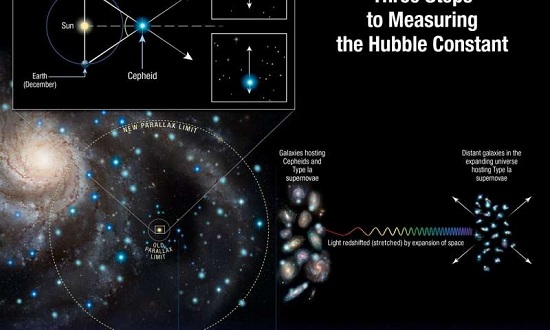
Riess’s team, which includes Stefano Casertano, also of STScI and Johns Hopkins, has been using Hubble over the past six years to refine the measurements of the distances to galaxies, using their stars as milepost markers. Those measurements are used to calculate how fast the universe expands with time, a value known as the Hubble constant. The team’s new study extends the number of stars analyzed to distances up to 10 times farther into space than previous Hubble results.
But Riess’s value reinforces the disparity with the expected value derived from observations of the early universe’s expansion, 378,000 years after the big bang – the violent event that created the universe roughly 13.8 billion years ago. Those measurements were made by the European Space Agency’s Planck satellite, which maps the cosmic microwave background, a relic of the big bang. The difference between the two values is about 9 percent. The new Hubble measurements help reduce the chance that the discrepancy in the values is a coincidence to 1 in 5,000.
Planck’s result predicted that the Hubble constant value should now be 67 kilometers per second per megaparsec (3.3 million light-years), and could be no higher than 69 kilometers per second per megaparsec. This means that for every 3.3 million light-years farther away a galaxy is from us, it is moving 67 kilometers per second faster. But Riess’s team measured a value of 73 kilometers per second per megaparsec, indicating galaxies are moving at a faster rate than implied by observations of the early universe.
The Hubble data are so precise that astronomers cannot dismiss the gap between the two results as errors in any single measurement or method. “Both results have been tested multiple ways, so barring a series of unrelated mistakes,” Riess explained, “it is increasingly likely that this is not a bug but a feature of the universe.”
Source:https://phys.org/news/2018-02-hubble-yardstick-fresh-evidence-physics.html