Hybrid Observatory for Earth-like Exoplanets: NASA’s Starshade Breakthrough
Why Current Telescopes Fall Short for Rocky Exoworld Imaging
NASA’s James Webb Space Telescope captures stunning infrared images, yet its Near Infrared Camera cannot directly observe Earth-like exoplanets. The upcoming Roman Space Telescope’s Coronagraph Instrument faces similar limitations. Why? Because an Earth-sized world in optical light appears one billion times fainter than its parent star. Current instruments simply cannot suppress that overwhelming stellar glare.
How a Starshade Creates an Artificial Eclipse
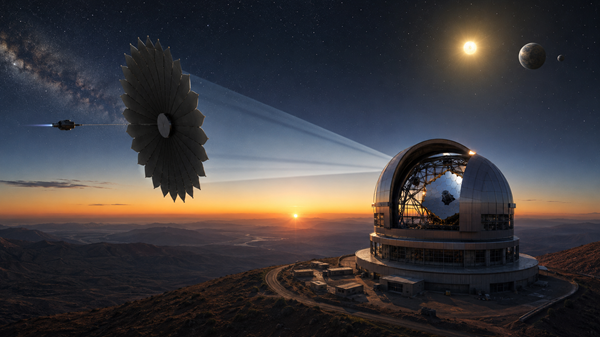
Positioned one hundred seventy-five thousand kilometers away in an elliptical Earth orbit, the starshade acts as an occulter. Its design features forty-eight petals, each twenty-four point five meters long, surrounding a fifty-meter-diameter central disk. These petals block starlight before it reaches the telescope, creating an artificial eclipse. The starshade hovers precisely on the line of sight between the ground telescope and the target star, offering continuous fine alignment.
HOEE: The Hybrid Observatory Concept
Dubbed the Hybrid Observatory for Earth-like Exoplanets (HOEE), this system pairs the orbital starshade with the European Southern Observatory’s Extremely Large Telescope in northern Chile, scheduled for scientific first light by late twenty-thirty. The starshade would likely first deploy alongside this thirty-nine-meter ground-based giant. But does the concept truly work? The team has already applied for Phase B NASA Innovative Advanced Concepts funding, hoping for approval by twenty twenty-seven.
Precision Positioning Within Six Meters
Microthrusters, most likely powered by hot hydrogen gas, reposition the starshade within six meters of accuracy. The spacecraft relies on a long elliptical astro-stationary orbit to match Earth’s rotation. Chemical propulsion handles station-keeping, while solar electric propulsion enables retargeting to different star systems. John Mather, a Nobel laureate and senior project scientist, has noted this efficient propulsion strategy in previous presentations.
Detecting Exoearths in Under One Minute
HOEE’s extreme sensitivity would enable detection of an exoearth within the first minute of observation. The system’s much sharper images allow astronomers to see entire exoplanetary systems and clearly separate planet images from both the host star and other Earth-sized worlds. This capability transforms our ability to survey nearby solar systems within twenty light years of Earth.
Auroral Signatures of Primitive Life
Vladimir Airapetian, a senior astrophysicist at NASA Goddard Space Flight Center and HOEE team member, seeks active stars that flare frequently enough to create extrasolar auroras on rocky planets. He targets solar-type F, G, and K stars in their first billion years on the hydrogen-burning main sequence. “We’re going for the spectral lines from red and green auroras that would signal that the atmospheres of these planets can support nitrogen and oxygen,” Airapetian told me in Paris. Could these auroral signatures reveal precursors of life or even primitive life itself?
Inflatable Design and Billion-Dollar Budget
The final occulter design likely involves an inflatable structure to keep total launch mass under one thousand five hundred kilograms. This allows the starshade to collapse efficiently into a standard launch vehicle’s payload. Projected costs clock in around the billion-dollar range. For decades, the starshade was a beautiful but impossible dream, says Airapetian. Today, through NASA funding, that dream is becoming a buildable reality.
A Definitive Path to Identifying Life’s Chemical Signatures
HOEE would enable a definitive path to identifying chemical signatures of life. By suppressing stellar glare before it ever enters Earth’s atmosphere, the system provides ground-based observers with reflected light directly from extrasolar planets. This hybrid approach offers something more efficient and available now than dedicated space observatories. The question remains: will HOEE become humanity’s first tool to photograph another Earth?
Source: Hybrid Observatory for Earth-like Exoplanets: NASA’s Starshade Breakthrough
Hybrid Observatory for Earth-like Exoplanets: NASA’s Starshade Breakthrough